
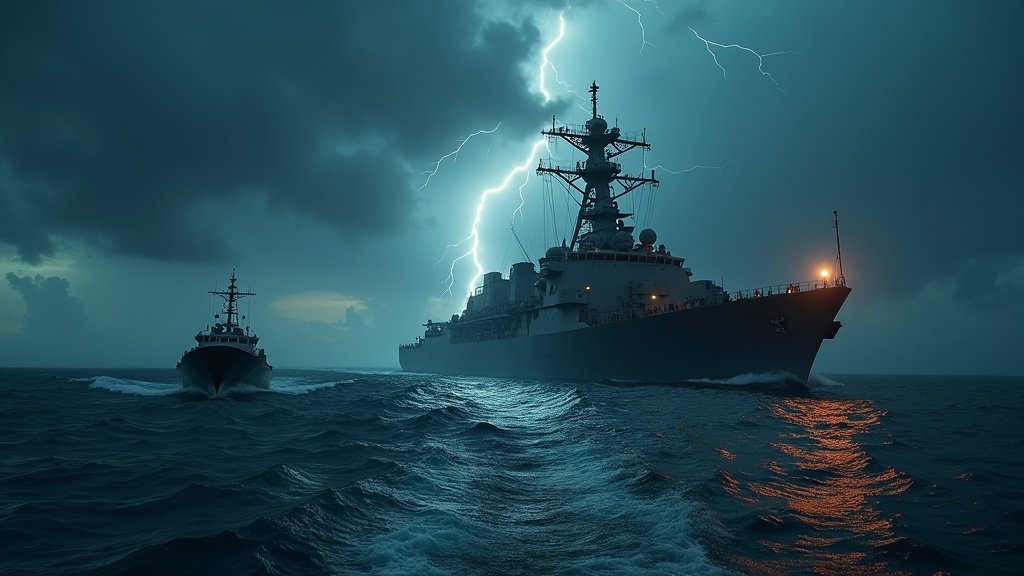
In a significant diplomatic development, France has publicly stated that recent United States military operations in the Caribbean “disregard international law,” raising serious concerns among allies and highlighting the escalating controversy surrounding the US campaign against suspected drug trafficking vessels. The French Foreign Minister’s sharp criticism comes amidst a backdrop of increasing international scrutiny, reports of allied nations pausing intelligence sharing, and a substantial US military buildup in the volatile Caribbean region.
US Escalates Maritime Operations with Deadly Strikes
Since early September, the United States military has conducted a series of at least 19 strikes against vessels allegedly involved in drug smuggling in the Caribbean and off the Pacific coasts of Latin America. These operations, championed by the Trump administration, have resulted in a reported death toll exceeding 70 individuals. The US asserts that the targeted vessels were engaged in illicit narcotics trafficking and that the occupants are combatants in an “armed conflict” with the US. However, the administration has not publicly provided evidence to substantiate these claims or explained its legal justification for using lethal force instead of traditional interdiction and arrest methods. This approach has been met with growing questions about its adherence to international legal norms.
France Voices Strong Opposition and Regional Stability Concerns
French Foreign Minister Jean-Noël Barrot articulated France’s deep reservations during a recent G7 foreign ministers’ meeting in Canada. He stated that the US military operations in the Caribbean “violate international law.” Barrot emphasized France’s vested interest in regional stability, noting that the nation has overseas territories in the Caribbean inhabited by over a million French citizens. “They could therefore be affected by the instability caused by any escalation, which we obviously want to avoid,” he warned, urging Washington to de-escalate tensions. This stance from a key G7 ally underscores the international unease with the US strategy.
International Law and Human Rights Under the Spotlight
The legality of the US strikes has drawn criticism from various international bodies and experts. The UN High Commissioner for Human Rights has declared that these operations “violate international human rights law” and must cease immediately, characterizing them as potential “extrajudicial killings” if not justified by an imminent threat to life. International legal scholars point to frameworks like the UN Convention on the Law of the Sea (UNCLOS) and the 1988 Vienna Convention, which govern maritime interdictions. These conventions emphasize due process and limit the use of lethal force to last resorts. Experts argue that targeting civilian vessels, even those suspected of illicit activities, without proper legal basis and clear identification of threats, could breach international humanitarian law and human rights norms, particularly on the high seas where jurisdiction and proportionality are critical considerations.
Allies Rethink Cooperation: UK Halts Intelligence Sharing
Adding another layer of diplomatic tension, reports emerged that the United Kingdom has suspended intelligence sharing with the United States concerning suspected drug trafficking vessels in the Caribbean. This significant move, described as a “rare rupture” between close allies, stems from London’s concerns that British intelligence could be used to facilitate strikes that may violate international law. The UK, which maintains a presence in the Caribbean and has historically shared intelligence to aid US drug interdiction efforts, reportedly paused this cooperation more than a month ago. While the UK government has officially declined to comment on intelligence matters, the cessation of support is seen as a strong signal of distrust regarding the legality and conduct of the US operations.
Regional Tensions Escalate with Military Buildup
In parallel with the controversial strikes, the United States has significantly augmented its military presence in the Caribbean. The arrival of the USS Gerald R. Ford, the world’s largest aircraft carrier, along with numerous other warships, has created the most substantial US military deployment in the region in decades. This buildup, framed by the US as “Operation Southern Spear” to combat transnational criminal organizations and drug trafficking, has heightened tensions, particularly with Venezuela. Venezuelan President Nicolás Maduro has vehemently condemned the US actions, accusing Washington of attempting to destabilize his government and using the counter-narcotics campaign as a pretext for military intervention. Venezuela has responded by conducting large-scale military exercises, further increasing the risk of regional instability.
Unanswered Questions and Future Implications
As this situation unfolds, critical questions remain regarding the US administration’s legal justification for its aggressive maritime strategy, the lack of transparency surrounding casualty assessments, and the long-term implications for international maritime law and human rights. The French minister’s strong condemnation, coupled with the UK’s intelligence pause and escalating rhetoric from Venezuela, paints a picture of a deepening international rift over US actions in the Caribbean today. The ongoing news from the region suggests a complex geopolitical challenge where counter-narcotics efforts are increasingly clashing with established international legal principles and allied diplomacy.