
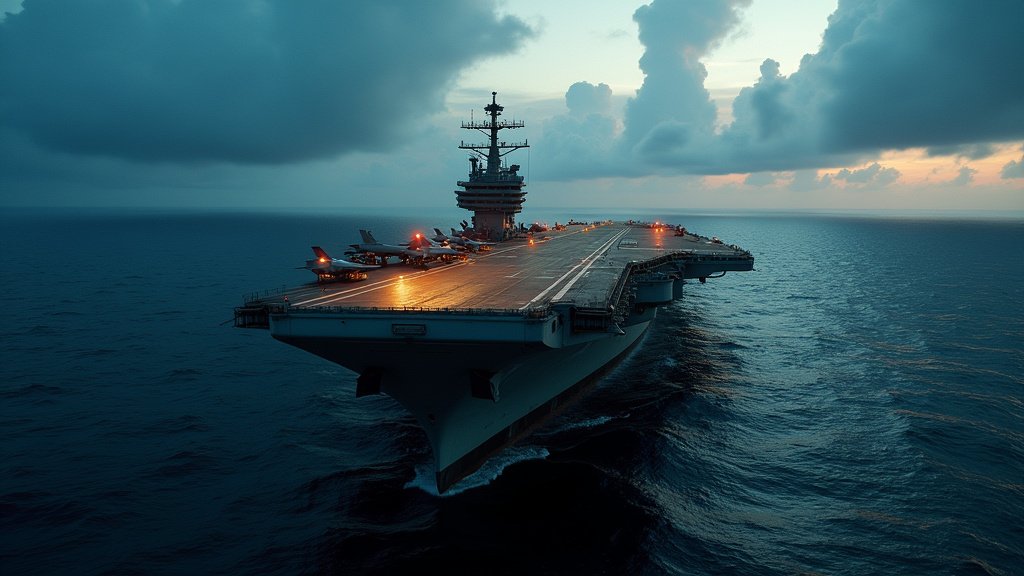
The arrival of the USS Gerald R. Ford, the United States’ largest and most advanced aircraft carrier, in the Caribbean Sea marks a significant escalation of American military presence and a sharpening of geopolitical tensions with Venezuela. The deployment, part of the U.S. military’s “Operation Southern Spear,” brings nearly a dozen naval vessels and approximately 12,000 troops to the region, bolstering a U.S. military footprint not seen in generations. This intensified presence comes as the U.S. prepares to officially designate Venezuela’s “Cartel de los Soles” as a foreign terrorist organization, a move that directly implicates President Nicolás Maduro and his government.
The Vanguard of U.S. Power Deploys
The USS Gerald R. Ford Carrier Strike Group entered the Caribbean Sea on November 16, 2025, a move announced by the U.S. military as a critical step to combat “narco-terrorism” and dismantle transnational criminal organizations. The formidable fleet, which includes squadrons of fighter jets and guided-missile destroyers, joins other U.S. warships already operating in the area. Secretary of Defense Pete Hegseth has spearheaded “Operation Southern Spear,” an initiative aimed at protecting the homeland by disrupting illicit drug trafficking networks emanating from the region. The carrier itself, a marvel of modern naval engineering, provides unparalleled power projection capabilities, transforming the balance of military power in the Caribbean.
Stated Mission Meets Geopolitical Maneuvering
Officially, the U.S. administration insists that this substantial military buildup is solely focused on interdicting the flow of illegal narcotics into the United States. However, the deployment is widely interpreted as a significant pressure tactic against Venezuelan President Nicolás Maduro, whom the U.S. does not recognize as legitimate. Tensions have been particularly high as the U.S. has conducted a series of strikes against small boats suspected of transporting drugs in international waters since early September 2025. These operations have resulted in numerous fatalities, with reports indicating at least 80 deaths in 20 separate attacks across the Caribbean and eastern Pacific Ocean. While the administration labels those targeted as “narco-terrorists,” critics question the evidence and the legality of these lethal actions.
“Cartel de los Soles”: A New Designation
Adding another layer of intensity to the regional dynamics, the U.S. State Department announced its intention to designate the “Cartel de los Soles” (Cartel of the Suns) as a Foreign Terrorist Organization (FTO). Secretary of State Marco Rubio stated that the group is allegedly headed by President Nicolás Maduro and other high-ranking Venezuelan officials who have corrupted the nation’s institutions. This designation, set to take effect on November 24, 2025, effectively labels Maduro and his associates as terrorists under U.S. law, further isolating his government and potentially opening new avenues for U.S. action. The Cartel de los Soles is also identified as providing material support to other designated FTOs, including Tren de Aragua and the Sinaloa Cartel.
International Law and Growing Scrutiny
The U.S. military’s strikes on alleged drug-smuggling vessels have drawn significant international criticism and legal scrutiny. Several international law experts and bodies, including the UN High Commissioner for Human Rights, have stated that these operations violate international human rights law and constitute “extrajudicial killings”. These concerns have prompted some allied nations, including the United Kingdom, France, Canada, and Colombia, to reconsider or suspend intelligence sharing with the U.S. regarding counternarcotics missions, fearing complicity in potentially unlawful acts. France has specifically voiced concern that the operations disregard international law and could destabilize the region, where it has a significant presence through its overseas territories. The U.S. administration has defended its actions, asserting they are lawful and within the framework of international humanitarian law, a claim that critics have strongly rejected.
Regional Echoes and Uncertain Future
The substantial U.S. military buildup in the Caribbean has heightened anxieties not only in Venezuela but across the broader region. China has publicly accused the U.S. of “gunboat diplomacy,” criticizing the increased military presence in Latin America. The sheer scale of the deployment, coupled with the rhetoric surrounding the “Cartel de los Soles” designation and the ongoing strikes, suggests a multifaceted strategy. While the stated goal remains counter-narcotics, the operation is perceived by many as a deliberate effort to apply maximum pressure on the Maduro regime, potentially paving the way for further actions, though President Trump has also hinted at a willingness to engage in dialogue. The convergence of a powerful naval force, a significant diplomatic and legal offensive, and a history of strained relations creates a volatile situation in the Caribbean today, with the ultimate implications for regional stability and Venezuela’s political future remaining profoundly uncertain.
This news today underscores the complex interplay between national security objectives, international law, and regional diplomacy in the current geopolitical climate.