
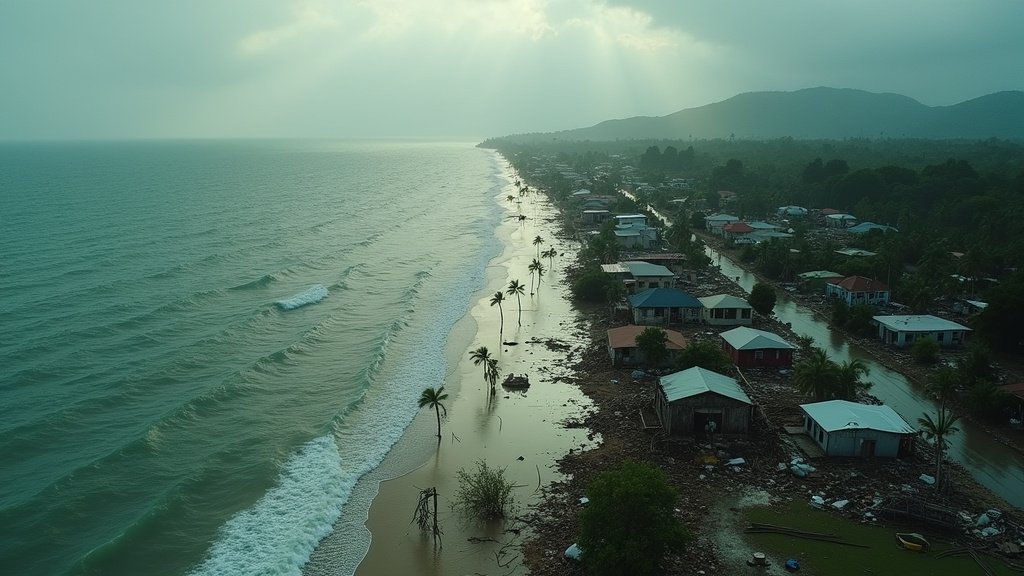
Hurricane Melissa, a monstrous Category 5 storm, has inflicted catastrophic damage across Jamaica, rewriting the island’s history as the strongest hurricane to ever make landfall there. The storm’s fury, characterized by unprecedented wind speeds, torrential rainfall, and devastating storm surges, has left a trail of widespread destruction and profound human impact across the Caribbean, before setting its sights on Cuba and other neighboring nations.
Cataclysmic Landfall in Jamaica
Hurricane Melissa intensified into an extremely powerful Category 5 storm shortly before making landfall near New Hope in Westmoreland Parish, Jamaica, on October 28, 2025. With maximum sustained winds recorded at 185 mph (295 km/h) and a minimum central pressure of 892 mbar, Melissa is now recognized as one of the most intense Atlantic hurricanes on record, tying with the 1935 Labor Day hurricane and Hurricane Dorian for the strongest landfalling hurricane in the Atlantic basin by sustained winds. A dropsonde measurement even captured a record-shattering wind gust of 252 mph (406 km/h), highlighting the storm’s extreme intensity.
The hurricane’s slow movement, exacerbated by warm ocean waters, allowed it to unleash its full destructive potential on Jamaica. Forecasters had warned of catastrophic wind impacts, with the potential for “total structural failure” in areas near the eyewall. Rainfall totals were staggering, with central Jamaica receiving an estimated 18–24 inches, and some areas possibly experiencing up to 40 inches of rain. This deluge, combined with a storm surge of 9 to 13 feet along Jamaica’s southern coast, led to catastrophic flash flooding and numerous landslides, submerging entire communities.
Devastation and Human Toll
The impact on Jamaica was immediate and devastating. Western parishes, particularly Westmoreland and Saint Elizabeth, bore the brunt of Melissa’s wrath. Many towns were left “underwater,” with entire buildings collapsing and communities reportedly obliterated. Satellite imagery revealed entire fishing villages reduced to rubble. More than 530,000 people, representing a significant portion of the island’s population, lost power. Telecommunications were severely affected, leading to a “total communication blackout” in some western areas, hampering initial damage assessments.
The human cost has been immense. As of mid-November, at least 32 deaths were confirmed in Jamaica, with dozens more reported across the region. Over 100,000 housing structures were damaged, and nearly 36,000 people required urgent food assistance. Thousands remained in emergency shelters, many having lost their homes and livelihoods, underscoring the profound disruption to daily life and the island’s overall lifestyle. The sheer scale of destruction has forced authorities to declare Jamaica a “disaster area”.
Path to Cuba and Wider Caribbean Impact
After battering Jamaica, Melissa emerged off the north coast as a Category 4 hurricane and continued its path toward Cuba. It made its third and final landfall near Chivirico, Cuba, as a Category 3 hurricane with 120 mph winds. While Cuba prepared for the worst with over 735,000 people evacuated, officials reported extensive damage, including collapsed houses and roofs blown off buildings, though thankfully no fatalities were reported in Cuba.
The storm’s reach extended across the Caribbean. Haiti suffered torrential rain and flooding, claiming at least 43 lives and causing catastrophic flash flooding and landslides. The Dominican Republic also experienced heavy rains and flooding. High swells generated by Melissa continued to affect Hispaniola, Cuba, the Bahamas, the Turks and Caicos Islands, and Bermuda, posing risks of life-threatening surf and rip currents along the U.S. East Coast.
Economic Fallout and Long Road to Recovery
The economic toll of Hurricane Melissa is staggering. New modeling suggests losses in Jamaica could exceed $20 billion, a figure higher than the country’s entire 2024 economic output and far above initial government estimates of $6 billion to $7 billion. The World Bank, in coordination with the Inter-American Development Bank, estimated the physical damage to Jamaica at $8.8 billion, equivalent to 41 percent of the country’s 2024 GDP, making it the costliest hurricane in Jamaica’s recorded history. Residential buildings accounted for the largest portion of this physical damage, followed by infrastructure. Private insurance losses across the affected regions are projected to be between $3 billion and $5 billion.
International aid and insurance payouts are beginning to flow. The World Bank’s catastrophe bond triggered its full $150 million payout, and the Caribbean Catastrophe Risk Insurance Facility is set to deliver a record $91.9 million payout. The U.S. State Department has mobilized a disaster assistance response team, including urban search-and-rescue teams, and is collaborating with UN agencies and NGOs to deliver essential supplies. The Jamaican government has also launched a dedicated platform for relief and recovery coordination. However, with persistent debris, damaged sanitation systems, and prolonged power outages, the risk of disease outbreaks remains high, and access to some isolated communities is still precarious.
Scientific Significance and Climate Change
Hurricane Melissa’s intensity and destructive power have made it a significant event for climate scientists. The storm’s rapid intensification and record-breaking winds are linked to record-warm sea-surface temperatures in the Caribbean, a phenomenon exacerbated by climate change. Scientific analysis indicates that climate change likely increased Melissa’s wind speeds by approximately 7% and rainfall by up to 16%, heightening its damage potential. For Jamaica, Melissa exceeded historical maximum wind speeds across nearly half the island, highlighting a fundamental challenge in catastrophe risk assessment where historical data may no longer be a sufficient predictor of future extreme events.
The immediate news following the storm has focused on rescue efforts, damage assessments, and the immense task of rebuilding. The resilience and determination of the people of the Caribbean will be tested as they navigate the long and arduous path to recovery from this historic and devastating storm. This news serves as a stark reminder of the increasing ferocity of tropical cyclones and the critical need for sustained global action on climate change.