
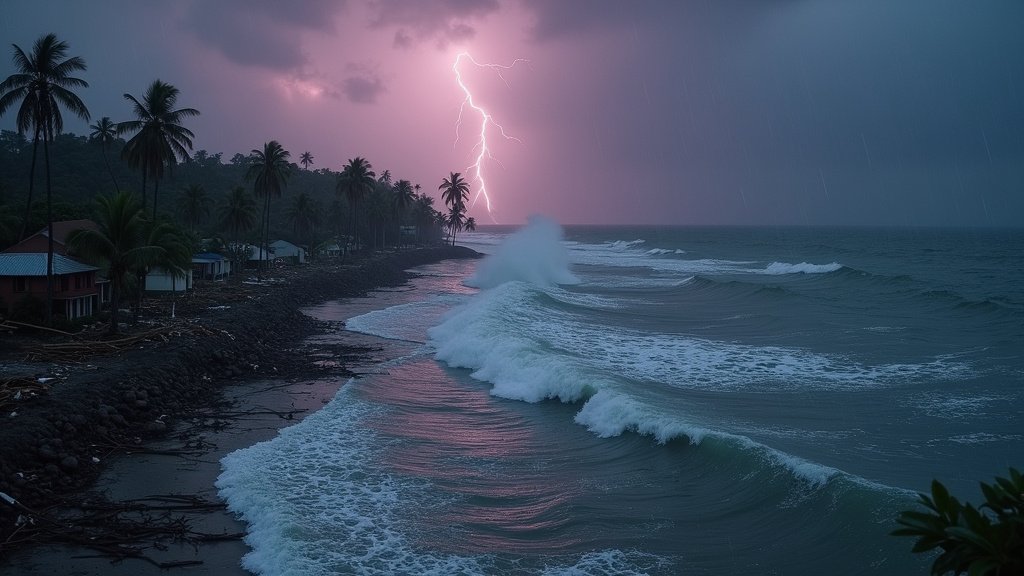
Jamaica Hit by Record-Breaking Category 5 Hurricane Melissa, Unleashing Catastrophic Damage and Loss of Life
Jamaica is reeling in the wake of Hurricane Melissa, a monstrous Category 5 storm that has made landfall, unleashing devastating winds, catastrophic flooding, and widespread destruction. The hurricane, currently the strongest tropical cyclone worldwide in 2025 and the most powerful on record to strike Jamaica, has caused immense damage and a significant loss of life, marking one of the most tragic natural disasters in the island nation’s history. News reports confirm at least 96 fatalities across the affected regions, with Jamaica bearing a heavy toll.
Melissa’s Unprecedented Fury and Impact on Jamaica
Hurricane Melissa made its catastrophic landfall near New Hope, Westmoreland, Jamaica, on October 28, 2025, as an extremely powerful Category 5 hurricane. Sustained winds of 185 mph (295 km/h) and a minimum central pressure of 892 mbar (hPa) characterized the storm’s peak intensity just south-southeast of Negril, Jamaica. The storm produced a record-breaking wind gust of 252 mph (406 km/h) measured by dropsonde data, the highest ever recorded, signaling the immense destructive power unleashed.
The hurricane brought life-threatening storm surge, with heights reaching 4 to 13 feet along Jamaica’s southern coast. Torrential rainfall inundated vast areas, with some locations receiving up to 500 mm (20 inches) and forecasts predicting up to 40 inches in some regions. This extreme precipitation triggered widespread flooding and dangerous landslides, isolating communities and hampering rescue efforts. Many towns in western Jamaica, particularly in the parishes of St. Elizabeth, Westmoreland, Hanover, and St. James, experienced near total destruction.
In Jamaica, the impact of Hurricane Melissa has been devastating, with an estimated $10 billion in damage, making it the costliest hurricane in the island’s history. The storm has left approximately 1.9 million people affected, with thousands displaced, many losing their homes and livelihoods. Official reports confirm at least 45 deaths in Jamaica, with 15 people still missing and over 30,000 households displaced as of November 11. The storm’s devastation has been likened to EF4 tornadoes in its eyewall zone.
A Storm Fueled by Warming Waters: The Climate Change Connection
Scientists have unequivocally linked the extreme intensity and rapid intensification of Hurricane Melissa to human-induced climate change and the warming of the world’s oceans. The storm drifted over exceptionally warm Caribbean waters, approximately 1.4°C (2.5°F) above average, conditions that climate scientists state were made up to 700 times more likely due to human-caused climate change. This excess heat provided an enormous reservoir of energy, allowing Melissa to explosively intensify from a moderate storm to a Category 5 hurricane in a single day.
Studies indicate that climate change increased Melissa’s wind speeds by an estimated 7% and its rainfall by 16%. Researchers at Imperial College London, using the IRIS model, found that a storm of Melissa’s magnitude was about four times more likely in the current climate compared to a pre-industrial baseline. The warming oceans, coupled with a warmer atmosphere holding more moisture, are fueling more frequent and intense hurricanes, posing an escalating threat to vulnerable coastal communities globally.
Regional Devastation and Humanitarian Crisis
Hurricane Melissa’s destructive path extended beyond Jamaica, causing significant damage and loss of life across the wider Caribbean. At least 96 deaths are attributed to the storm across the region, including 46 in Jamaica and 43 in Haiti. Haiti, already facing a humanitarian crisis, has been particularly hard-hit, with devastating floods and landslides claiming numerous lives, especially in its southern region. The Dominican Republic also reported fatalities and injuries. Hurricane warnings and watches were issued for parts of Cuba and the Bahamas, with Cuba experiencing significant damage as a Category 3 hurricane.
The storm’s trajectory also included a path towards Bermuda, where conditions were expected to deteriorate significantly. The exacerbation of existing humanitarian crises, particularly in Haiti, remains a major global concern.
Government Response and International Aid
In Jamaica, the government declared the entire island a disaster area following the landfall, mobilizing its armed forces and emergency services for search and rescue operations and to restore critical services. The National Works Agency (NWA) undertook flood mitigation efforts, while the Jamaica Public Service Company worked to restore power, though hundreds of thousands of customers remained without electricity for extended periods.
The international community has mobilized to provide assistance. The United States Department of State deployed a Disaster Assistance Response Team, including urban search-and-rescue specialists, and is collaborating with UN agencies, NGOs, and host governments to deliver essential supplies. Japan has provided emergency relief goods through the Japan International Cooperation Agency (JICA). The World Bank and the Inter-American Development Bank (IDB) are providing financial and technical assistance for reconstruction efforts, with the World Bank confirming a US$150 million payout from Jamaica’s catastrophe bond. Organizations like the International Organization for Migration (IOM) and Airbnb.org are partnering to provide emergency housing for displaced families and frontline responders.
Economic Fallout and Long-Term Recovery
The economic impact of Hurricane Melissa on Jamaica is projected to be immense, with preliminary estimates of physical damage totaling US$8.8 billion, equivalent to 41% of the country’s 2024 GDP. This figure makes Melissa the costliest hurricane in Jamaica’s recorded history, surpassing previous benchmarks like Hurricane Gilbert. The agricultural sector alone sustained losses of approximately $29.5 billion, impacting over 70,000 farmers and resulting in the loss of over 1.2 million animals. The tourism sector, a vital pillar of Jamaica’s economy, has come to a standstill, with airports closed and hotels impacted.
The scale of destruction necessitates a comprehensive and long-term recovery plan. Jamaica is seeking grants, investment, and concessional finance to cover its estimated US$10 billion reconstruction bill, aiming to avoid increasing its national debt burden. The nation’s resilience and determination will be key to rebuilding lives and restoring opportunity, but the global community’s sustained support will be crucial in navigating this challenging recovery phase and addressing the escalating threats of climate change. The news today underscores the urgent need for global climate action to mitigate the increasing frequency and intensity of such catastrophic weather events.