
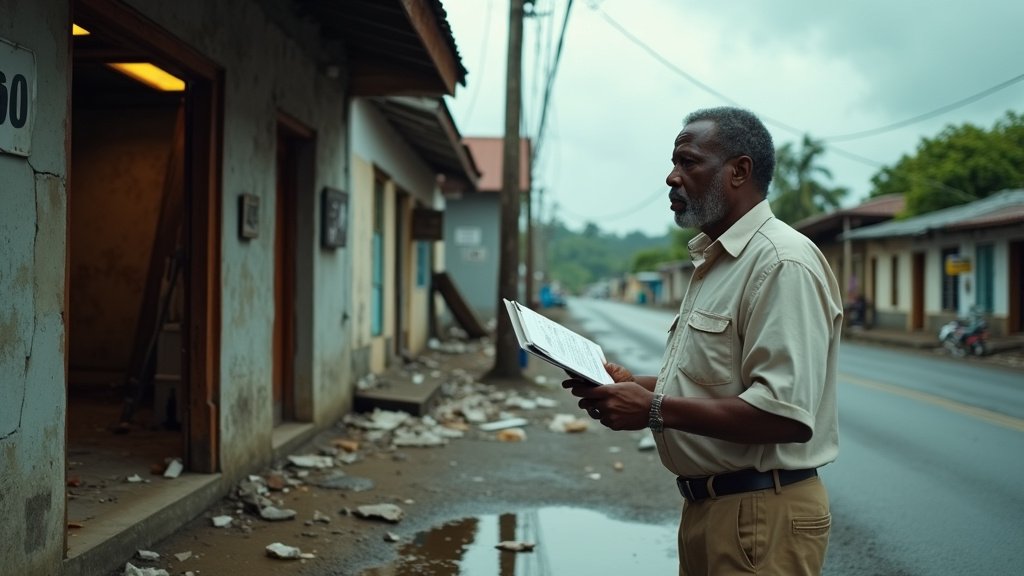
The Small Business Association of Jamaica (SBAJ) has launched a comprehensive regional assessment of businesses impacted by Hurricane Melissa, a Category 5 storm that has left a trail of unprecedented destruction across the island nation. The initiative, led by SBAJ President Garnet Reid, aims to provide a firsthand understanding of the challenges facing small and medium-sized enterprises (SMEs) as they grapple with the economic fallout from the catastrophic event [Initial Context, 26].
Hurricane Melissa’s Record-Breaking Impact
Making landfall on October 28, 2025, Hurricane Melissa became the strongest hurricane to ever hit Jamaica, unleashing catastrophic winds exceeding 185 mph and torrential rainfall. The storm’s destructive path has resulted in an estimated US$8.8 billion in physical damage, a figure equivalent to 41% of Jamaica’s projected 2024 GDP, making it the costliest natural disaster in the country’s recorded history. Preliminary assessments suggest that broader economic losses, including business interruptions and lost productivity, are expected to be substantially higher, with some projections placing the total economic toll upwards of US$20 billion.
Key parishes such as St. Elizabeth, Westmoreland, St. James, Manchester, Hanover, and Trelawny bore the brunt of the hurricane’s fury, experiencing widespread damage to residential buildings, infrastructure, and commercial properties. The devastation has not only impacted physical structures but has also crippled vital sectors like tourism and agriculture, which are cornerstones of the Caribbean economy.
SBAJ’s Mission: Understanding the On-the-Ground Reality
SBAJ President Garnet Reid and the board of directors are actively touring affected parishes, engaging directly with business owners to grasp the severity of their losses [Initial Context, 26]. This crucial news comes as many small business operators report being unable to conduct business due to destroyed premises, damaged equipment, and loss of stock. For instance, in St. James, one welding shop and garage owner reported losses of approximately J$2.5 million in tools and machinery, rendering his business inoperable. Similarly, a cook shop operator found her business, equipment, and stock completely destroyed, with limited ability to reopen due to ongoing power outages.
Reid has emphasized that many of these vital enterprises, often uninsured and without financial buffers, require immediate external intervention to restart operations. The SBAJ is advocating for urgent relief measures, including a six-month freeze on debt service payments, a temporary reduction in import duties on agricultural produce, and rebates from the Jamaica Public Service for businesses that suffered prolonged power outages. The association is also urging members to meticulously document their damages to present to financial institutions when seeking assistance.
Far-Reaching Economic and Social Consequences
The economic repercussions of Hurricane Melissa are profound and far-reaching. The tourism sector, a significant contributor to Jamaica’s GDP and employment, has come to a standstill, with major hotel chains sustaining extensive damage, some not expecting to reopen until mid-2026. The agriculture sector has also suffered immensely, with preliminary assessments indicating losses of approximately J$29.5 billion, impacting tens of thousands of farmers and leading to the loss of over 1.2 million animals.
Beyond direct property and economic losses, the hurricane has exacerbated existing vulnerabilities. Many businesses were already struggling to recover from the COVID-19 pandemic and other economic headwinds, making the impact of Melissa a “double whammy”. The lack of insurance coverage among small businesses, with an estimated 95% of insured properties being underinsured, further widens the protection gap, leaving countless families and entrepreneurs exposed to severe financial hardship. The United Nations Development Programme (UNDP) analysis highlights the immense challenge of debris removal, estimating over 4.8 million tonnes blocking critical infrastructure and hindering recovery efforts.
A Call for Resilience in the Caribbean Context
In the wake of Hurricane Melissa, discussions surrounding climate resilience and sustainable infrastructure have gained renewed urgency across the Caribbean. Leaders and experts convened at the inaugural Caribbean Sustainable Infrastructure Conference (CSIC 2025) in Barbados, organized by the Caribbean Development Bank (CDB), to address the region’s vulnerability to increasing natural disasters and infrastructure challenges. The conference underscored the critical need for building infrastructure that can withstand climate risks, promoting economic competitiveness, social inclusion, and environmental stewardship. This broader context emphasizes that effective recovery and future resilience for Jamaica’s business community will require both immediate relief and long-term strategic investments in robust and adaptive infrastructure.
Road to Recovery
The Small Business Association of Jamaica’s assessment tour is a critical step in galvanizing support and informing policy for the arduous recovery process. The news of Hurricane Melissa’s devastation serves as a stark reminder of the region’s susceptibility to extreme weather events and the indispensable role of resilient business sectors in the economic stability of Caribbean nations. The path forward for Jamaica’s small businesses will depend on coordinated efforts, targeted assistance, and a collective commitment to rebuilding stronger and more resilient communities.