
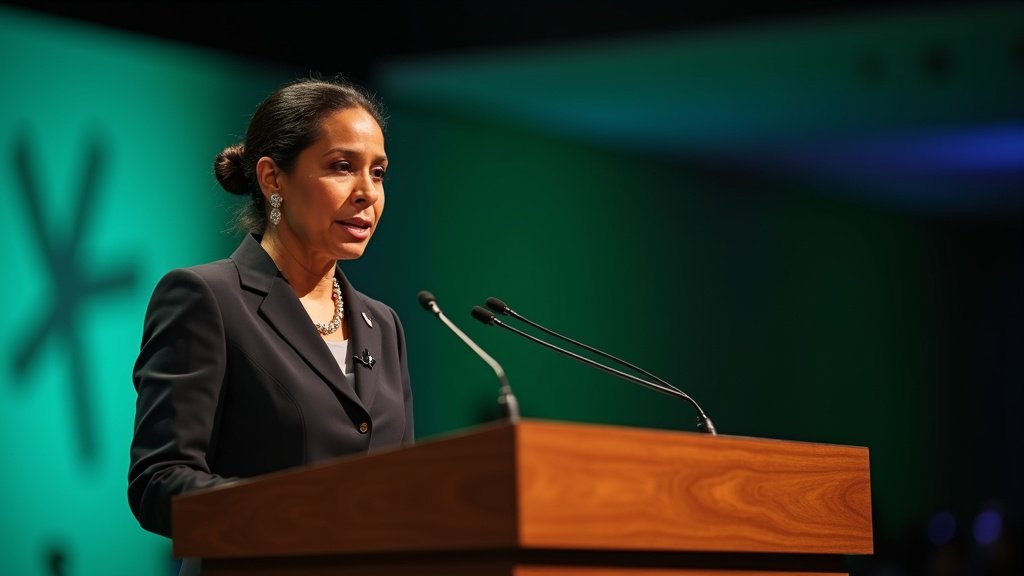
Caribbean Ambassador Urges Global Action on Climate-Induced Displacement at COP30
BELÉM, BRAZIL – As global leaders convene at the COP30 climate conference in Belém, Brazil, Antigua and Barbuda’s Ambassador for Climate Change, Ruleta Camacho-Thomas, has delivered a stark message: climate mobility is no longer a future risk for the Caribbean, but a lived reality reshaping communities and threatening cultural identities.
Speaking at a high-level session focused on Climate Mobility and Loss and Damage, Ambassador Camacho-Thomas underscored the urgent need for international support to address the escalating displacement caused by climate-induced disasters across the region. Her impassioned plea highlighted the profound disruption to the lifestyle and social foundations of Caribbean nations, which are disproportionately affected by climate change despite contributing minimally to its causes.
Climate Mobility: An Urgent Crisis in the Caribbean
The Caribbean is acutely vulnerable to the escalating impacts of climate change, facing threats from rising sea levels, more frequent and intense storms, and extreme weather events. For many island nations, these environmental shifts are not abstract projections but direct drivers of human mobility, encompassing displacement, migration, and planned relocation. Ambassador Camacho-Thomas emphasized that this phenomenon, known as climate mobility, is already profoundly altering the lifestyle and social fabric of these communities.
She articulated that villages and communities across the Caribbean represent far more than mere geographical locations. They embody deep-seated identity, livelihoods, traditions, and the cultural roots that bind generations. When climate impacts force people to move, the consequences extend beyond the physical act of relocation, disrupting mental well-being, severing social networks, and jeopardizing the preservation of invaluable cultural memory. This reality places Caribbean nations at the forefront of the global climate emergency, a position they occupy due to their inherent vulnerabilities rather than their contribution to the crisis.
Voices from the Frontlines: Ambassador Camacho-Thomas’s COP30 Address
Ambassador Camacho-Thomas’s address at COP30 served as a powerful testament to Antigua and Barbuda’s ongoing commitment to climate justice and resilience advocacy for Small Island Developing States (SIDS). She stressed that the displacement wrought by hurricanes and other climate impacts does more than uproot individuals; it fundamentally disrupts identity, culture, and the very social foundations that define Caribbean life.
“Climate mobility is not a future risk – it is already reshaping Caribbean life,” Ambassador Camacho-Thomas stated. “Protecting people, culture, and dignity must remain at the center of our collective response.” Her participation at the conference underscored the critical need for a human-centred approach to climate action, ensuring that those most affected are heard and their rights protected.
Lived Experiences: Hurricanes Irma and Melissa and the Cost of Displacement
Drawing on recent regional disasters, Ambassador Camacho-Thomas highlighted the tangible evidence of climate mobility. Antigua and Barbuda experienced devastating displacement following Hurricane Irma in 2017. The category 5 storm battered Barbuda, with estimates suggesting 90-95% of buildings were destroyed or damaged, rendering the island a “near-deserted disaster zone”. The entire population of Barbuda, approximately 1,600 people, was evacuated to Antigua, marking a significant rupture in the island’s history and its unique system of collective land ownership. The long-term psychological impacts on survivors are also a critical concern.
Similarly, Jamaica has faced immense hardship in the wake of Hurricane Melissa. This category 5 storm, described as a “new phase of climate change,” caused billions of dollars in damage, equivalent to a significant portion of the nation’s GDP, and displaced hundreds of thousands of people. The storm’s ferocity, amplified by warmer ocean waters, led to widespread destruction of homes, infrastructure, and livelihoods, disrupting essential services and causing immense suffering. The human toll includes not only physical destruction but also the loss of cultural heritage, such as centuries-old churches, deeply affecting the island’s identity.
These events serve as stark reminders of how swiftly extreme weather can fracture social stability and leave lasting scars on affected populations, profoundly altering the daily lifestyle of those impacted.
The Critical Plea for the Loss and Damage Fund
Ambassador Camacho-Thomas reiterated the paramount importance of international access to the Fund for Responding to Loss and Damage. This fund is crucial for supporting recovery efforts, protecting invaluable cultural heritage, and alleviating the immense economic and emotional strain of displacement when national adaptation measures are overwhelmed. The fund has recently launched its first call for proposals, making $250 million available for projects addressing a range of climate-related losses, including infrastructure damage, cultural heritage, and community displacement.
For vulnerable nations, particularly SIDS, securing adequate finance is a critical determinant of their ability to cope. As stated by regional advocates, “justice without finance is delay by another name”. The Caribbean has been at the forefront of demanding robust financial mechanisms to address these profound losses and damages, stressing that aid should not only focus on recovery but also on preserving culture and community integrity.
Regional Solidarity and Global Responsibility
The news from COP30 underscores a collective call for stronger international collaboration and regional solidarity to confront the climate crisis. Small island states, represented by blocs like AOSIS, are imploring major emitters to honor their climate commitments and limit global warming to 1.5°C, emphasizing that for them, this is a matter of survival. The recent advisory opinions from the International Court of Justice, reinforcing states’ obligations to prevent climate harm, provide significant leverage for these nations.
However, challenges persist in accessing climate finance, with many Caribbean nations burdened by debt, which is often exacerbated by disaster recovery costs. There is a growing recognition of the need to quantify non-economic losses—such as cultural heritage, mental health impacts, and skills loss—as these are often not adequately captured by traditional economic metrics but are vital for holistic recovery and accessing appropriate funding.
A Call for Urgent, Human-Centred Action
Ambassador Camacho-Thomas’s message from COP30 reverberates with the urgent reality faced by Caribbean communities. Climate mobility, driven by the accelerating climate crisis, is displacing people, eroding cultural heritage, and challenging the very survival of nations. The summit in Belém provides a critical platform for translating rhetoric into tangible action, demanding increased financial support, particularly through the Loss and Damage Fund, and fostering a global commitment to protect the dignity and resilience of those on the frontlines of climate change. As the news from COP30 unfolds, the imperative for equitable and immediate climate action for the Caribbean and other vulnerable regions has never been clearer.