
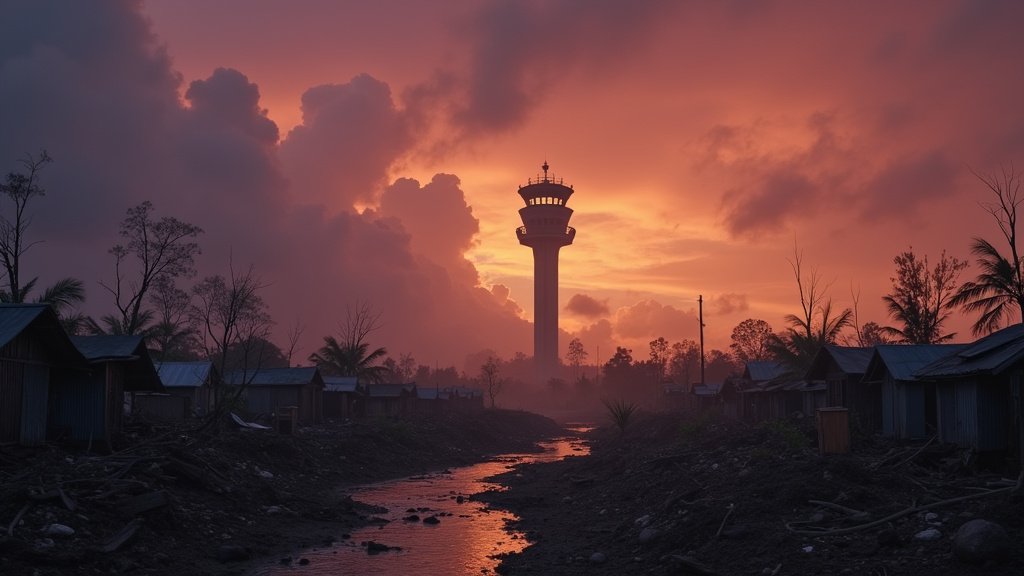
In a confluence of severe crises, the world grapples with the far-reaching impacts of a protracted U.S. government shutdown and the catastrophic devastation wrought by Typhoon Kalmaegi in the Philippines. The shutdown, which concluded after a record-breaking 43 days on November 12, 2025, plunged millions of Americans into uncertainty and crippled essential government services, most notably leading to widespread disruptions in air travel due to an exacerbated shortage of air traffic controllers. Meanwhile, the Philippines is engaged in a massive recovery and relief effort following the brutal onslaught of Typhoon Kalmaegi, known locally as Tino, which unleashed immense destruction, claimed hundreds of lives, and displaced vast populations.
US Government Shutdown Triggers Air Travel Chaos
The extended U.S. government shutdown, spanning from October 1 to November 12, 2025, stemmed from a failure by Congress to pass appropriations legislation for the 2026 fiscal year, marked by partisan disagreements over spending priorities and essential policy issues like Affordable Care Act subsidies. As federal employees, including air traffic controllers and Transportation Security Administration (TSA) officers, worked without pay for weeks, a critical shortage within the air traffic control system intensified significantly. Many controllers, facing financial strain, fatigue, and prolonged stress, called in sick, resigned, or took second jobs, leading to a notable increase in absenteeism and a strain on those remaining on duty.
This critical staffing deficit prompted the Federal Aviation Administration (FAA) to implement unprecedented measures to ensure aviation safety. Citing safety concerns and a growing number of “staffing triggers”—instances where controller availability dropped below safe operational levels—the FAA mandated significant flight reductions at 40 major U.S. airports. Initially affecting 4% of flights, these cuts escalated to 6% and were projected to reach 10% in some scenarios, causing thousands of flight delays and cancellations daily across the nation. Major airlines reported staggering numbers of disruptions, with some days seeing over 5,000 flights impacted by delays or cancellations. Transportation Secretary Sean Duffy and FAA Administrator Bryan Bedford acknowledged the severity of the situation, emphasizing safety as the paramount concern.
Following the shutdown’s end and the promise of back pay for controllers, staffing levels began to rebound. The FAA progressively eased restrictions, eventually lifting all emergency orders on November 17, allowing airlines to resume normal schedules from November 18. While immediate chaos subsided, aviation experts warned that the shutdown had exacerbated a pre-existing, long-term shortage of air traffic controllers, a problem that will require years of recruitment and training to fully resolve.
Typhoon Kalmaegi Unleashes Devastation in the Philippines
Concurrently, the Philippines found itself battling the immense destructive power of Typhoon Kalmaegi, known locally as Tino. This potent and deadly tropical cyclone, one of the strongest to hit the region in recent memory, made landfall in early November 2025, leaving a trail of widespread flooding, landslides, and catastrophic damage across multiple islands. The typhoon’s ferocity resulted in a tragic loss of life, with official reports indicating nearly 300 fatalities and over 100 individuals still missing.
The storm’s impact was devastating for millions of Filipinos. Over 5.45 million people were affected, and more than 270,000 were displaced from their homes, with many seeking refuge in evacuation centers or with family and friends. An estimated 253,845 homes suffered damage, and over 35,000 were completely destroyed. Critical infrastructure, including roads, bridges, power grids, water systems, and telecommunications networks, sustained extensive damage, hampering relief efforts and leaving communities isolated. The agricultural sector was also severely hit, with substantial losses reported in crops and livestock, impacting the livelihoods of thousands of farmers and fisherfolk.
The Philippines’ vulnerability was underscored by the fact that Kalmaegi struck in the wake of other natural disasters, including a significant earthquake in Cebu and another major typhoon, Fung-wong (Uwan), shortly thereafter. This series of calamities stretched the capacity of national disaster responders and international humanitarian agencies to their limits. In response, the United States provided significant emergency disaster assistance, contributing $2.5 million in aid for logistics, shelter, water, sanitation, and evacuation center management, underscoring international solidarity in the face of such widespread disaster. Organizations like Médecins Sans Frontières (MSF) and World Central Kitchen (WCK) were on the ground, providing essential medical services, food, and clean water to affected populations.
Lingering Challenges and Global News Today
As the immediate crises begin to recede, the world reflects on the cascading effects of these events. The U.S. government shutdown highlighted the fragility of essential systems, particularly air traffic control, and renewed calls for legislative measures to prevent future appropriations impasses from disrupting critical infrastructure. Lawmakers have introduced bills aimed at insulating critical agencies like the FAA from shutdown impacts, although political consensus remains a challenge.
In the Philippines, recovery is a long and arduous process, with ongoing needs for food, water, shelter, and infrastructure repair. The resilience of the Filipino people, coupled with international support, is crucial for rebuilding affected communities. These concurrent events serve as stark reminders of the interconnectedness of global stability, the impact of political decisions on daily life, and the ever-present threat of natural disasters, making them central pieces of world news today.