
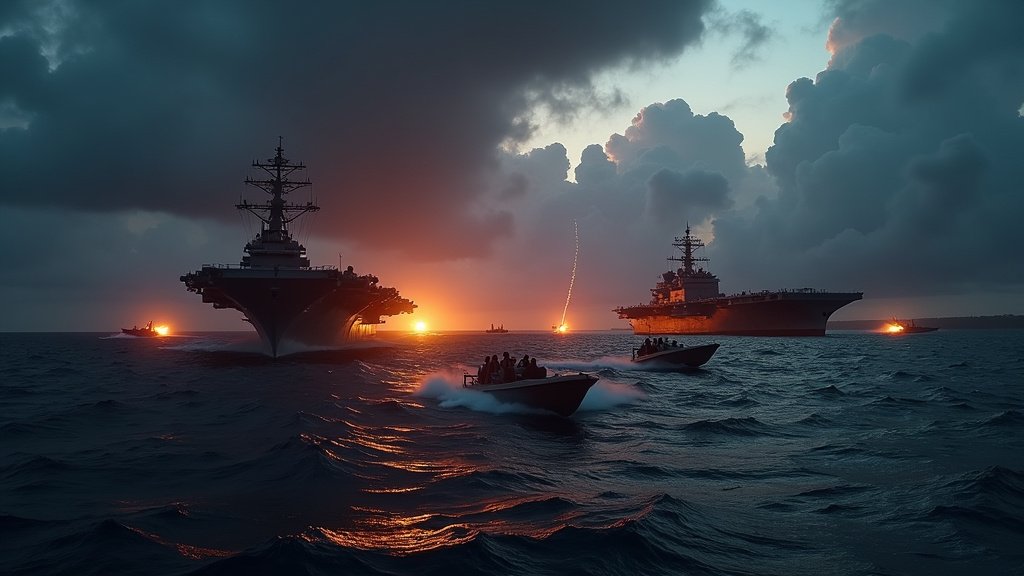
The United States has intensified its military operations in the Caribbean Sea, carrying out a series of lethal strikes against suspected drug-trafficking vessels in a dramatic escalation of its counternarcotics strategy. This aggressive campaign, which began in September 2025, has involved the destruction of numerous boats and resulted in the deaths of over 80 individuals, drawing sharp criticism from Venezuela, international human rights organizations, and some U.S. allies. The ongoing actions are set against a backdrop of heightened tensions between Washington and Caracas.
Intensified Maritime Warfare Campaign
President Donald Trump’s administration has initiated a far-reaching military campaign, primarily targeting vessels in the Caribbean Sea and extending into the Eastern Pacific. These operations, characterized as “kinetic strikes,” have involved the use of missiles and airstrikes to destroy boats allegedly involved in smuggling narcotics destined for the United States. The first publicly acknowledged strike occurred on September 2, 2025, resulting in the deaths of 11 individuals aboard a vessel reportedly carrying drugs from Venezuela and affiliated with the Tren de Aragua gang.
Since that initial engagement, the frequency of these strikes has increased, with the U.S. military conducting at least 20 known attacks by mid-November 2025. Secretary of Defense Pete Hegseth has been a prominent figure in announcing these operations, often sharing videos of vessels being destroyed at sea. The administration has justified these actions by stating that the targeted individuals were “narco-terrorists” operating on known drug-trafficking routes and that the United States is in an “armed conflict” with drug cartels.
Operation Southern Spear and Regional Military Buildup
These strikes are part of a broader U.S. military buildup in the Caribbean, notably under “Operation Southern Spear.” This operation has seen the deployment of significant naval assets, including the USS Gerald R. Ford, the U.S. Navy’s most advanced aircraft carrier, and its strike group. The presence of nearly a dozen warships and approximately 12,000 sailors and Marines in the region marks one of the largest American military concentrations in the Caribbean in decades. This substantial force posture, operating under U.S. Southern Command (SOUTHCOM), has placed American military power unprecedentedly close to Venezuela’s coast.
Targeting Allegations and Legal Scrutiny
The U.S. administration has alleged that the targeted vessels were operated by “narcoterrorists” and criminal organizations, including the Venezuelan Tren de Aragua and the Colombian National Liberation Army (ELN). President Trump has asserted that these strikes are necessary because traditional maritime interdiction methods, primarily handled by the U.S. Coast Guard, have been “totally ineffective”.
However, the legality and justification for these lethal strikes have been heavily debated. Critics, including members of Congress, human rights groups, and international observers, question whether these actions constitute extrajudicial killings and may violate international law. The Trump administration has stated its legal authority is derived from the determination of an “armed conflict” with cartels, with a classified Department of Justice memo reportedly serving as justification.
Venezuela’s Response and Regional Repercussions
Venezuela has vehemently condemned the U.S. actions, denouncing them as illegal incursions and provocations that threaten national sovereignty. In response to the escalating U.S. military presence, Venezuela launched a “massive” nationwide military exercise, mobilizing an estimated 200,000 troops and civilians. Venezuelan officials, including Defense Minister Vladimir Padrino, have accused the U.S. of murdering defenseless people without due process and suggested the military buildup is a prelude to regime change.
Other regional actors have also expressed concern. Colombia’s President Gustavo Petro ordered his country to halt intelligence sharing with the U.S. in protest of the strikes, stating the directive would remain in force as long as the attacks continued. The escalating situation highlights a growing divide in regional security approaches, with the U.S. prioritizing aggressive military action and some neighboring nations advocating for caution and adherence to established international legal frameworks.
Parallel Coast Guard Operations
Alongside the military campaign, the U.S. Coast Guard has continued its traditional maritime interdiction operations, reporting record seizures of illicit drugs in 2025. These law enforcement actions, which involve intercepting vessels, arresting crews, and bringing them to justice for prosecution, are distinct from the military strikes that destroy vessels and result in fatalities. While the Coast Guard emphasizes the value of intelligence gathered from apprehended smugglers, the Trump administration has largely dismissed the effectiveness of these law enforcement-focused interdictions in favor of lethal military force. This dual approach underscores competing strategies in the ongoing fight against drug trafficking in the Western Hemisphere, with the news today reflecting an era of unprecedented military engagement in the Caribbean.