
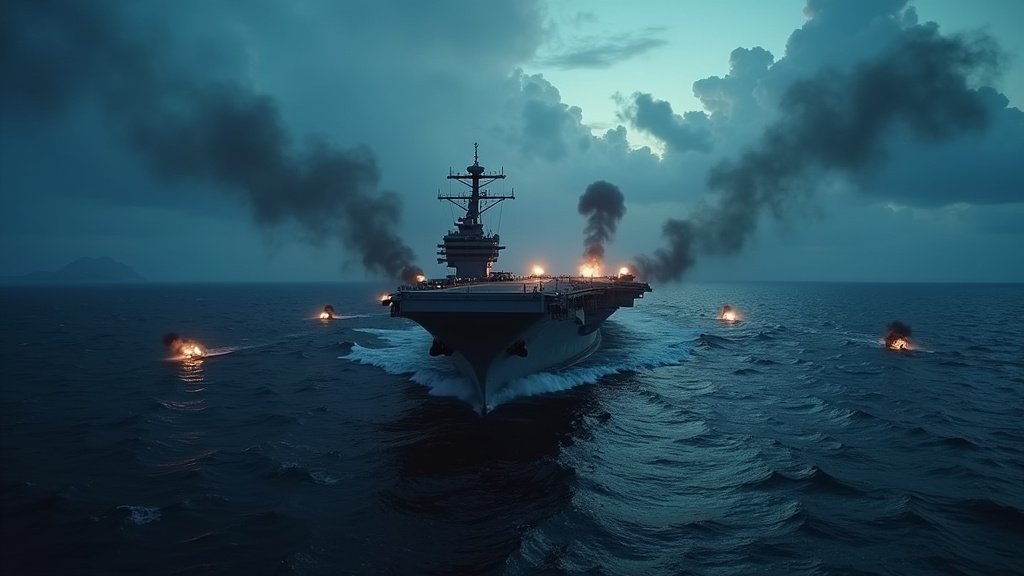
A series of US military strikes targeting vessels in the Caribbean Sea, beginning in September 2025, has resulted in dozens of fatalities and sparked widespread international condemnation. The operations, which the US claims are aimed at combating drug trafficking, have drawn sharp criticism from the United Nations, regional leaders, and human rights advocates who allege violations of international law.
Escalating US Military Action in the Caribbean
The US military campaign, dubbed “Operation Southern Spear,” has seen an aggressive posture in the Caribbean and the Pacific, with numerous strikes on alleged drug-smuggling boats. By mid-November 2025, reports indicate that at least 83 people have been killed in 21 strikes. This aggressive US military buildup in the region includes the deployment of major assets such as the USS Gerald R. Ford aircraft carrier strike group, comprising nearly a dozen Navy ships and approximately 12,000 personnel.
The October 16th Incident and its Aftermath
A notable strike occurred on October 16, 2025, when US forces attacked a vessel described as a “narco-submarine” off the coast of Venezuela. This operation resulted in two fatalities and, for the first time in the series of strikes, two survivors. These survivors were subsequently rescued by a US Navy helicopter and taken aboard a US warship before being repatriated to their home countries of Colombia and Ecuador. Prior to this, on October 14, 2025, another strike reportedly killed six individuals, with concerns raised that two of them may have been nationals of Trinidad and Tobago.
International Outcry and Legal Objections
The increasing death toll and the nature of the US operations have drawn strong rebukes from international bodies. Volker Türk, the UN High Commissioner for Human Rights, issued a stark condemnation, stating that the airstrikes “violate international human rights law” and must cease immediately. Türk described the attacks as “unacceptable” and potentially “extrajudicial killings,” noting that lethal force is only permissible as a last resort when individuals pose an imminent threat to life. He called for prompt, independent, and transparent investigations into the reported attacks, emphasizing that drug trafficking should be handled as a law-enforcement matter, not a military one.
Russia has also joined the chorus of criticism, with its foreign ministry spokesperson calling the US operations a “direct violation of international and domestic laws”.
Regional Condemnation and Divided Reactions
Venezuelan President Nicolás Maduro has been a vocal critic, vehemently condemning the US strikes and joint military exercises with Trinidad and Tobago as a threat to regional peace and security. Maduro has accused the US of attempting to destabilize his government under the pretext of combating drug trafficking and has warned of a potential regional war, describing the US naval buildup as an “absolutely criminal and bloody threat”. Venezuela has filed a formal complaint with the United Nations Security Council, arguing that the attacks constitute an assault on its sovereignty.
Many Caribbean Community (CARICOM) leaders have expressed alarm over the increased military presence and the potential impact on regional stability. They have reiterated their commitment to maintaining the Caribbean as a zone of peace, emphasizing that efforts to combat crime must align with international law. However, reactions are not uniform; Trinidad and Tobago has publicly supported the US actions, citing the nation’s struggles with gun-related crimes and gang violence as justification for enhanced military cooperation and training. These joint exercises, including those conducted by the 22nd Marine Expeditionary Unit, are seen by some as standard military-to-military engagement aimed at countering transnational threats, while others view them as provocations near Venezuela’s borders.
US Justification and Underlying Concerns
The US administration, led by President Donald Trump and Defense Secretary Pete Hegseth, has defended the strikes as necessary actions against “narco-terrorists” and a crucial effort to intercept deadly drugs destined for America. The operation, officially named “Operation Southern Spear,” aims to disrupt transnational criminal networks. However, critics point to a lack of publicly presented evidence linking the targeted vessels and their occupants to drug trafficking or posing an imminent threat, leading to concerns about the legality and ethical implications of the operations.
Some analysts suggest that the extensive military buildup and aggressive tactics in the Caribbean extend beyond anti-drug operations, potentially serving broader US foreign policy objectives, including exerting political and economic pressure on Venezuela and countering the influence of other global powers in the region.
A Region on Edge
The current news from the Caribbean paints a picture of escalating US military activity, leading to fatalities and a sharp increase in regional and international tensions. As the US continues its campaign, the legality of these actions remains under intense scrutiny, with the UN calling for accountability and many nations in the region voicing their concerns about peace and sovereignty. The situation today highlights a critical juncture in US foreign policy in the Caribbean, raising questions about the long-term implications for regional security and international law. Joint US-Trinidad and Tobago military exercises are scheduled to continue, further underscoring the heightened military presence and activity in the Caribbean today.