
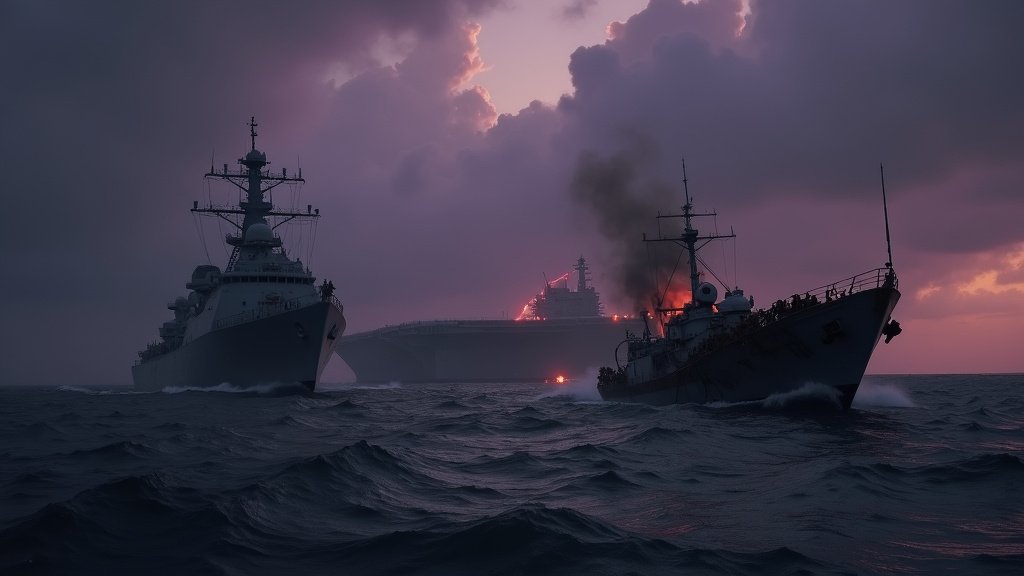
The United Nations has issued a scathing condemnation of the United States’ ongoing airstrikes against vessels in the Caribbean and Eastern Pacific, labeling the operations “unacceptable” and a grave violation of international human rights law. UN High Commissioner for Human Rights Volker Türk urgently called for an immediate halt to the strikes, citing “strong evidence” that they constitute “extrajudicial killings” and demanding thorough, independent investigations into the mounting human cost. This stark rebuke comes as the U.S. military’s “Operation Southern Spear” intensifies its campaign against alleged drug trafficking networks, significantly escalating regional tensions.
UN’s Stern Rebuke: A Violation of International Law
In a series of strong statements, UN High Commissioner for Human Rights Volker Türk declared that the U.S. military’s actions on the high seas “violate international human rights law” and “find no justification in international law”. The UN human rights chief emphasized that countering illicit drug trafficking is fundamentally a law-enforcement matter, governed by strict limits on the use of lethal force. According to international human rights law, the intentional use of lethal force is permissible only as a last resort when individuals pose an imminent threat to life. Türk’s office has stated that based on the limited information publicly released by U.S. authorities, individuals on the targeted boats did not appear to pose such an imminent threat, thus justifying the lethal force employed against them. The UN’s condemnation marks the first outright rebuke of these U.S. operations from a United Nations organization.
U.S. Justification and Escalating Military Presence
The U.S. administration, led by President Donald Trump, has defended the strikes as a necessary component of its broader anti-drug offensive and a response to what it terms an “armed conflict” with drug cartels, which have been designated as “narco-terrorists” or “foreign terror organizations”. Defense Secretary Pete Hegseth formally launched “Operation Southern Spear,” a mission aimed at removing these alleged “narco-terrorists” from the hemisphere and protecting the U.S. homeland from drug flows. The campaign has been accompanied by a significant U.S. military buildup in the region, including the deployment of the advanced aircraft carrier USS Gerald R. Ford and its strike group, along with thousands of Navy and Marine personnel, marking the largest concentration of American maritime power in the Caribbean in decades. U.S. Southern Command (SOUTHCOM) has stated these actions are crucial for combating transnational threats that destabilize the region.
The Human and Legal Toll of the Strikes
As of mid-November 2025, U.S. forces have conducted at least 21 strikes on 22 vessels, resulting in a death toll of at least 83 individuals, with only two survivors apprehended. Eleven of these strikes occurred in the Caribbean Sea, and eleven in the Eastern Pacific Ocean. Critics, including UN experts and international legal scholars, argue that these actions, particularly when lethal force is used without due process or judicial oversight, amount to unlawful killings and potentially war crimes. The administration has provided sparse details about the targeted vessels and the individuals aboard, fueling concerns about accountability and the legality of the operations under international law.
Global Backlash and Regional Tensions
The U.S. military actions have drawn sharp criticism not only from the UN but also from a growing list of international partners and regional governments. France, through its Foreign Minister Jean-Noël Barrot, has stated that the U.S. operations “violate international law”. The United Kingdom has suspended intelligence sharing with the U.S. regarding suspected drug trafficking vessels in the Caribbean, signaling its doubts about the legality of Washington’s practices. Canada has informed the U.S. that its intelligence is not to be used to facilitate these deadly strikes, while Colombia and Mexico have also voiced opposition and taken steps to limit U.S. actions.
Venezuela, a key target of U.S. pressure, has vehemently denied U.S. accusations of ties to drug cartels and denounced the strikes as a threat to regional peace and stability. President Nicolás Maduro’s government has accused Washington of using the fight against drug trafficking as a pretext for intervention and potential regime change. Meanwhile, Trinidad and Tobago has engaged in joint military training exercises with the U.S. in the region, with local officials stating these are aimed at tackling violent crime.
Geopolitical Undercurrents and Future Implications
Beyond the immediate humanitarian and legal concerns, the escalating U.S. military presence and operations in the Caribbean have raised broader geopolitical questions. Some analysts suggest that the anti-narcotics campaign may serve as a cover for extending U.S. political and economic influence in Latin America or for pursuing regime change in Venezuela. The legality of the strikes remains a contentious issue, with U.S. lawmakers, including Democrats Jim Himes and Jack Reed, also raising concerns about the lack of transparency and credible legal justification provided by the administration. The ongoing debate highlights a fundamental conflict between the U.S. administration’s assertion of an “armed conflict” and the international legal framework that increasingly views these operations as matters of law enforcement requiring adherence to human rights standards. As these strikes continue news today, the international community watches closely, with the UN’s call for accountability and adherence to international law serving as a critical counterpoint to the U.S.’s unilateral military actions in the region.