
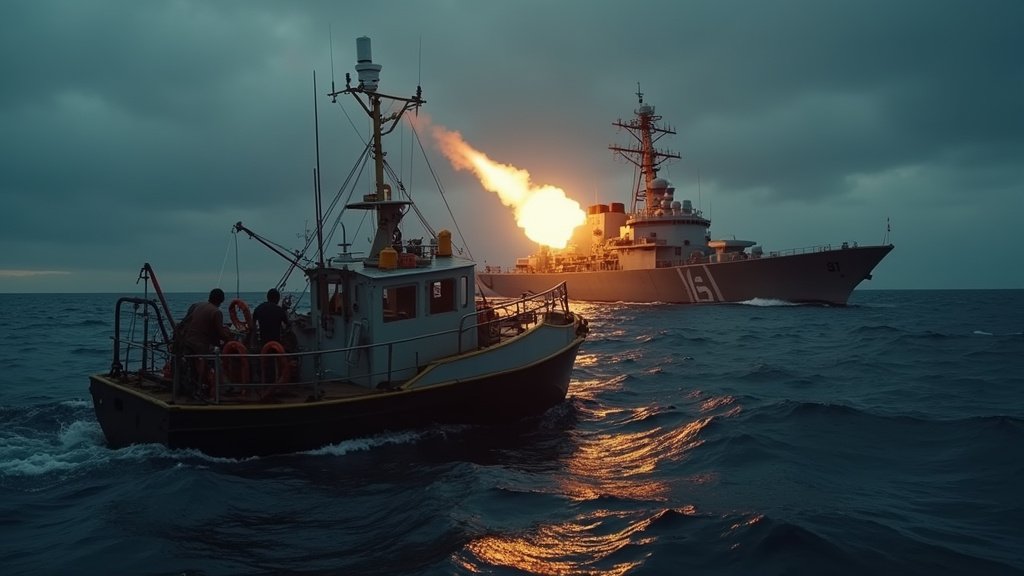
Washington Escalates Deadly Strikes on Suspected Drug Boats in International Waters
In a dramatic escalation of its counternarcotics campaign, the Trump administration has conducted a series of lethal strikes on vessels suspected of trafficking narcotics, expanding its operations from the Caribbean to the Eastern Pacific. The latest incident, on November 5, 2025, resulted in the deaths of at least two individuals aboard a vessel in the Eastern Pacific Ocean, according to Defense Secretary Pete Hegseth. This action is part of a broader, controversial policy that has led to numerous fatalities and drawn sharp criticism from international bodies, human rights groups, and some governments.
The Unfolding Campaign of Maritime Strikes
The Trump administration’s aggressive posture against maritime drug smuggling began in early September 2025. Initially focused on the Caribbean Sea, the campaign rapidly expanded to the Eastern Pacific Ocean by October. These operations, often announced via social media by Secretary Hegseth, involve the U.S. military striking vessels alleged to be involved in illicit narcotics smuggling. Officials claim intelligence confirms these vessels are transiting known narco-trafficking routes and are laden with drugs destined for the United States.
President Donald Trump has personally justified these actions, asserting that traditional methods of interdicting drug boats have been a “major failure” after 30 years of ineffectiveness. He has characterized those on the targeted vessels as “narco-terrorists” and cartel members. As of mid-November 2025, these strikes have resulted in the deaths of at least 83 people across 21 documented attacks on 22 vessels, with 11 strikes occurring in the Caribbean and 10 in the Eastern Pacific. The number of fatalities has steadily climbed, with reports indicating over 80 deaths as of mid-November.
International Outcry and Legal Challenges
The administration’s “shoot first” policy has ignited a firestorm of international criticism. United Nations human rights experts have declared that the use of lethal force in international waters without a proper legal basis constitutes “extrajudicial executions”. The UN High Commissioner for Human Rights, Volker Türk, has called for the U.S. to halt these strikes to prevent further “extrajudicial killings” and urged an investigation. Experts and human rights groups argue that these killings are illegal under both U.S. and international law.
The governments of Colombia and Venezuela have been particularly vocal, accusing the U.S. of engaging in “extrajudicial murder”. Colombian President Gustavo Petro has directly challenged the strikes, stating that his country would suspend intelligence sharing with the U.S. as long as the attacks continued, emphasizing that “the fight against drugs must be subordinated to the human rights of the Caribbean people”. Venezuela’s Ministry of Defense has decried the actions as “murdering defenseless people… executing them without due process”.
Shifting Strategy: From Interdiction to Elimination
For decades, the U.S. Coast Guard has been the primary agency responsible for maritime drug interdictions, operating under laws like the Maritime Drug Law Enforcement Act (MDLEA). This traditional approach focused on intercepting vessels, seizing narcotics, and prosecuting the crew, a method that often yielded valuable intelligence about trafficking networks. However, the Trump administration has explicitly rejected this strategy, with Secretary of State Marco Rubio stating that interdictions alone are “ineffective” and have “limited to no deterrent effect”.
Instead, the administration appears to be operating under a directive that considers drug cartel members as combatants in an “armed conflict”. This justification, reportedly based on a classified Department of Justice memo, allows for a more forceful approach. Some internal discussions within the Justice Department had even suggested that the U.S. should “just sink” the boats without further process, a notion that reportedly shocked attendees at a prosecutor’s conference.
Operation Southern Spear and Increased Military Presence
Concurrent with these strikes, the U.S. military has significantly increased its presence in the Caribbean. Secretary of War Pete Hegseth announced the formation of Joint Task Force Southern Spear and the commencement of “Operation Southern Spear”. This operation involves a substantial deployment of naval assets, including the USS Gerald R. Ford aircraft carrier strike group, bolstering the U.S. military’s capacity to monitor and engage suspected trafficking vessels. This buildup has been interpreted by some as a broader strategy to exert pressure on the Venezuelan government, with speculation that regime change could be an ultimate objective.
While the U.S. Coast Guard continues to achieve record-breaking drug seizures through traditional interdictions—seizing tens of thousands of pounds of narcotics in single patrols—the parallel military campaign has sparked debate. Critics argue that resources might be better allocated to traditional law enforcement, which preserves the potential for intelligence gathering and avoids loss of life. The escalating news cycle surrounding these events highlights a contentious new chapter in the war on drugs, with profound implications for international law, human rights, and regional stability in the Caribbean and beyond.