
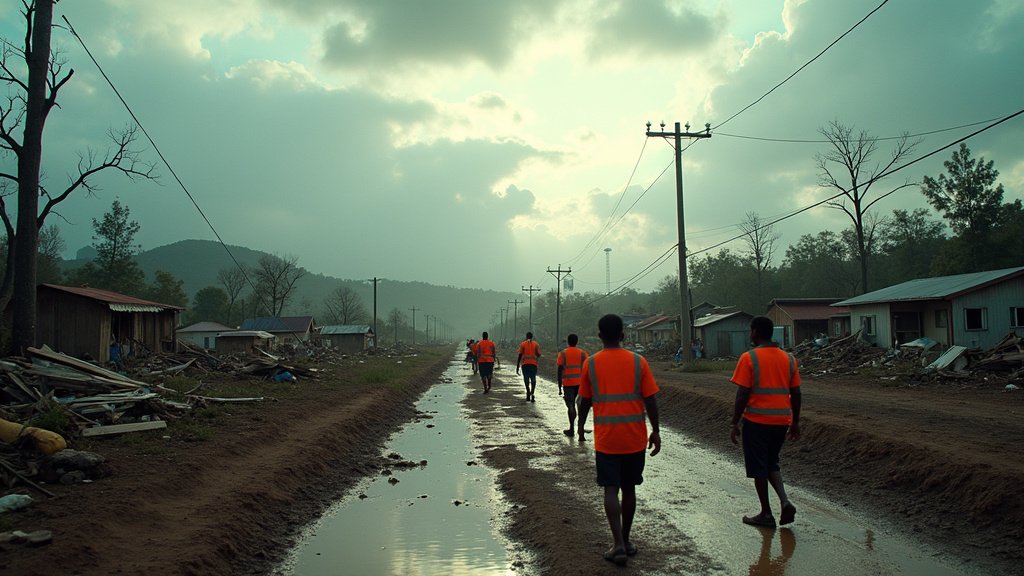
Weeks after Hurricane Melissa unleashed its fury across the Caribbean, relief efforts are intensifying as damage assessments reveal a scale of destruction far greater than initially feared. The catastrophic Category 5 storm, one of the most powerful Atlantic hurricanes on record, has left a trail of devastation in its wake, impacting millions and necessitating a massive, ongoing regional response.
The Fury of Hurricane Melissa
Forming on October 21, 2025, Hurricane Melissa rapidly intensified over the Atlantic, reaching sustained winds of 185 mph (295 km/h) and a record-low central pressure of 892 millibars. It made landfall in Jamaica on October 28 as a Category 5 hurricane, marking the strongest storm ever to hit the island nation and surpassing Hurricane Gilbert in 1988. The hurricane’s immense power was evident in its record-breaking wind gust of 252 mph (406 km/h) recorded by dropsonde data. After battering Jamaica, Melissa weakened slightly but made a second landfall in eastern Cuba on October 29 as a Category 3 hurricane before weakening further and transitioning into a post-tropical cyclone on October 31.
Devastation Across Nations: A Caribbean Nightmare
The impact across the affected islands has been dire.
Jamaica bore the brunt of Melissa’s destructive power, with physical damage estimated at a staggering $8.8 billion – equivalent to 41% of the country’s 2024 GDP. This makes Melissa the costliest hurricane in Jamaica’s recorded history. The storm demolished or severely damaged over 122,000 dwellings, crippled critical infrastructure including hospitals, clinics, roads, and bridges, and left hundreds of thousands without power and water for extended periods. The southwestern parish of St. Elizabeth, particularly the town of Black River, was described as “ground zero,” with up to 90% of structures losing their roofs. Infrastructure damage accounted for 33% of the total losses, with residential buildings bearing 41%. The agricultural sector also suffered, with 41,390 hectares of crops damaged and losses of over 1.25 million animals.
Haiti faced a significant humanitarian crisis, with official reports indicating at least 43 deaths, including 10 children, and 13 people missing. Over 11,900 houses were flooded, and hundreds more destroyed or damaged. Landslides and catastrophic flooding devastated communities, particularly in the southwest, pushing an already fragile health system to its limits. Many roads became impassable, severely hindering relief efforts.
In Cuba, Hurricane Melissa made landfall as a Category 3 storm, causing widespread flooding, damage to homes, and disrupting critical services. Over 735,000 people were evacuated ahead of the storm, and preliminary assessments indicate that nearly 150,000 homes were affected, with tens of thousands suffering complete collapses or roof failures. Santiago de Cuba province, the country’s second-most populous, remained over 60% without electricity for weeks, and over 450,000 people experienced disruptions to safe water supply. The widespread damage also exacerbated existing health challenges, with reports of arboviral diseases affecting 30% of the population.
Other Caribbean nations, including the Dominican Republic, the Bahamas, and Turks and Caicos Islands, also experienced severe weather, localized flooding, and power outages.
The Urgent Humanitarian Response
Governments and a coalition of international aid organizations are working tirelessly to deliver essential aid across the region. The United Nations World Food Programme (WFP) is intensifying its life-saving food distributions and cash assistance programs, aiming to reach over 1.3 million affected individuals. The UN Office for the Coordination of Humanitarian Affairs (OCHA) is supporting national responses by assisting people in shelters and distributing vital supplies. The UN Humanitarian Air Service (UNHAS) has expanded operations to reach isolated communities. The Pan American Health Organization (PAHO) is coordinating with health ministries to restore essential medical services, monitor disease outbreaks, and address mental health needs. Organizations like UNESCO are providing support for educational continuity and cultural heritage preservation. The U.S. State Department has committed $24 million in disaster relief and deployed search-and-rescue teams, collaborating with local authorities and NGOs to deliver food, water, and medical supplies.
Mounting Challenges and a Long Road to Recovery
Despite the intensified relief efforts, significant challenges persist. Damaged roads, landslides, and debris continue to impede access to many isolated communities, delaying the delivery of much-needed humanitarian supplies. The widespread disruption of water and sanitation infrastructure has raised serious concerns about the risk of waterborne and vector-borne diseases, including leptospirosis, dengue, and cholera, especially in densely populated shelters. Hospitals and health facilities in many areas have sustained major damage, impacting the availability of medical care and essential medications.
The scale of destruction has necessitated a long-term recovery strategy. International financial institutions, including the World Bank and the Inter-American Development Bank, are conducting detailed damage assessments to guide reconstruction efforts. The immediate focus remains on providing life-saving assistance, restoring critical services, and ensuring the safety and well-being of hundreds of thousands of displaced individuals across the Caribbean region. The recovery will require sustained regional and international cooperation to rebuild resilience against increasingly frequent and intense extreme weather events. Today’s news underscores the urgent need for continued support for the affected populations as they begin the arduous process of rebuilding their lives and communities.