
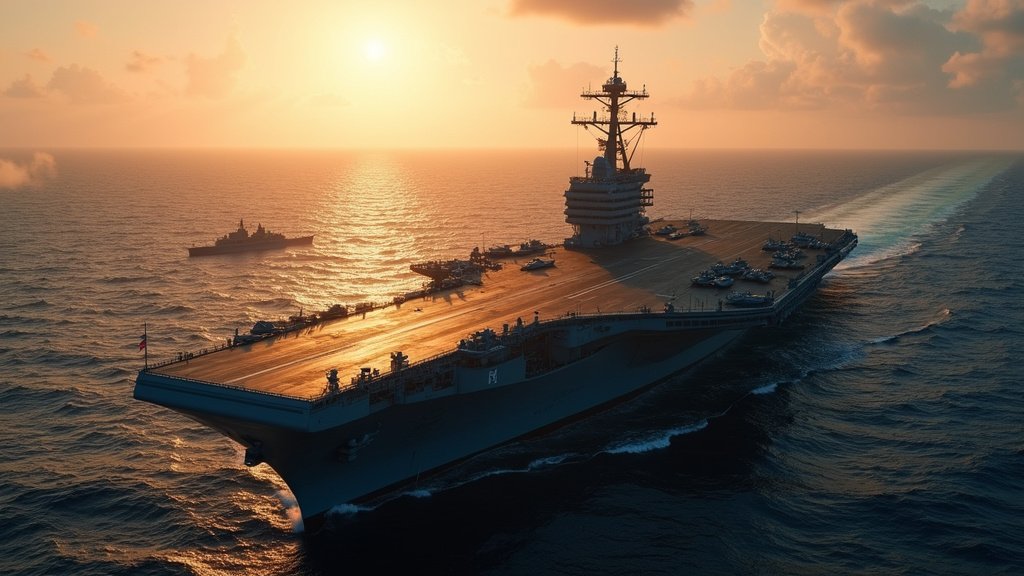
The USS Gerald R. Ford, the U.S. Navy’s most advanced aircraft carrier, has arrived in the Caribbean Sea, marking a significant military buildup in the region and intensifying a multi-faceted operation aimed at combating transnational criminal organizations and narco-terrorism. This deployment, dubbed “Operation Southern Spear,” is seen by many as a strategic move to increase pressure on Venezuelan President Nicolás Maduro’s government, while U.S. officials maintain the primary focus is on disrupting drug trafficking routes.
Operation Southern Spear Takes Center Stage
The arrival of the USS Gerald R. Ford on Sunday, November 17, 2025, in the Caribbean Sea signifies the largest U.S. military deployment to the region in decades. The carrier strike group, which includes the world’s largest warship, transited the Anegada Passage near the British Virgin Islands. Operation Southern Spear, officially launched and led by Joint Task Force Southern Spear under U.S. Southern Command (SOUTHCOM), involves nearly a dozen Navy ships and approximately 12,000 sailors and Marines. The operation’s stated objective is to dismantle transnational criminal organizations and counter narco-terrorism, with the ultimate goal of protecting the U.S. homeland from illicit drugs.
Dual Purpose: Counter-Narcotics and Political Pressure
U.S. military and administration officials, including Defense Secretary Pete Hegseth and Secretary of State Marco Rubio, have consistently framed Operation Southern Spear as a critical effort to stem the flow of narcotics into the United States. This justification has been accompanied by a series of U.S. strikes targeting small boats accused of transporting drugs in the Caribbean and eastern Pacific since early September. These interdictions have resulted in at least 80 deaths across approximately 20-21 incidents, though the administration has not publicly provided evidence to substantiate claims that those killed were “narcoterrorists”.
Despite the emphasis on counter-narcotics, the deployment is widely interpreted as a significant pressure tactic against Venezuelan President Nicolás Maduro. The U.S. government does not recognize Maduro’s administration as legitimate, and Secretary of State Marco Rubio has described Maduro’s regime as a “transshipment organization” for drug traffickers. In response to the escalating U.S. military presence, Venezuela has announced nationwide military exercises involving a substantial number of personnel, indicating heightened regional tensions.
Escalating Tensions and Military Buildup
The arrival of the Ford carrier strike group adds a formidable layer of U.S. military power to an already significant presence in the region. The strike group itself comprises the USS Gerald R. Ford (CVN-78), its embarked Carrier Air Wing Eight with multiple squadrons of F/A-18 Super Hornets and other advanced aircraft, and escorting Arleigh Burke-class guided-missile destroyers such as the USS Bainbridge, USS Mahan, and USS Winston S. Churchill. Beyond the carrier strike group, the U.S. has deployed other assets, including F-35 fighter jets and MQ-9 Reaper drones in Puerto Rico, along with Air Force bombers and transport aircraft operating in the region. This expanded naval and air power constitutes the largest concentration of American maritime and aerial might in the Caribbean in generations.
The U.S. has also taken steps to further isolate Maduro’s government, with the State Department announcing its intent to designate the “Cartel de los Soles,” an organization allegedly composed of high-ranking Venezuelan military and government figures including Maduro himself, as a Foreign Terrorist Organization. This designation, set to be effective November 24, 2025, could pave the way for further U.S. actions against the regime.
Background and Regional Reactions
The intensified U.S. military actions follow months of increased activity in the Caribbean and eastern Pacific. Since September 2, 2025, U.S. forces have conducted numerous strikes on vessels, with reports indicating at least 83 deaths attributed to these operations. Concerns have been raised by international observers and some allies regarding the legality and transparency of these strikes, particularly given the lack of publicly presented evidence linking all targeted individuals to drug smuggling.
Venezuela’s President Maduro has characterized the U.S. military presence as a threat and an attempt to provoke regime change, ordering military mobilizations in response. The situation has created significant anxiety throughout the region, with neighboring countries closely monitoring the escalating tensions.
The deployment of the USS Gerald R. Ford and the broader “Operation Southern Spear” represent a significant strategic maneuver by the U.S. administration. While officially framed as a critical counter-narcotics mission, the sheer scale of the military commitment and the targeted pressure on Venezuela indicate a complex geopolitical dynamic at play in the Caribbean today. The coming weeks will likely reveal the full extent of the U.S. strategy and its impact on regional stability.