
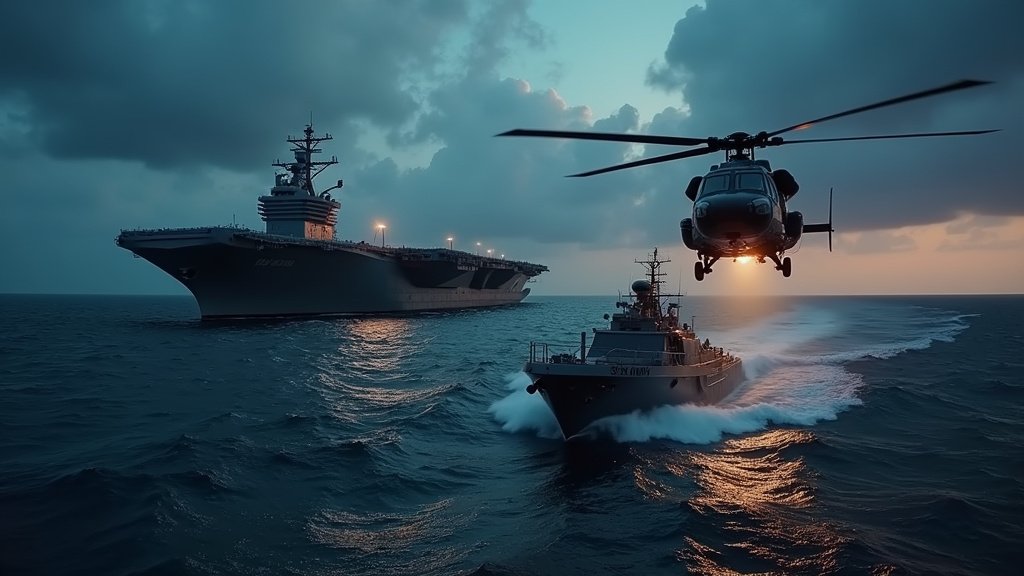
The U.S. military has carried out its 20th strike on a vessel accused of trafficking drugs in the Caribbean Sea, resulting in the deaths of four individuals. This latest incident, which occurred on a Monday and was reported on Friday, marks a grim escalation in the Trump administration’s “Operation Southern Spear,” an intensified campaign targeting alleged narcotics smuggling in South American waters and the broader Caribbean region. Since the operation commenced in September, these strikes have led to a cumulative death toll of at least 80 people.
U.S. Southern Command (SOUTHCOM) confirmed that intelligence indicated the vessel was involved in illicit narcotics smuggling along a known narco-trafficking route. Defense Secretary Pete Hegseth has stated that such operations target “narco-terrorists” and are crucial for protecting the homeland from drugs that are “killing our people.” The administration’s aggressive stance has been underscored by the recent deployment of the state-of-the-art aircraft carrier USS Gerald R. Ford and its strike group to the region, a significant show of military might aimed at dismantling drug trafficking networks.
Operation Southern Spear: An Escalated Campaign
“Operation Southern Spear,” officially announced on November 13, 2025, represents a substantial ramping up of U.S. military involvement in counternarcotics efforts. The deployment includes the USS Gerald R. Ford, accompanied by multiple escort ships and approximately 10,000 U.S. personnel. This force aims to disrupt drug flows and dismantle transnational criminal organizations that operate throughout the Western Hemisphere. Secretary Hegseth has declared the mission’s objective to “defend our Homeland, removes narco-terrorists from our Hemisphere, and secures our Homeland from the drugs that are killing our people.”
The administration’s justification for these lethal strikes often centers on the assertion that drug cartels are engaged in an “armed conflict” with the United States, killing more Americans than groups like Al-Qaeda. This narrative frames the targeted vessels as operating under a designation of “unlawful combatants” or “narco-terrorists.”
The Caribbean’s Role in Global Drug Trafficking
The Caribbean Sea remains a critical, albeit complex, transit zone for illicit narcotics originating from South America, primarily Colombia, Peru, and Bolivia. Historically, routes through the Caribbean have been vital for delivering cocaine and other drugs to North American and European markets. While maritime interdiction efforts by the U.S. Coast Guard have seen record seizures, experts suggest that drug trafficking organizations have adapted, diversifying routes and employing various methods, including go-fast vessels and semi-submersibles, to evade authorities.
Venezuela, under President Nicolás Maduro, is frequently cited as a key transit country, with its territory allegedly facilitating the movement of drugs northward. The U.S. Department of State has moved to designate Venezuela’s Cartel de los Soles as a Foreign Terrorist Organization, further intensifying geopolitical pressures on the Maduro regime.
Mounting Criticisms and International Concerns
Despite the administration’s assertions, the campaign of strikes has drawn significant criticism from various quarters. Human rights organizations, including U.N. human rights experts, have voiced grave concerns, labeling the strikes as potential “extrajudicial killings” and violations of international law, citing a lack of due process and transparency. Reports have emerged of potential civilian casualties, including fishermen, and questions persist about the certainty of the intelligence used to identify targets.
The legality of these operations has been challenged by legal experts and lawmakers alike, with concerns raised that they may contravene international human rights law, which mandates that deprivations of life must be strictly necessary and a last resort. Some U.S. allies, including the United Kingdom, the Netherlands, Canada, and Colombia, have reportedly curtailed intelligence sharing with the U.S. in response to these concerns, fearing their support could facilitate unlawful actions. Colombian President Gustavo Petro explicitly stated that the fight against drugs must be “subordinated to the human rights of the Caribbean people.”
Geopolitical Tensions and Dual Approaches
The U.S. military buildup in the Caribbean, spearheaded by the arrival of the USS Gerald R. Ford, has been interpreted by some as a pressure tactic against Venezuela, aiming to destabilize President Maduro’s government. Venezuela, in turn, has decried the U.S. presence as an act of aggression. The contrasting strategies of direct military strikes versus traditional law enforcement interdictions are also a point of contention.
While the Department of War pursues lethal kinetic actions, the U.S. Coast Guard continues its maritime law enforcement operations, reporting record drug seizures. However, some officials acknowledge that these interdictions, while significant, do not appear to have dramatically altered the overall flow of drugs. The effectiveness of the current strategy in truly stemming the tide of narcotics into the United States and its impact on the local communities in the Caribbean remains a subject of intense debate.
An Uncertain Future
The ongoing “Operation Southern Spear” has introduced a new and controversial dimension to the U.S. counternarcotics strategy in the Caribbean. As the death toll rises and international condemnation grows, the long-term implications for regional stability, human rights, and the effectiveness of U.S. foreign policy are becoming increasingly apparent. The stories emerging from this campaign highlight a complex interplay of national security imperatives, geopolitical objectives, and profound ethical and legal questions that continue to unfold in the waters of the Caribbean and beyond.