
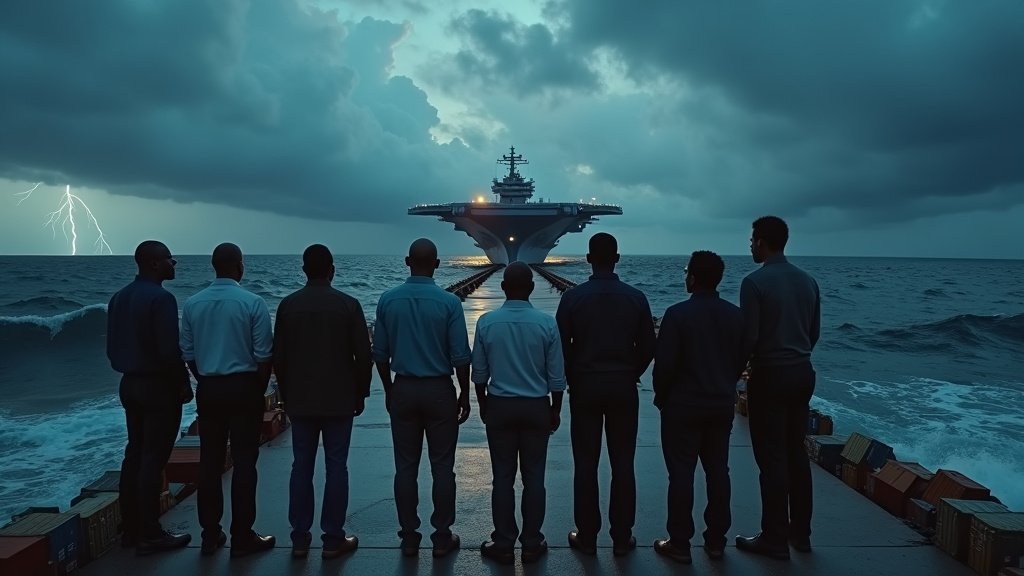
As 2025 draws to a close, the Caribbean Community (CARICOM) finds itself at a critical juncture, facing a confluence of unprecedented geopolitical, military, environmental, and economic challenges that test its very survival. The final four months of the year have brought a surge of global and regional pressures, from a dramatic US military buildup in its backyard to the urgent demands of climate action at COP 30, all while grappling with persistent economic vulnerabilities.
A New Era of US Military Engagement in the Caribbean
The geopolitical landscape has been dramatically altered by a significant escalation of US military presence in the Caribbean. Since August 2025, a robust naval buildup, dubbed Operation Southern Spear, has seen an array of US warships, including the aircraft carrier USS Gerald R. Ford, converge on the region. The stated objective is to combat drug trafficking and transnational criminal organizations, with specific operations targeting vessels off Venezuela’s coast and in the Pacific. However, the scale of this deployment, involving thousands of troops and advanced military assets, has fueled speculation that broader strategic aims, including pressure on the Venezuelan regime and a potential shift towards regime change, may be at play.
This military surge occurs against the backdrop of a “Trump 2.0” administration, whose “America First” foreign policy is reshaping regional dynamics. Analysts and leaders express concern over potential impacts, including stricter immigration policies that could affect Caribbean nationals and their remittances, and trade policies that may lead to economic losses for countries heavily reliant on the US market. The erosion of multilateralism, marked by the US absence from key global forums like COP 30, further complicates the diplomatic environment for smaller nations. The growing multipolar world order, with increased Chinese influence in the Caribbean, adds another layer of complexity to the region’s geopolitical positioning. CARICOM leaders have acknowledged these shifts, urging unity and strategic foresight to navigate a volatile global order that often sidelines smaller states.
Climate Vulnerability Takes Center Stage at COP 30
As the international community convenes for COP 30 in Belém, Brazil, the Caribbean’s existential threat from climate change remains paramount. CARICOM nations, despite contributing negligibly to global greenhouse gas emissions, are disproportionately bearing the brunt of its impacts, from devastating hurricanes like Melissa to accelerating sea-level rise. At COP 30, CARICOM leaders, including those from Jamaica and Cuba, are forcefully advocating for climate justice and demanding that major emitters honor their commitments to limit global warming to 1.5°C, framing the issue as a matter of survival.
A critical focus of these negotiations is the persistent gap in climate finance. CARICOM is calling for increased, predictable, and concessional financing for adaptation and mitigation efforts, urging innovative financial tools such as debt-for-climate swaps. The region is also championing ecosystem-based adaptation and community-led conservation, while highlighting that the absence of the United States from formal COP 30 negotiations exacerbates challenges in securing adequate funding. CARICOM is working towards its own climate resilience goals, developing solutions for energy, transport, and agriculture, and seeking to present a united front on climate financing and adaptation.
Economic Headwinds and Fiscal Strains
The economic outlook for CARICOM in the latter half of 2025 is one of deceleration, characterized by growing uncertainty and tightening global financial conditions. Forecasts point to a slowdown in regional growth for 2025-2026, influenced by a weakening global economy, volatile commodity prices, and geopolitical conflicts. The imposition of “America First” trade policies by the US poses a significant risk, potentially leading to trade tensions and reduced economic opportunities for nations dependent on US trade. Furthermore, stricter US immigration laws could diminish vital remittance flows, impacting household incomes across the region.
Many CARICOM governments continue to face constraints related to limited fiscal space and risks to debt sustainability, exacerbated by high import costs for energy and transportation, and the recurrent threat of natural disasters. While some countries are pursuing fiscal consolidation, the overall economic environment demands greater resilience and diversification. Experts and leaders emphasize the need to harness the Fourth Industrial Revolution, invest in infrastructure, and explore niche markets to bolster economic activity and competitiveness. The region’s economic performance varies, with nations like Guyana seeing significant growth driven by the hydrocarbons sector, while others, such as Haiti, struggle with instability and falling below pre-pandemic output levels.
The Imperative of Unity and Strong Leadership
In the face of these multifaceted crises, the call for unity, collaboration, and strong leadership within CARICOM has never been more urgent. Figures like Barbados Prime Minister Mia Mottley, who declared 2025 a defining year for the region’s legacy, and Jamaica’s Prime Minister Andrew Holness, as current CARICOM chair, have emphasized acting with “one voice and one purpose”. The region is actively working to strengthen its CARICOM Single Market and Economy (CSME) to facilitate the free movement of goods, services, and people, though progress has been acknowledged as too slow.
CARICOM leaders are also tackling critical security issues, adopting declarations to combat transnational organized crime and gangs, recognizing that “a secure CARICOM is a viable CARICOM”. There is a clear recognition that the region must be adaptable, resilient, and proactive in its engagement with global partners and in pursuing necessary internal reforms. The collective survival and prosperity of CARICOM in these turbulent times will hinge on its ability to foster deep regional integration, demonstrate decisive leadership, and forge strategic alliances to navigate a complex and often unforgiving international environment. The final months of 2025 thus represent a crucial test of CARICOM’s capacity to endure and adapt.