
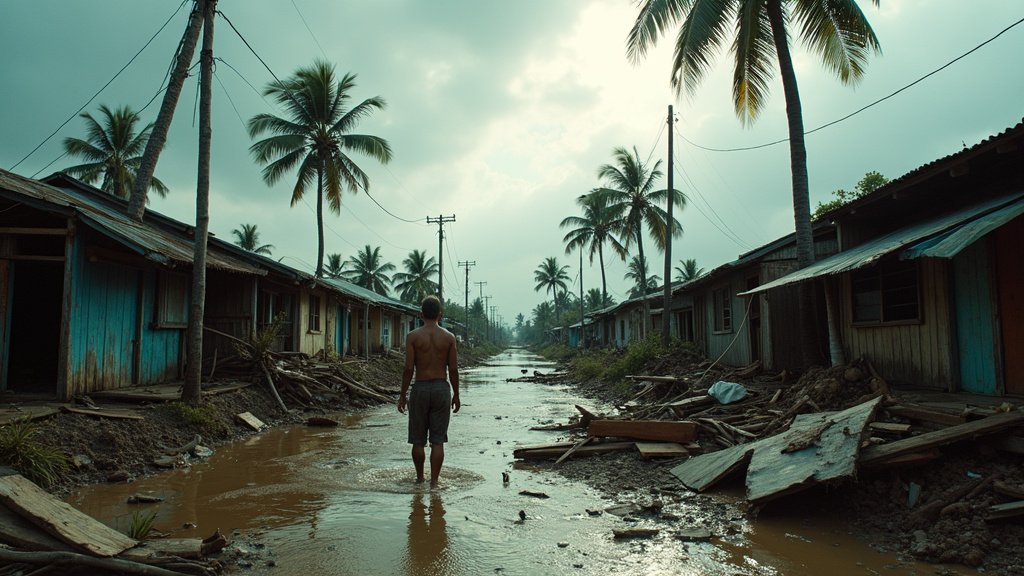
Jamaica is grappling with the monumental task of recovery and rebuilding in the wake of Hurricane Melissa, a catastrophic Category 5 storm that made a direct hit on the island on October 28, 2025. The hurricane, one of the most intense Atlantic storms on record, has left a trail of widespread destruction, impacting an estimated 1.5 million Jamaicans and causing an unprecedented level of damage that has been declared the costliest natural disaster in the nation’s history.
The Storm’s Unprecedented Fury
Hurricane Melissa formed from a tropical wave that originated in West Africa, eventually intensifying into a monstrous Category 5 hurricane. Before making landfall in Jamaica, it generated wind gusts of up to 252 mph (406 km/h), making it the strongest tropical cyclone globally in 2025 and the most intense hurricane to ever make landfall in the Atlantic basin. Its arrival on Jamaica’s southwestern coast near New Hope, Westmoreland, with sustained winds of 185 mph (295 km/h) and a minimum central pressure of 892 millibars, inflicted devastating winds, catastrophic rainfall, and life-threatening storm surge. Prime Minister Andrew Holness declared the entire island a disaster area, underscoring the severity of the situation.
Widespread Devastation Across the Island
The impact of Hurricane Melissa has been catastrophic and far-reaching, particularly in the western and southern parishes. Saint Elizabeth and Westmoreland bore the brunt of the storm, with extensive damage reported across St. James, Hanover, Manchester, Trelawny, and St. Ann as well. Reports describe entire communities obliterated, with residential and non-residential buildings collapsing and many towns submerged under floodwaters. Infrastructure has been severely compromised, with major roads rendered impassable due to landslides and flooding, crippling transportation and hampering initial recovery efforts. Communications networks, including telecommunications and electricity, have been extensively disrupted, leaving many areas isolated. Thousands of housing structures have been damaged or destroyed, displacing tens of thousands of residents who are now in urgent need of shelter and basic necessities.
Human and Economic Toll
The human cost of Hurricane Melissa is staggering. The confirmed death toll has risen to 45, with 15 individuals still missing and investigations ongoing into nine additional cases. The highest numbers of fatalities were recorded in St. Elizabeth with 18 deaths and Westmoreland with 15. Thousands of families have been left homeless, and the nation mourns the loss of lives, homes, farms, businesses, and livelihoods. Beyond the immediate human tragedy, the economic fallout is immense. Preliminary assessments by the World Bank and the Inter-American Development Bank (IDB) estimate the physical damage at a record-breaking US$8.8 billion, equivalent to 41% of Jamaica’s 2024 gross domestic product (GDP). This figure, calculated by the Global Rapid Damage Estimation (GRADE) assessment, focuses on physical damage and does not include the broader economic losses, which are expected to be significantly higher. Some modeling even suggests the full economic toll could exceed US$20 billion.
Impact on Key Sectors
The agricultural sector, the breadbasket of Jamaica, has been particularly hard hit. Preliminary estimates indicate losses of approximately J$29.5 billion (around US$124.5 million), affecting over 70,000 farmers and disrupting operations across more than 41,000 hectares of farmland. Approximately 1.25 million animals, including poultry, cattle, and small ruminants, have been lost. Major crops like yams, bananas, plantains, coffee, and vegetables sustained extensive damage, raising serious concerns about food security and price stability in the coming months. The destruction to farmlands, greenhouses, and storage facilities, coupled with damaged roads, has severely hampered market access and relief efforts. The disruption to the food system is already being felt in urban markets, with reports of emptier stalls and anticipated price hikes.
National and International Response
In the immediate aftermath, the Jamaican government declared the entire island a disaster area, empowering swift action for life-saving measures, emergency funding, and a coordinated response. The Office of Disaster Preparedness and Emergency Management (ODPEM), in conjunction with various ministries and partners, has been leading damage assessment and relief coordination. International partners, including the United Nations, the World Bank, and the Inter-American Development Bank, have mobilized to support recovery efforts. The UN has allocated emergency funds and is coordinating aid operations, while the World Bank and IDB are providing financial and technical assistance for rebuilding. Initial payouts from Jamaica’s catastrophe bond have offered a crucial financial lifeline, though they represent only a fraction of the total damage. Efforts are focused on restoring essential services, clearing roads, providing food and shelter, and beginning the long process of reconstruction. The global news of the hurricane’s devastation has also spurred fundraising and aid initiatives in diaspora communities, particularly in the United States.
The Path Forward: Resilience and Rebuilding
Hurricane Melissa has underscored the vulnerability of Small Island Developing States to extreme weather events exacerbated by climate change. The path to recovery for Jamaica will be long and arduous. The focus is now shifting towards a sustained reconstruction phase, aiming to build back more resiliently. World Bank Vice President Susana Cordeiro Guerra has affirmed the Bank’s commitment to supporting Jamaica’s transition from response to reconstruction, emphasizing the importance of collective determination, strong leadership, and resilient rebuilding. The nation’s ability to navigate this crisis will depend on continued international support, effective governance, and the enduring resilience of the Jamaican people as they work to restore their lives and their country. This event serves as a stark reminder of the escalating threats posed by climate change to the Caribbean and global lifestyle patterns.