
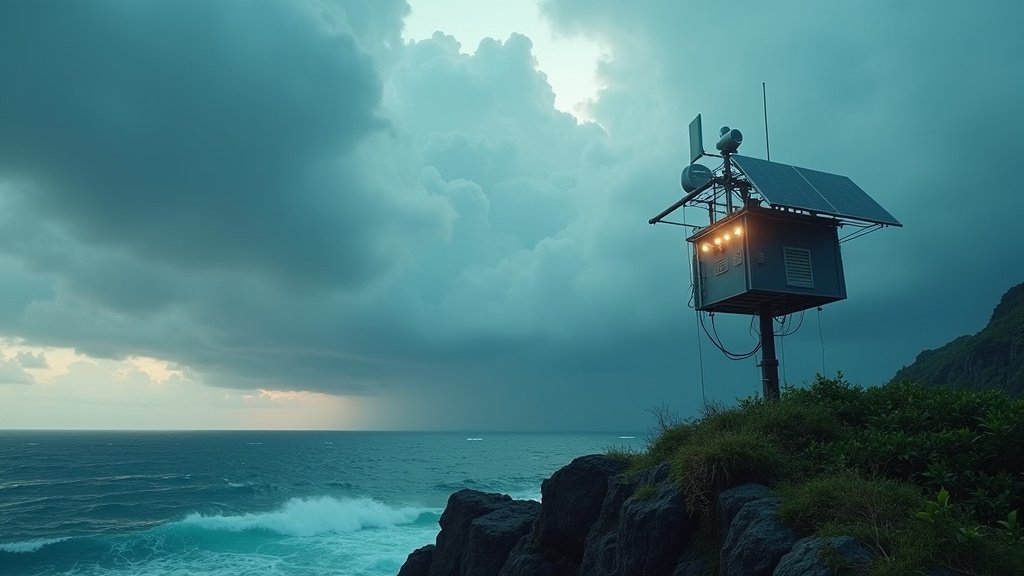
The Caribbean region, a perennial hotspot for tropical weather activity, stands to gain significantly from advancements in meteorological technology. A private company, Weatherstem, is expanding its network of sophisticated, solar-powered weather stations across the Caribbean, including the U.S. Virgin Islands (USVI), aiming to provide critical, real-time data for improved storm tracking and disaster preparedness. This initiative introduces a new layer of technological capability that could bolster the resilience of these vulnerable island communities.
Advanced Technology for Hyperlocal Monitoring
Weatherstem, founded in 2015 by meteorologist and engineer Edward Mansouri, specializes in creating “hyperlocal weather monitoring systems.” These systems comprise advanced weather stations equipped with a suite of sensors capable of measuring temperature, barometric pressure, wind speed and direction, humidity, rainfall, solar and ultraviolet radiation, and dew point. A distinctive feature of Weatherstem’s technology is its rapid data sampling rate, reporting changes in increments of one second or less, with some systems achieving speeds of 0.8 seconds. This near-instantaneous data transmission is crucial for identifying rapidly developing weather hazards.
Furthermore, Weatherstem stations are designed for resilience, built to withstand hurricane-force winds and operate independently even when traditional power and internet infrastructure fail. This is largely due to their solar-powered design, making them invaluable for continuous monitoring during severe weather events. Each station also incorporates high-definition cameras that provide still images and live streaming video, offering visual context to the collected data. The company’s platform archives all collected information and video, a feature Mansouri terms “weather forensics,” allowing for detailed review of past weather incidents. Automated alerts and warnings can also be generated, notifying users of dangerous conditions like high winds or nearby lightning strikes.
Building a Caribbean Mesonet
Weatherstem’s ambitious vision extends to establishing a comprehensive “mesonet”—a dense network of interconnected weather stations—across the Caribbean. This type of network is vital for capturing hyperlocal weather conditions, which can vary dramatically over short distances, a reality particularly relevant in island territories like the USVI. The company currently operates approximately 1,000 systems, predominantly in the southeastern United States, with existing stations already established in the Bahamas (Blue Lagoon Island), the British Virgin Islands (Tortola), and on St. Croix in the USVI at the Cruzan Rum distillery. The successful partnership model used in Florida, where public agencies and corporate sponsors fund the stations, is being considered as a blueprint for future expansion throughout the Caribbean.
Enhancing Storm Preparedness in the USVI
The expansion of such high-tech weather networks offers substantial benefits for the U.S. Virgin Islands and its neighboring islands. For communities like the USVI, which are highly susceptible to hurricanes and other extreme weather events exacerbated by climate change, accurate and immediate weather data is paramount. Having multiple stations across the major islands could empower residents and emergency managers to track rainfall totals in real-time, monitor heat risks, and confirm wind speeds during fast-moving storms. This improved situational awareness can lead to more timely and effective disaster response, potentially saving lives and protecting property. The ability to review historical weather data through “weather forensics” also aids in learning from past events and refining preparedness strategies.
Addressing Climate Vulnerabilities and Future-Proofing
Climate change is intensifying weather-related risks across the Caribbean, with rising sea levels, increased storm intensity, and more frequent extreme heat events posing significant threats. Advanced weather monitoring systems like Weatherstem’s are crucial tools for adaptation and mitigation efforts. By providing detailed, localized, and real-time data, these technologies can help communities better anticipate and respond to these escalating challenges. The goal is to enhance early-warning capabilities and strengthen overall disaster preparedness, ensuring that the region can better withstand and recover from the impacts of a changing climate.
The integration of advanced technology, such as Weatherstem’s network, into the Caribbean’s weather infrastructure represents a significant step forward. As the region continues to face the realities of climate change and hurricane season, these high-tech weather solutions offer a powerful means to improve forecasting, enhance preparedness, and ultimately safeguard the lives and livelihoods of its inhabitants. This news highlights a critical development in the ongoing effort to build a more resilient Caribbean.