
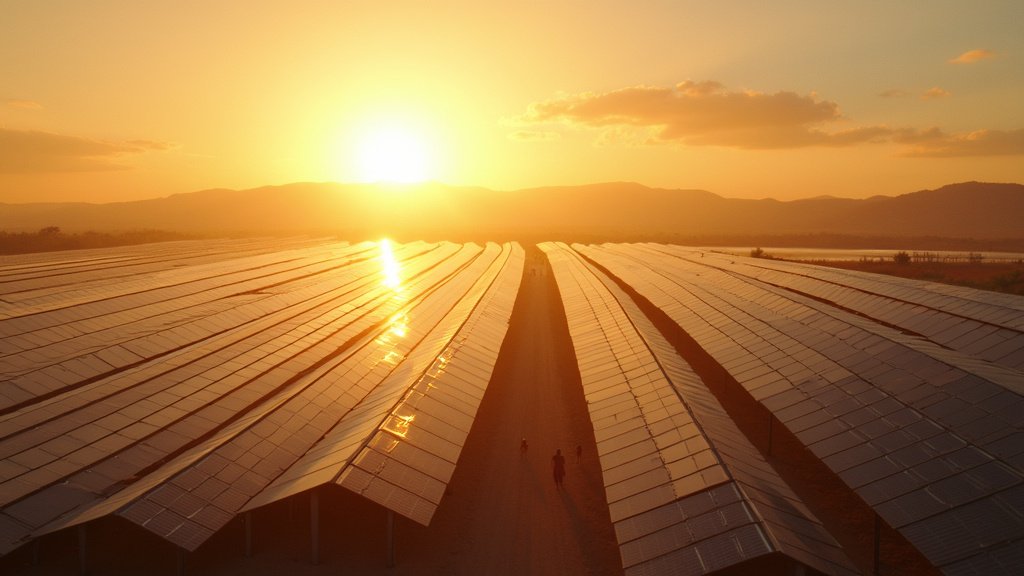
The Dominican Republic has officially inaugurated Cotoperí Solar. This marks a significant milestone for the nation and the Caribbean region. It is now the largest solar photovoltaic complex in Central America and the Caribbean. The inauguration ceremony took place in Guaymate, La Romana province. Vice President Raquel Peña led the event. Energy and Mines Minister Joel Santos was also in attendance. The project represents a major step toward a cleaner energy future.
Cotoperí Solar: A New Energy Giant
Cotoperí Solar is an impressive feat of engineering and investment. It boasts a nominal installed capacity of 162.6 MW. The complex is composed of three separate solar plants. This massive facility is projected to generate 286 GWh of clean energy annually. This output is enough to power approximately 166,000 homes. Furthermore, the plant will significantly reduce carbon emissions. It is expected to prevent over 210,000 tons of CO₂ emissions each year. This is equivalent to planting more than 5.5 million trees. The project underscores the Dominican Republic’s commitment to renewable energy. It contributes to the country’s goal of energy diversification and sustainability.
Key Players and Investment
Spanish renewable energy company Acciona Energía is the primary developer of Cotoperí Solar. Acciona Energía holds a 51% majority stake in the project. The remaining 49% is owned by Cotosolar Holding. Cotosolar Holding includes local investors. These partners are the JMMB Sustainable Energy Fund (FES), Grupo País, and other minority investors. Acciona Energía’s president and CEO, José Manuel Entrecanales, attended the inauguration. Juan José Melo, Executive President of JMMB Dominican Republic, and Juan Carlos País, CEO of Grupo País, were also present. This partnership highlights strong collaboration between international and local entities. Grupo País and JMMB FES have a significant role in financing renewable energy in the Dominican Republic. Their combined investments exceed 710 MWp of installed capacity.
Economic and Community Impact
The Cotoperí Solar project has generated substantial economic benefits for the region. During its construction phase, it created over 600 direct and indirect jobs. This provided a significant boost to the local economy. Furthermore, the project implements several community-focused initiatives. These programs aim to foster local development and improve the quality of life for residents. Over 3,500 people benefit from these initiatives. They include job placement programs that prioritize local workers. The project also offers vocational and entrepreneurship training. Road safety awareness campaigns are another key component. In partnership with Centro Arcoíris and acciona.org, Cotoperí Solar is also working to improve water and sanitation access. This effort benefits more than 4,500 residents in the Bella Vista and Villa Penca communities in Bajos de Haina. These stories of community development highlight the project’s broader social impact.
Dominican Republic’s Renewable Energy Push
Cotoperí Solar is not an isolated event. It represents a significant advancement in the Dominican Republic’s broader energy transition. The country has set ambitious goals for renewable energy. The target is to generate 25% of its electricity from renewable sources by 2025. As of late 2024, renewables already contributed 23.32% to the national generation capacity. In 2024 alone, the country installed 1.396 GW of new renewable energy capacity. The Dominican Republic aims for 30% renewables by 2030. This push is driven by a desire for energy independence and reduced reliance on imported fossil fuels. Historically, the country depended heavily on natural gas, coal, and fuel oil. In 2023, fossil fuels accounted for 85% of the energy mix. This shift is supported by government policies, including regulatory reforms and investments in transmission lines and substations. Acciona Energía plays a key role in this transition. Cotoperí Solar is Acciona’s second operational solar project in the country. It follows the Calabaza I plant (58 MWp), inaugurated in 2023. The company is also constructing the Pedro Corto solar plant (82.69 MWp). These projects collectively strengthen Acciona’s renewable portfolio in the region.
Broader Caribbean Context
The Cotoperí Solar complex is the largest in Central America and the Caribbean. It surpasses previous benchmarks in the region. For instance, Lightsource bp’s project in Trinidad and Tobago is 148 MWp. The Montecristi solar farm in the Dominican Republic was previously noted as the Caribbean’s largest at 58 MW. The Dominican Republic’s progress positions it as a leader in renewable energy in the Caribbean. Many nations in the Caribbean rely heavily on imported fuels, making them vulnerable to price volatility. Projects like Cotoperí Solar offer a pathway toward greater energy security and independence for the entire Caribbean region. The growth of solar power across the Caribbean is vital. It addresses climate change mitigation and economic development. These initiatives contribute to the global shift toward a sustainable future.
Looking Ahead
The successful inauguration of Cotoperí Solar is a testament to the Dominican Republic’s commitment to a sustainable energy future. It demonstrates the viability of large-scale renewable projects in the Caribbean. These developments are crucial for energy independence and environmental protection across the region. The stories emerging from this project highlight its positive impact on both the environment and the community. It sets a strong precedent for future renewable energy investments in Central America and the Caribbean.