
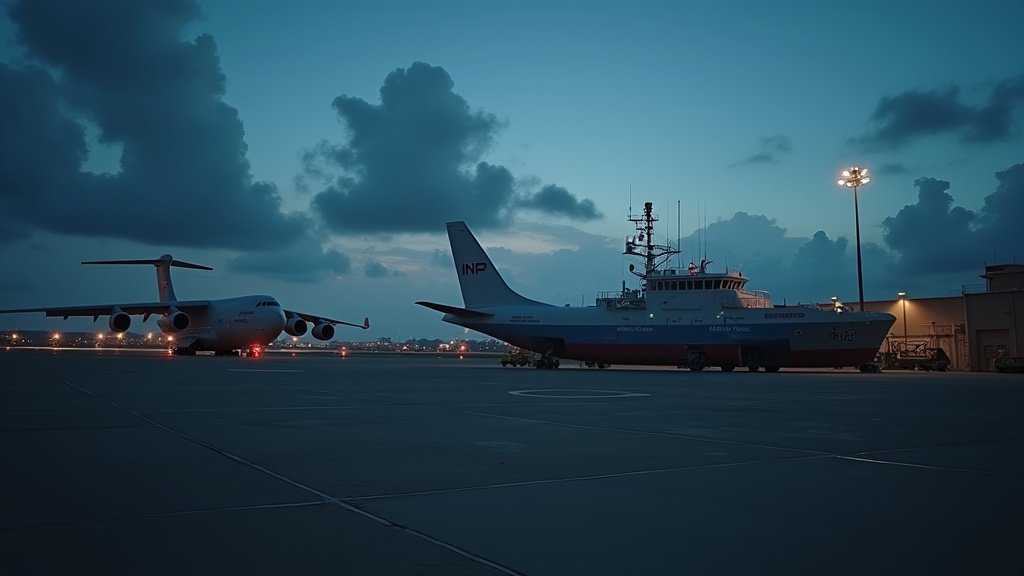
Trinidad and Tobago will grant U.S. military access to its airports. This decision comes in the coming weeks. Tensions remain high between the U.S. and Venezuela. This news broke on Monday, December 15, 2025. The Caribbean nation’s government made the announcement. It allows for logistical activities. These include supply replenishment. It also covers routine personnel rotations. The U.S. military recently installed a radar system. This radar is at the airport in Tobago. The government states it is for local crime fighting. It is not for attacking other countries. This move escalates regional concerns.
Growing U.S. Military Footprint
The United States has increased its military pressure. This has been happening since September 2025. U.S. forces have conducted strikes on alleged drug boats. These actions occurred in the Caribbean and Pacific. The U.S. has also deployed warships. The USS Gravely destroyer docked in Port-of-Spain. This happened in October 2025. It participated in joint military drills. Marines also trained with local forces. This signals a heightened U.S. focus. It is a significant military presence. The U.S. describes its actions as a counter-narcotics initiative. It targets transnational criminal organizations.
Trinidad and Tobago’s Position
Trinidad and Tobago’s Ministry of Foreign Affairs confirmed the airport access. The U.S. military will use the airports for logistical purposes. This means supporting operations. It does not involve offensive actions. The government maintains its commitment. It supports regional safety and security. Prime Minister Kamla Persad-Bissessar previously praised U.S. anti-drug efforts. She welcomed the presence of U.S. naval forces. The nation’s close proximity to Venezuela is notable. The two countries are only seven miles apart at their closest point. Trinidad and Tobago has two main airports. These are Piarco International Airport and ANR Robinson International Airport. The government has stated the radar is for local crime. It assures the nation is not a launchpad for attacks.
Venezuela’s Strong Condemnation
Venezuela reacted sharply to the news. Vice President Delcy Rodríguez criticized the decision. She accused Trinidad and Tobago of complicity. This followed the U.S. seizure of a Venezuelan oil tanker. The seizure happened on December 10, 2025. Rodríguez called it an “act of piracy.” She stated the Prime Minister had turned the nation into an “aircraft carrier.” This was directed against Venezuela. The accusation signifies deep mistrust. Venezuela promptly canceled its natural gas supply contracts. These were with Trinidad and Tobago. Rodríguez called the U.S. access “unequivocal vassalage.” Venezuela views U.S. military actions as aggression. It sees them as a threat to regional stability.
Wider U.S. Strategy in the Region
The U.S. campaign targets Venezuela’s regime. It aims to cut off oil revenues. This pressure is part of a broader strategy. Some observers call it a “Trump Corollary” to the Monroe Doctrine. This strategy seeks to reassert American pre-eminence. The U.S. is focusing on drug trafficking networks. It alleges links between these networks and the Venezuelan government. The U.S. military buildup is the largest in decades. This escalation is pushing U.S.-Venezuela relations to a volatile phase. The seizure of the oil tanker “Skipper” highlights this. It targeted Venezuela’s “shadow fleet” of tankers. This fleet circumvents sanctions.
Regional Ramifications and Future Outlook
This news arrives amid significant geopolitical tensions. The Caribbean region is a key focus. The U.S. military presence continues to grow. Trinidad and Tobago’s decision places it directly in this dynamic. Venezuela views these developments as a direct threat. It has warned against “military provocation.” The ongoing situation underscores the delicate balance of power. It highlights the complex security challenges facing the Caribbean. Further diplomatic and military developments are expected. The regional news today reflects this heightened concern. The coming weeks will likely reveal more implications. This regional development signals ongoing friction.