
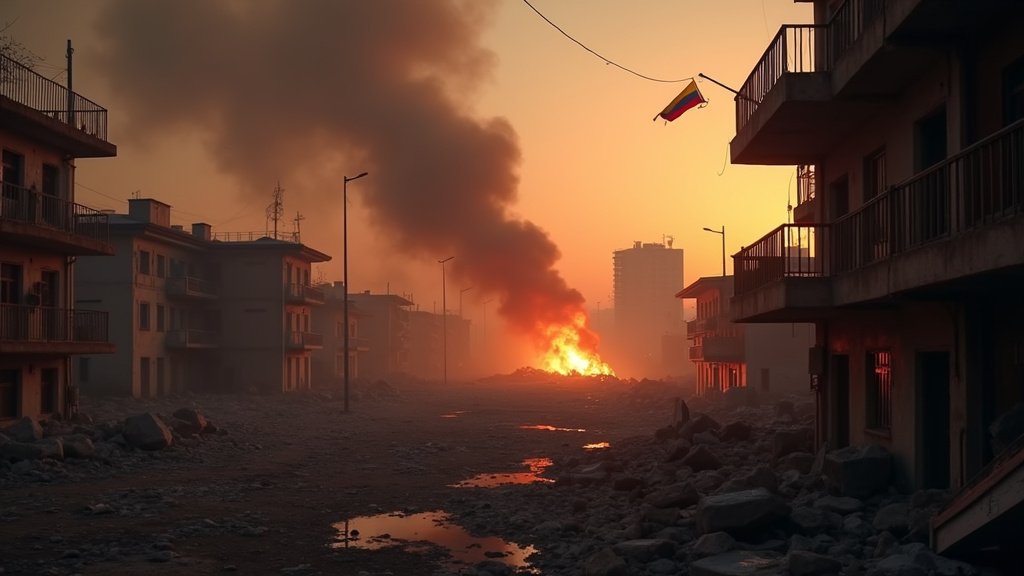
Explosions ripped through Venezuela’s capital. Caracas awoke to chaos early Saturday, January 3, 2026. Multiple blasts shook the city. Fires broke out near key military sites. Videos of the events flooded social media. They showed explosions near La Carlota military airport. Other detonations sounded across the metropolitan area. This happened around 2 AM local time.
Venezuela’s government reacted swiftly. They accused the United States of military aggression. President Nicolás Maduro declared a state of emergency. His government called the actions “extremely grave.” They stated it was a violation of the UN Charter. The United States military was reportedly behind the strikes.
Maduro Captured, US Confirms Strikes
President Donald Trump confirmed US involvement. He announced the capture of President Nicolás Maduro. Trump stated Maduro and his wife were “captured and flown out of the country”. US media outlets cited unnamed officials confirming this. Elite Delta Force troops allegedly carried out the capture. Venezuelan Vice President Delcy Rodriguez confirmed Maduro’s absence. She demanded proof of life from the US government.
Background: A Campaign of Pressure
These events followed months of escalating US pressure. The Trump administration accused Maduro of leading a “narco-terrorist” cartel. This cartel was often referred to as the Cartel de los Soles. The US also claimed Venezuela was flooding its borders with drugs.
The US significantly increased its military presence in the Caribbean. Warships and an aircraft carrier were deployed. The US military conducted numerous strikes on vessels in the Caribbean Sea. These were allegedly drug-smuggling boats. At least 105 people died in these strikes. The US also conducted a land strike on a docking area for drug boats.
Furthermore, the US designated Venezuelan groups as foreign terrorist organizations. This included the Cartel de los Soles and the Tren de Aragua gang. These designations provided justification for increased actions. The US even declared a “non-international armed conflict” against certain drug cartels.
Venezuela Denounces Aggression
Venezuela’s government condemned the US actions vehemently. They called the strikes “military aggression.” The government stated these actions targeted civilian and military locations. Blasts reportedly hit Caracas and the states of Miranda, Aragua, and La Guaira.
Venezuelan officials described the attacks as a violation of international law. They cited the UN Charter’s principles of sovereignty and non-aggression. The government vowed comprehensive defense measures. They accused the US of seeking regime change. The objective, they claimed, was to seize Venezuela’s vast oil and mineral resources.
Global Reactions Pour In
The US military action drew widespread international condemnation. Several nations voiced strong opposition. Cuba and Iran were among the first to react. Cuban President Miguel Díaz-Canel called it a “criminal attack.” He labeled it “state terrorism” against “Our America”. Iran’s Foreign Ministry called the strikes a “flagrant violation” of sovereignty.
Russia also condemned the strikes. Its foreign ministry called them an “act of armed aggression.” They stated the actions had “no substantive basis”. Russia urged de-escalation and adherence to international law. Colombia expressed deep concern. President Gustavo Petro called for an urgent UN meeting. He rejected any unilateral military action. Argentina’s president, however, praised Trump’s claims.
Implications for Regional Stability
This dramatic escalation raises serious questions. The legality of US military actions is debated by experts. Venezuela claims the attacks threaten regional peace and stability. The community of nations watches closely. The future relationship between the US and Venezuela remains uncertain. The long-standing tensions have now reached a critical point. The impact on the local community and beyond is significant. These stories highlight the volatile dynamics in Latin America and the Caribbean.