
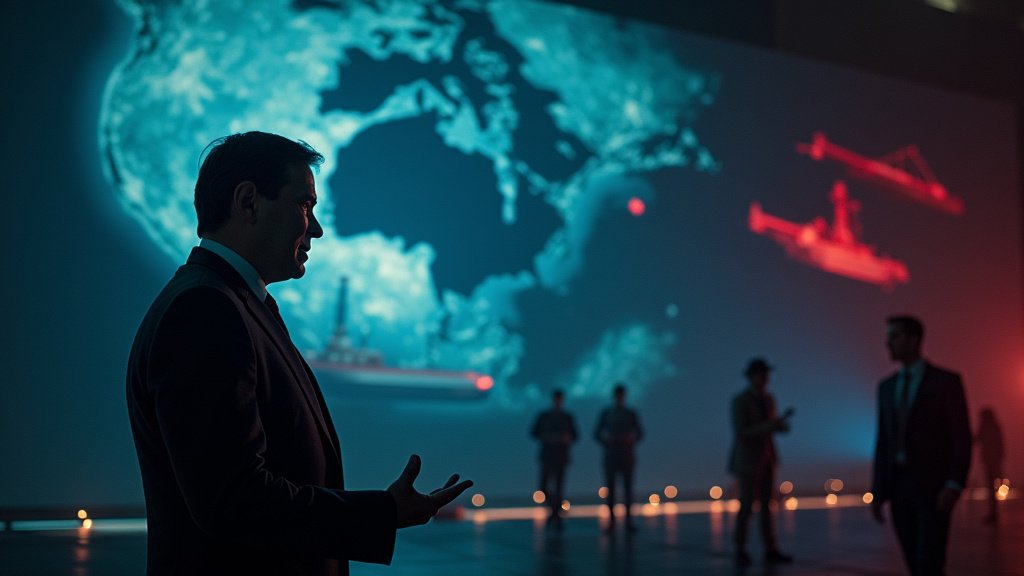
The United States has launched a bold gambit in Latin America. Senator Marco Rubio is at its forefront. This action centers on Venezuela. It signals a major shift in U.S. foreign policy. The goal is to reshape the region’s political landscape.
Maduro’s Capture and U.S. Objectives
On January 3, 2026, U.S. forces captured Venezuelan President Nicolás Maduro. His wife was also taken into custody. They were transported to New York. There, Maduro faces drug charges. This operation followed months of U.S. military actions. These included strikes on alleged drug boats. They also targeted oil tankers in the Caribbean. President Trump stated the U.S. would “run” Venezuela. This would continue until a safe transition occurred. However, Secretary of State Marco Rubio later refined this. He said the U.S. aims to influence policy. It will not administer the country day-to-day.
Rubio’s Strategic Blueprint
Marco Rubio has long advocated a forceful stance on Venezuela. Now serving as Secretary of State, he drives U.S. policy. His strategy employs financial pressure. An “oil quarantine” is a key tool. This aims to squeeze Venezuela’s revenue. Rubio demands Venezuela sever ties with Iran, Hezbollah, and Cuba. He views Venezuela as a lever against Cuba. Rubio also seeks to counter Chinese influence. He supports pro-American leaders in Latin America. His approach is described as a “gambit” for regional change. It has been called the “Putinization of US foreign policy.”
Historical Context and U.S. Leverage
U.S. sanctions on Venezuela began years ago. They intensified under the Trump administration. The current actions echo past U.S. interventions. The 1989 Panama invasion is one example. The U.S. frames this as a crackdown. It targets “narco-traffickers” and “narco-terrorism.” Venezuela’s oil sector is central to its economy. U.S. actions aim to control this vital resource. The U.S. expresses interest in rebuilding Venezuela’s oil industry.
The Cuba Factor and Rising Tensions
Cuba has played a significant role in supporting Maduro’s government. Havana sent security and intelligence personnel to Venezuela. The U.S. operation reportedly killed 32 Cuban citizens. These casualties deepen tensions between Washington and Havana. Rubio accuses Cuba of propping up Maduro. He calls for Venezuela to “declare independence from Cuba.” Cuba condemns the U.S. actions as “state terrorism.” The U.S. has issued warnings to Havana.
Confronting Regional Adversaries
Rubio sees Venezuela as a potential hub for adversaries. This includes Iran, Russia, and China. The U.S. seeks to prevent this. It aims to limit competitors’ investments in Venezuela. Rubio demands Venezuela sever ties with Iran and Hezbollah. He views Iran’s presence as a regional security threat.
Shifting Regional Dynamics
The U.S. military buildup in the Caribbean is substantial. This operation has stirred regional anxieties. U.S. actions raise questions about hegemony. They could be seen as a revival of the Monroe Doctrine. Neighboring countries watch closely. The consequences of this intervention are far-reaching. The political game in the region has high stakes.
The Path Forward
Maduro’s capture leaves Venezuela in uncertainty. The U.S. claims it is running policy, not troops on the ground. Leverage will come from financial control. The “oil blockade” remains in place. Rubio insists the goal is positive results for Venezuela. Most importantly, it serves U.S. national interest. This dramatic geopolitical news unfolds quickly. The region’s future remains in flux.