
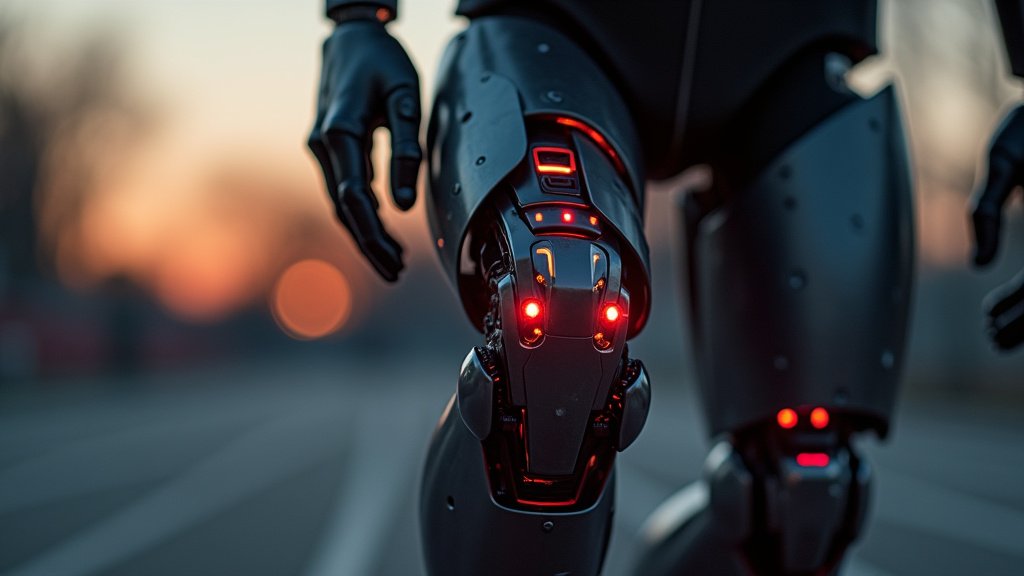
In a feat that underscores the rapid evolution of embodied artificial intelligence, a humanoid robot developed by the Chinese technology firm Honor has stunned the world, completing a half-marathon in Beijing in just 50 minutes and 26 seconds. The performance, which occurred at the Beijing E-Town Half Marathon on Sunday, April 19, 2026, officially smashed the current human half-marathon world record of 57 minutes and 20 seconds, held by Uganda’s Jacob Kiplimo.
This achievement is not merely a novelty; it represents a pivotal shift in the trajectory of robotics. What was once the domain of stiff, laboratory-bound prototypes has transitioned into the realm of high-performance, endurance-capable machines. As these robots navigate complex urban environments, the implications for labor, logistics, and human-robot interaction are being rewritten in real-time.
The Anatomy of the 50-Minute Sprint
The winning machine, dubbed “Lightning,” is a 169cm (5.5ft) tall humanoid weighing approximately 45kg (99lbs). Its design focuses on mimicking elite human biomechanics—a stark departure from the clunky, heavy-legged robots of the early 2020s. Engineers utilized liquid cooling technology, adapted directly from Honor’s smartphone architecture, to manage the intense thermal loads generated by continuous, high-speed joint actuation.
Unlike previous years, where robots required remote piloting for even the most basic navigation, this year’s event introduced a rigorous ‘autonomous navigation’ category. The ‘Lightning’ model operated without human intervention, relying on real-time sensory input from BeiDou Navigation Satellite System-powered badges and onboard computer vision to traverse the 21.0975-kilometer course. This autonomy is the real story; it proves that bipedal machines can now process dynamic environmental obstacles, maintain balance at speed, and adjust their stride mid-race without crashing.
The Beijing Robotics Ecosystem: A Catalyst for Growth
The Beijing E-Town industrial zone has become a crucible for this technological explosion. The event featured over 100 competing teams, a fivefold increase from the inaugural race just one year prior. This surge in participation is not coincidental. It is the result of deep integration between academia, private industry, and state-backed manufacturing initiatives. Companies like Honor, traditionally known for consumer electronics, are pivoting their supply chains to support the booming humanoid sector, bringing mass-production efficiency to the high-stakes world of robotics hardware.
The race also served as a demonstration of a new standardization framework released in March 2026, which outlines requirements for humanoid ‘physical intelligence.’ By forcing robots to compete on the same tracks as human runners, regulators and developers have created a ‘stress test’ environment that yields data far more valuable than anything obtained in a controlled lab.
The Engineering Hurdles of Endurance
While the headline-grabbing speed is impressive, the real victory lies in mechanical reliability. Maintaining a run for 50 minutes is fundamentally different from a 10-second sprint. Each stride subjects the robot’s actuators, gearboxes, and battery management systems to repetitive shock loads.
Solving the Power Density Problem
Energy storage remains the primary bottleneck for humanoid robotics. To finish a half-marathon, a robot must achieve a specific power-to-weight ratio that ensures both speed and endurance. The ‘Lightning’ model’s ability to remain upright and mobile for the duration of the race confirms that recent breakthroughs in battery chemistry—specifically, high-energy-density solid-state cells—are beginning to reach maturity.
Dynamic Balance and Surface Adaptation
Running is a continuous, controlled fall. For a robot to sustain this for 21 kilometers, it must anticipate irregularities in the track surface, potential obstacles, and the fatigue of its own internal components. The successful navigation of this year’s course by multiple autonomous units indicates that sophisticated ‘predictive balance’ algorithms have finally caught up to the hardware, allowing these machines to behave less like rigid machines and more like fluid, biological organisms.
The Future of Embodied AI and Labor
Critics and analysts are now grappling with the ‘so what?’ question. While a robot running a half-marathon is a compelling spectacle, the long-term impact on global labor markets is the true driver of this investment. If a robot can navigate 21 kilometers autonomously, it can navigate a warehouse, a disaster site, or an elderly care facility.
From Track to Task
The engineering agility displayed in Beijing is a precursor to a wider deployment in industrial and service sectors. Humanoid robots are being designed not to replace human runners, but to replace human workers in ‘dull, dirty, and dangerous’ environments. The 2026 Beijing event proves that these machines are rapidly approaching the mobility threshold required to interact safely and effectively in human spaces.
The Competitive Geopolitical Landscape
This race is also a proxy for global technological dominance. As the U.S. (via firms like Tesla and Figure AI) and China compete for the lead in general-purpose robotics, public milestones like the Beijing marathon serve as a powerful signal of intent and capability. China’s ability to mobilize hundreds of teams, standardize their output, and demonstrate rapid iteration suggests a formidable, state-supported push that aims to define the standards for the next generation of industrial automation.
FAQ: People Also Ask
Q: Did the robot beat the human record?
A: Yes. The winning humanoid, ‘Lightning,’ completed the 21km course in 50 minutes and 26 seconds, which is faster than the current human half-marathon world record of 57 minutes and 20 seconds set by Jacob Kiplimo.
Q: Was the robot autonomously controlled?
A: Yes, the winning entry competed in the autonomous category. It used onboard vision, LiDAR, and real-time path planning to navigate the course without remote human intervention.
Q: Why does this matter for everyday technology?
A: The race acts as a high-stress test for battery life, motor durability, and AI navigation. The technological leaps required to sustain this speed are the same ones needed for robots to eventually work in warehouses, homes, and emergency response settings.
Q: Are there risks to having robots run in public spaces?
A: The event included safety protocols, and the robots ran on parallel tracks to human participants. However, the occasional ‘hiccups’—such as robots falling or hitting barriers—highlight the ongoing challenges in ensuring total reliability when these machines eventually operate alongside the general public.