
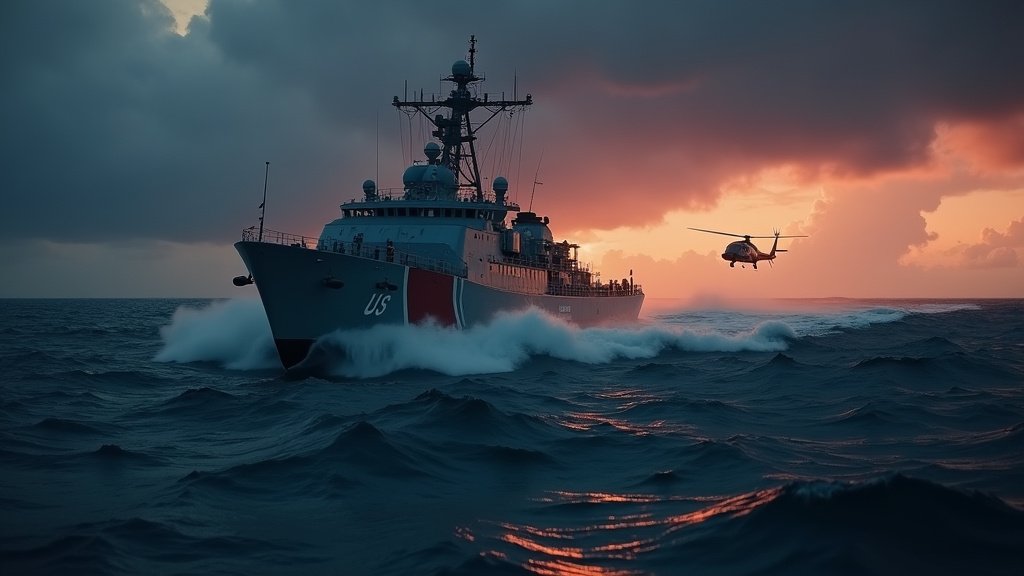
WASHINGTON D.C. – The U.S. Coast Guard continues its persistent anti-trafficking operations in the Caribbean Sea today, a critical mission underscored by an evolving U.S. military posture and a recent, highly debated lethal strike against an alleged drug-smuggling vessel. As the Pentagon redefines the military’s role within U.S. Southern Command (SOUTHCOM), these ongoing interdiction efforts aim to disrupt the flow of illicit narcotics before they reach American shores, operating under a comprehensive, whole-of-government approach to dismantle transnational criminal organizations.
Ongoing Operations in the Caribbean Sea
The U.S. Coast Guard remains a principal force in maritime law enforcement across the Caribbean, deploying multiple cutters to interdict drug trafficking boats. These operations are crucial for national security, aiming to prevent the inundation of the United States with dangerous substances like cocaine and fentanyl. The service’s unique authorities under Title 14 of the U.S. Code empower its crews to conduct law enforcement actions on the high seas. These efforts are part of a broader interagency and international collaboration, with Joint Interagency Task Force–South (JIATF-S) playing a central role in detecting and monitoring drug transit routes. In recent months, substantial drug seizures have been reported, with the Coast Guard interdicting vast quantities of cocaine and marijuana, underscoring the persistent threat.
A Lethal Strike Targets Tren de Aragua
A significant development in this regional battle occurred recently when an unidentified U.S. military aircraft conducted a lethal strike on a vessel suspected of transporting drugs from Venezuela. The operation, which took place in international waters, resulted in the deaths of 11 individuals identified as alleged members of the Tren de Aragua (TdA) gang. President Donald Trump announced the strike via social media, releasing footage of the vessel being destroyed and asserting that the individuals aboard were “narco-terrorists”. He declared that military force was used in self-defense against these cartels, which his administration has classified as terrorists.
The Evolving Military Mandate
Traditionally, military assets have augmented the Coast Guard’s operations by providing support for reconnaissance and law enforcement. However, recent developments indicate a redefinition of this role. The Pentagon is currently refining its mission parameters within SOUTHCOM, a command responsible for U.S. military operations across the Caribbean and South America. The U.S. military has increased its presence, deploying multiple warships and, notably, the USS Gerald R. Ford aircraft carrier strike group to the region. This build-up, coupled with a series of kinetic strikes against suspected drug vessels since September 2025, suggests a more assertive military engagement in counternarcotics efforts. As of mid-November, over 83 individuals have reportedly been killed in approximately 21 such strikes.
Tren de Aragua: A Declared Terrorist Threat
The Tren de Aragua, a transnational criminal organization that originated in Venezuela, has become a significant focus for U.S. counterterrorism efforts. In February, the State Department officially designated TdA as a Foreign Terrorist Organization (FTO) and a Specially Designated Global Terrorist (SDGT). This designation allows U.S. authorities to take legal action against the group’s funding streams and signifies its perceived threat level beyond typical criminal activity. TdA is known for a wide range of illicit activities, including kidnapping, extortion, human trafficking, and violence. The organization has expanded its reach across Latin America and into the United States, reportedly facilitated by mass migration from Venezuela. The administration’s justification for military actions often hinges on these FTO designations, though legal experts and international bodies have raised questions about the application of military force against suspected drug traffickers and the potential for extrajudicial killings.
Regional Ramifications and Legal Questions
The heightened U.S. military activity in the Caribbean has not gone unnoticed. Venezuelan President Nicolás Maduro has condemned the strikes, accusing the U.S. of fabricating a conflict. Venezuela has responded by increasing its military presence along its coast and border. Furthermore, international partners have expressed reservations; reports indicate the United Kingdom has ceased sharing intelligence regarding suspected drug trafficking vessels due to concerns about complicity in potentially unlawful U.S. military actions. The broader implications of this intensified, and at times controversial, approach to drug interdiction are significant. Critics argue that the conflation of drug trafficking with terrorism and the broad interpretation of wartime powers risk undermining international law and humanitarian principles.
As the Coast Guard continues its vital interdiction missions, the strategic landscape of the Caribbean drug war is clearly in flux. The interplay between law enforcement and direct military action, alongside the designation of criminal groups as terrorist entities, presents a complex and evolving challenge for regional security and international relations. The news today highlights the ongoing tension between the urgent need to combat illicit drug flows and the legal and ethical considerations surrounding the use of military force in such operations.