
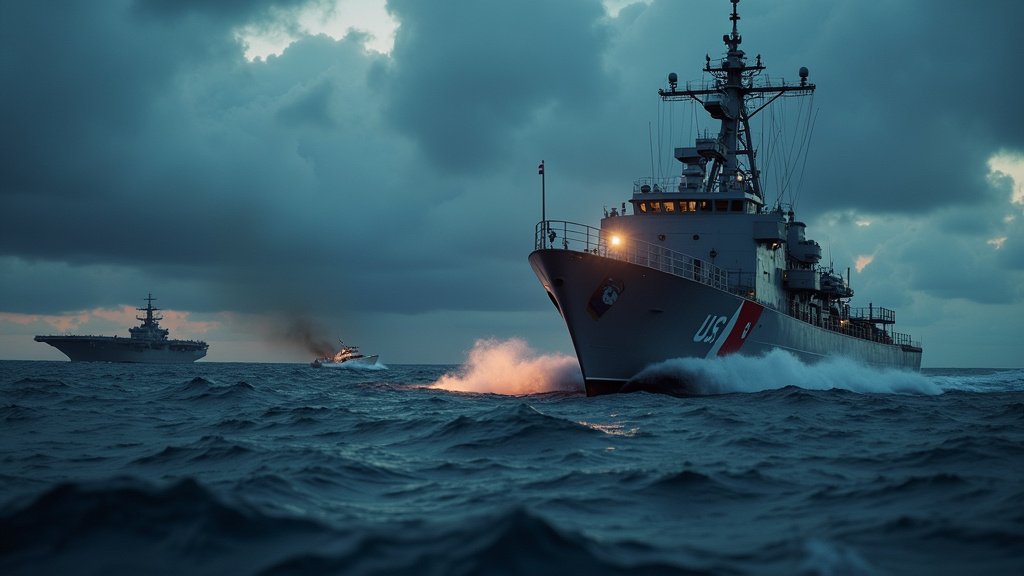
As the U.S. Pentagon redefines its mission and amplifies its military presence in the Caribbean, the U.S. Coast Guard continues its vital law enforcement operations to interdict illicit drug flows before they reach American shores. This evolving security landscape follows a series of unprecedented lethal military strikes against alleged drug trafficking vessels, signaling a significant shift in U.S. military posture in the region.
Coast Guard’s Enduring Law Enforcement Role
The U.S. Coast Guard remains at the forefront of combating transnational criminal organizations in the Caribbean Sea, operating under its unique legal authorities granted by Title 14 of the U.S. Code. Multiple Coast Guard cutters are actively engaged in law enforcement interdictions, a critical component of a whole-of-government approach aimed at dismantling these criminal networks. These operations are distinct from traditional military actions, focusing on the interdiction and seizure of narcotics and the apprehension of smugglers.
In fiscal year 2025, the Coast Guard achieved a historic milestone, seizing nearly 510,000 pounds of cocaine in the Eastern Pacific Ocean and Caribbean, more than three times the annual average. This accomplishment underscores the service’s persistent efforts to secure U.S. borders and maritime approaches against the influx of dangerous drugs that fuel addiction and violence domestically.
Military’s Escalated Offensive and Redefined Mission
In parallel with the Coast Guard’s ongoing work, the U.S. military has significantly intensified its operations in the U.S. Southern Command (SOUTHCOM) area of responsibility. This escalation includes a substantial naval buildup, featuring the arrival of the USS Gerald R. Ford carrier strike group, which joins several other U.S. warships in the region. These forces are tasked with disrupting narcotics trafficking and degrading transnational criminal organizations.
This heightened military engagement follows a lethal strike on September 1st or 2nd, 2025, where an unidentified U.S. military aircraft targeted a vessel suspected of transporting drugs from Venezuela. The strike reportedly killed 11 alleged members of the Tren de Aragua gang, a group designated as a Foreign Terrorist Organization by the State Department. This event marks a dramatic shift, moving beyond traditional military support for Coast Guard interdictions to direct, offensive actions.
Trump Administration’s Assertive Stance and Legal Framework
President Donald Trump has characterized drug cartels as terrorists and has declared the United States to be in an “armed conflict” with them, labeling their members as “unlawful combatants”. This assertion provides a legal framework for the military’s increasingly aggressive actions, including airstrikes on vessels in international waters. The administration has conducted numerous strikes since September, targeting alleged drug-smuggling boats in both the Caribbean and the Pacific, resulting in significant casualties, though details and evidence linking the targeted vessels to drug trafficking or direct threats to the U.S. have not always been publicly detailed.
The administration’s strategy, termed “Operation Southern Spear,” aims to remove “narco-terrorist” groups from the Western Hemisphere and combat the flow of illegal drugs, framing these operations as self-defense against national security threats.
Questions of Legality and Regional Impact
The increased military activity and the nature of the strikes have raised questions regarding their legality and adherence to international law, with some experts and U.N. human rights officials warning of potential extrajudicial killings. Regional reactions have been mixed; Venezuela views the military buildup as a threat, while Colombia has suspended intelligence sharing with the U.S. due to the ongoing strikes.
The combined efforts of the Coast Guard’s law enforcement missions and the military’s redefined combat role underscore a robust, albeit controversial, U.S. strategy to combat drug trafficking. As these operations continue, the focus remains on dismantling criminal enterprises, but the evolving nature of military engagement in the Caribbean is shaping regional dynamics and sparking ongoing debate.
This complex operational environment highlights the intricate interplay between law enforcement and military action in addressing the persistent challenge of drug trafficking across the Caribbean.