
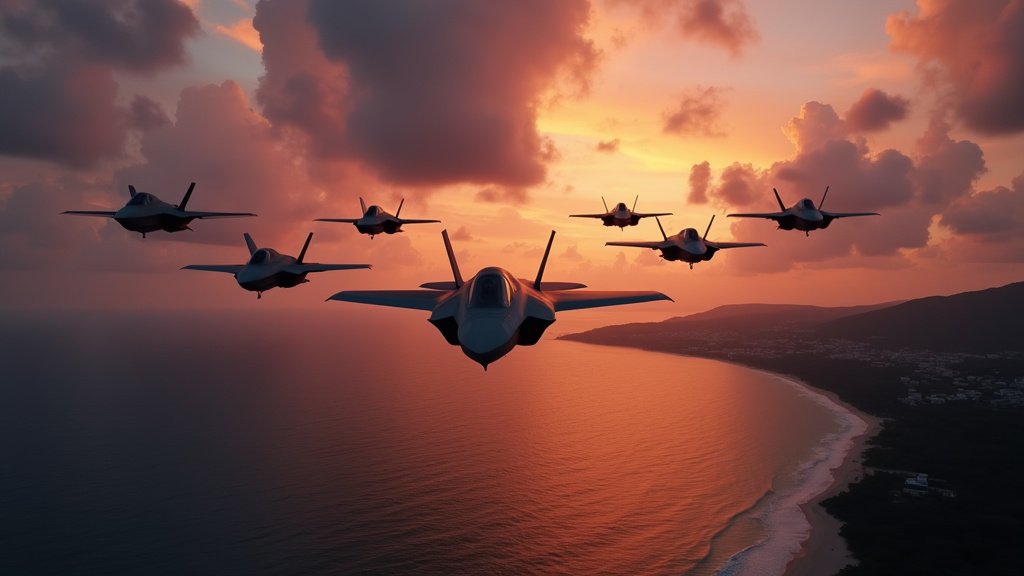
The United States has significantly bolstered its military presence in the Caribbean with the deployment of ten F-35 stealth fighter jets to Puerto Rico, a move that sharpens escalating tensions with Venezuela and underscores an intensified U.S. campaign against drug cartels. This strategic repositioning marks one of the largest American military buildups in the region in decades, signaling a complex interplay of counter-narcotics operations, geopolitical pressure, and regional security concerns.
A New Era of Aerial Power in the Caribbean
The arrival of the advanced F-35 Lightning II aircraft at a reactivated Cold War-era naval base in Puerto Rico signifies a potent upgrade in U.S. capabilities in the hemisphere. These fifth-generation fighter jets, renowned for their stealth, advanced sensors, and electronic warfare capabilities, are designed for high-intensity conflicts. Their deployment to Puerto Rico, situated approximately 500 miles from Venezuela’s coast, enables enhanced intelligence, surveillance, and reconnaissance (ISR) operations, as well as rapid response and strike potential. While the F-35s are primarily framed as assets for combating drug cartels, their presence also sends a clear message of U.S. military resolve and power projection across the region.
Escalating Confrontations and Counter-Narcotics Operations
The F-35 deployment follows a series of direct confrontations and U.S. military actions targeting alleged drug smuggling operations. In recent months, U.S. forces have conducted numerous airstrikes on vessels suspected of transporting narcotics from Venezuela and other Latin American countries. These strikes, part of what the administration terms an expanded ‘war on drugs’ and operation ‘Southern Spear,’ have resulted in significant casualties, though the U.S. has not publicly provided extensive evidence to substantiate its claims of drug trafficking and narco-terrorism.
Notably, a U.S. strike on a boat off Venezuela’s coast resulted in eleven fatalities, which the Trump administration attributed to members of the Tren de Aragua, a Venezuelan criminal organization linked to President Nicolás Maduro. This incident, along with a provocative flyover of a U.S. Navy destroyer by Venezuelan fighter jets, has fueled the escalating tensions between the two nations. The U.S. has also indicted Maduro and other Venezuelan officials on charges of narco-terrorism and designated Venezuela’s ‘Cartel de los Soles’ as a foreign terrorist organization, intensifying diplomatic and economic pressure.
Venezuela’s Response and Regional Apprehensions
Caracas has responded with a robust military posture, declaring a state of “maximum preparedness” and initiating large-scale military mobilizations involving hundreds of thousands of troops and civilian militias. Venezuelan President Nicolás Maduro has characterized the U.S. military buildup as an “imperial threat” and a hostile provocation aimed at undermining his government’s sovereignty. The deployment of the USS Gerald R. Ford carrier strike group, the world’s most advanced aircraft carrier, further amplifies the U.S. presence and has led to widespread concerns about potential miscalculation and escalation.
The increased U.S. military activity has also raised apprehensions among other Caribbean nations, which fear the potential for regional instability and a return to cross-border operations without sovereign consent. While the U.S. states its operations are focused on combating illicit actors and regional instability, many analysts and regional governments perceive the buildup as part of a broader strategy to exert pressure on Maduro’s regime and potentially engineer regime change.
Strategic Rationale and Lingering Questions
The decision to employ F-35s, highly sophisticated and expensive platforms designed for peer-state warfare, for counter-narcotics missions has sparked debate among military experts. Some question the cost-effectiveness, suggesting that less advanced and more affordable assets like drones might suffice for intercepting drug smugglers who typically lack sophisticated air defenses. However, proponents argue that the F-35’s advanced ISR capabilities provide an unparalleled strategic advantage in complex environments, acting as both a deterrent and an intelligence-gathering asset.
The broader implications of this escalated U.S. military posture in the Caribbean are significant. The deployment provides the U.S. administration with a range of options, from maritime interdiction to potential strikes, while simultaneously provoking a strong defensive reaction from Venezuela. The situation remains highly fluid, with ongoing news and developments shaping the geopolitical landscape of the Caribbean and its complex relationship with regional powers.