
The United States has significantly escalated its military operations in the Caribbean Sea and Eastern Pacific, launching a series of deadly strikes against suspected drug-trafficking vessels under the banner of “Operation Southern Spear.” This aggressive new campaign, formally unveiled in November 2025, has resulted in numerous fatalities and intensified diplomatic friction, particularly with Venezuela. The operation marks a departure from traditional maritime interdiction strategies, employing a more forceful approach that has drawn both praise for its perceived effectiveness against drug cartels and criticism over its legality and human cost.
Operation Southern Spear: A New Era of Maritime Enforcement
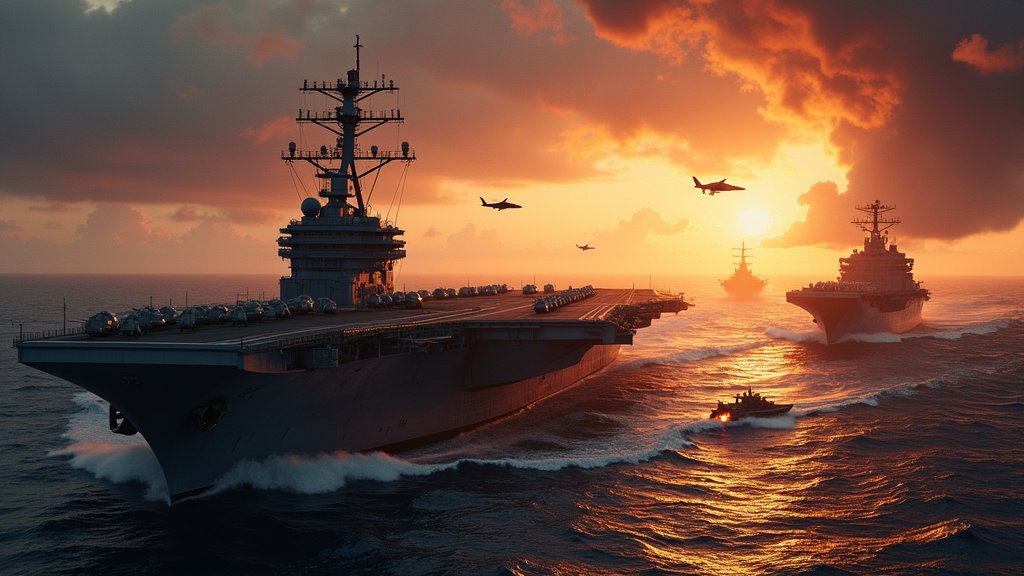
Officially announced by Secretary of Defense Pete Hegseth on November 13, 2025, Operation Southern Spear is characterized by the deployment of a formidable US military presence in the Western Hemisphere. The operation’s stated objective is to “defend our Homeland, remove narco-terrorists from our Hemisphere, and secure our homeland from the drugs that are killing our people,” according to Hegseth. This initiative is coordinated by U.S. Southern Command (SOUTHCOM) and involves a joint task force leveraging advanced technologies, including robotic and autonomous systems. The cornerstone of this deployment is the arrival of the USS Gerald R. Ford, the US Navy’s most advanced aircraft carrier, along with its strike group, which entered the Caribbean in mid-November 2025. This buildup represents the largest US military concentration in the region in decades, featuring nearly a dozen warships and approximately 12,000 personnel, including thousands of Marines.
A Grim Toll: The Wave of Deadly Strikes
The sharp edge of Operation Southern Spear has been the series of airstrikes and naval actions against vessels accused of smuggling illicit drugs. The campaign began on September 2, 2025, with the strike and sinking of a speedboat allegedly carrying drugs from Venezuela, resulting in 11 deaths. Since then, these kinetic actions have increased in frequency, expanding from the Caribbean to the Eastern Pacific. As of mid-November 2025, US forces have conducted approximately 21 strikes on 22 vessels, resulting in at least 83 reported deaths. These strikes have targeted groups allegedly affiliated with organizations such as the Venezuelan criminal organization Tren de Aragua and the Colombian guerilla group National Liberation Army. While US officials have characterized the deceased as “narco-terrorists,” credible news reports and witness accounts from affected regions suggest that many killed were laborers or fishermen making a living on the sea.
Heightened Tensions with Venezuela
The US military actions are inextricably linked to the ongoing political and economic crisis in Venezuela and the broader geopolitical tensions between Washington and Caracas. The Trump administration has repeatedly accused Venezuelan President Nicolás Maduro and his regime of being complicit in drug trafficking, labeling Venezuela a “narco-state.” These accusations have fueled a significant increase in US military readiness and deployment near Venezuela’s coast, with Trinidad and Tobago, a nation just seven miles from Venezuela’s shore, hosting joint US military exercises. Venezuela has vehemently condemned the US strikes, with its foreign minister stating that the attacks violate fundamental principles of international law and constitute an assault on the nation’s sovereignty. Caracas has responded with its own military mobilizations, framing the US actions as a prelude to further intervention or regime change.
Controversy and Questions of Legality
Operation Southern Spear has not been without significant controversy, both domestically and internationally. Critics, including foreign leaders, human rights organizations, and some US lawmakers, have raised serious concerns about the legality and justification for these lethal strikes. Reports indicate that the US administration has not consistently provided evidence to substantiate claims that targeted vessels were actively involved in drug trafficking. The decision to employ deadly force without clear congressional authorization and standard procedures like hailing or warning shots has led to accusations of extrajudicial killings and a violation of international law. Furthermore, questions persist about Venezuela’s actual role as a major drug source for the US, with some reports suggesting that traditional interdiction methods, which have historically yielded significant drug seizures and intelligence, might be more effective and legally sound.
Broader Regional Implications
Beyond counter-narcotics efforts, the sheer scale of the US military buildup and the aggressive posture have led analysts and regional governments to question the administration’s ultimate objectives. Some interpret these actions as a resurgence of the “Monroe Doctrine,” aiming to reassert US dominance in its traditional “backyard” and potentially pave the way for regime change in Venezuela. The deployment of advanced carrier strike groups and thousands of troops near Venezuelan territory has heightened fears of regional destabilization. While some nations in the Caribbean support US efforts to combat transnational threats, many are alarmed by the potential for escalation and the disregard for sovereign rights, drawing parallels to past US interventions in Latin America. This new wave of US military activity in the region presents a complex news landscape, balancing the declared fight against drugs with deep-seated geopolitical rivalries and concerns for international law and regional stability.