
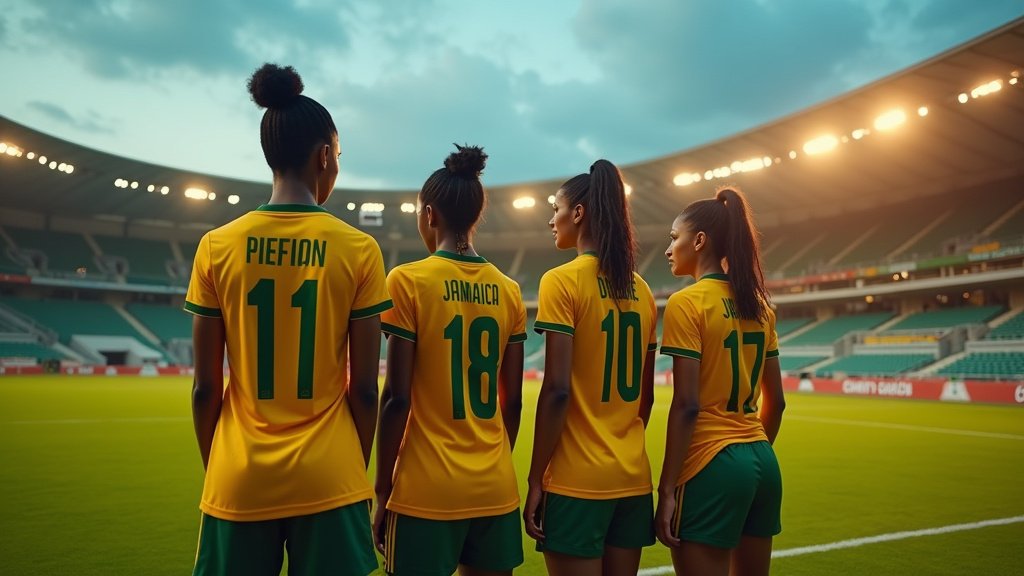
Jamaica has officially entered the international spotlight, joining forces with the United States, Mexico, and Costa Rica in a historic joint bid to host the 2031 FIFA Women’s World Cup. This ambitious proposal, formally launched in New York City, signals a transformative moment for women’s football, aiming to create the most impactful tournament in the competition’s history by fostering inspiration, empowering women and girls through sport, and leaving a lasting global legacy. The announcement marks a significant step in the campaign to bring the world’s premier women’s football event to North America, Central America, and the Caribbean.
A Continental Vision: The Four-Nation Alliance
The joint bid represents an unprecedented collaboration among four CONCACAF nations, stretching across a diverse geographical and cultural landscape. This alliance is designed to deliver a truly continental celebration of women’s football, uniting nations under the banner of the “One CONCACAF” philosophy. For the United States, this would mark its third time hosting the Women’s World Cup, building on its successful staging of the tournament in 1999 and 2003. Mexico and Costa Rica would host the senior Women’s World Cup for the first time, while Jamaica stands to make history as the first Caribbean nation to host a FIFA World Cup match. The formal launch of this cooperative effort underscores the growing strength and unity within the region’s football confederation.
Goals of Impact: Empowering Through Sport
The core vision of the “For Now. For Next.” bid centers on creating a tournament that extends far beyond the final whistle. Organizers have pledged to deliver an event that inspires future generations of athletes and fans, with a strong emphasis on empowering women and girls through the power of sport. This includes a groundbreaking commitment to reinvest tournament proceeds into the global development of women’s football, focusing on youth programs, coaching education, and infrastructure growth across member associations. U.S. Soccer President Cindy Parlow Cone highlighted the opportunity to “set a new global standard” for how sport supports female athletes, aiming to foster lasting progress and equality.
Jamaica’s Historic Opportunity
For Jamaica, being part of this monumental bid is a source of immense national pride and a testament to the growth of its women’s football program. Jamaica Football Federation President Michael Ricketts described the opportunity as “absolutely tremendous,” stating that hosting World Cup matches would be “huge for Jamaica and for every person who proudly calls themselves Jamaican”. The Reggae Girlz have made significant strides, improving their FIFA ranking from 119th to the 40s and qualifying consecutively for the 2019 and 2023 FIFA Women’s World Cups, even reaching the Round of 16 in the latter. The potential hosting role aligns with infrastructure development plans, including the redevelopment of the National Stadium in Kingston, projected for completion in 2029. This would position Jamaica as the smallest nation to ever host matches in such a global spectacle, making it the most significant international sporting event in Caribbean history.
The Road to 2031: FIFA’s Bidding Process
The journey to the 2031 FIFA Women’s World Cup involves a structured bidding process managed by FIFA. The FIFA Council approved the bid regulations in March 2025, restricting bids to CONCACAF and CAF members. Expressions of interest were to be submitted by March 31, 2025, with formal bid submissions due in Q4 2025. FIFA will conduct on-site inspection visits in February 2026, and the official announcement of the host(s) is scheduled for the 76th FIFA Congress in Vancouver on April 30, 2026. The current North American, Central American, and Caribbean bid is uncontested, suggesting a strong likelihood of its ratification, though FIFA’s thorough evaluation process remains.
Elevating Women’s Football: Global Implications
The 2031 tournament is set to be the largest in Women’s World Cup history, expanding to 48 teams and featuring 104 matches, mirroring the men’s tournament format. This expansion is expected to significantly boost revenue, with FIFA targeting $1 billion for the tournament, with a portion reinvested into the women’s game. The success of the 2023 Women’s World Cup, which generated over $570 million and attracted a global audience of 2 billion, underscores the exponential growth of women’s football. This bid, if successful, aims to capitalize on this momentum, further enhancing the sport’s profile, driving economic benefits, and creating lasting infrastructure and development opportunities across the region and globally. The involvement of multiple nations also increases accessibility, allowing more fans and players across different countries to experience the pinnacle of women’s football.
A Legacy for the Future
The joint bid by the United States, Mexico, Costa Rica, and Jamaica is more than just a proposal for a sporting event; it is a vision for the future of women’s football. It represents a commitment to equality, empowerment, and sustainable growth, aiming to inspire a new era of participation and investment in the sport. As the bidding process moves forward, the prospect of the world’s biggest women’s sporting event unfolding across North America, Central America, and the Caribbean offers a beacon of hope and a promise of an unforgettable tournament, a landmark moment in sports news and development for the region.