
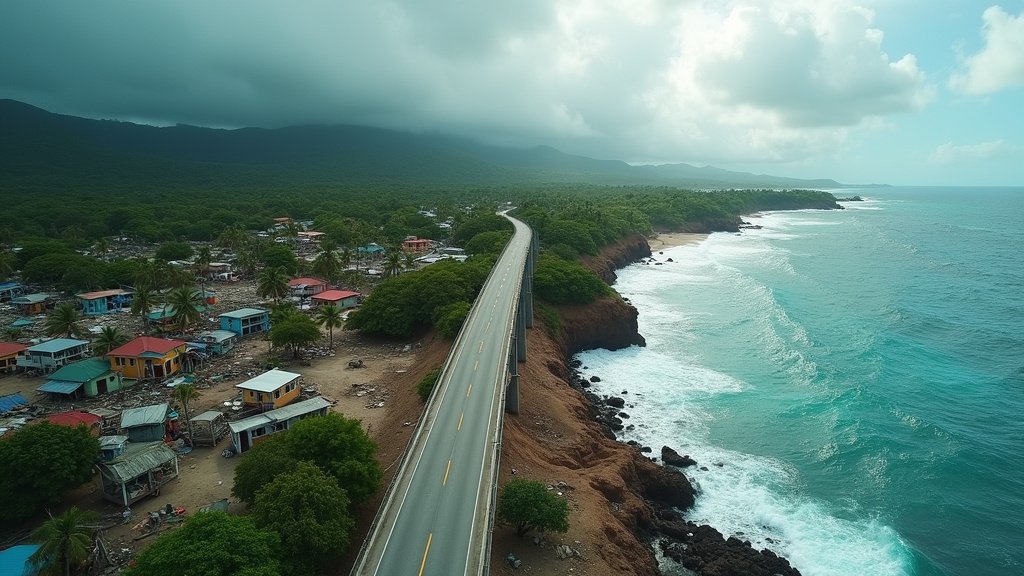
The catastrophic force of Hurricane Melissa, which tore through the Caribbean in late October 2025, has amplified a long-standing and increasingly urgent call from regional leaders and development experts: the necessity of building climate-resilient infrastructure. The Category 5 storm, one of the most powerful Atlantic hurricanes on record, inflicted widespread devastation, leaving a trail of destruction that underscored the profound vulnerability of small island developing states (SIDS) to a changing climate.
The Fury of Hurricane Melissa
Hurricane Melissa made landfall in Jamaica on October 28, 2025, as a monstrous Category 5 storm, unleashing winds of up to 185 mph (295 km/h) and torrential rains. It then crossed into eastern Cuba as a major Category 3 hurricane. The storm’s impact was felt across multiple nations, including Haiti, affecting an estimated 5 million people and claiming at least 96 lives across the region. The human toll was immense, but the damage to infrastructure was equally staggering. In Jamaica alone, damages were estimated to be close to US$10 billion, representing roughly a third of the nation’s GDP. Over 4.8 million tons of debris were left in western Jamaica, blocking vital access routes and hindering recovery efforts.
Hundreds of healthcare facilities were severely damaged, with reports indicating 642 health facilities compromised in Cuba, 54 in Jamaica, and 10 in Haiti. Roads were rendered impassable by debris and landslides, cutting off communities and severely hampering the delivery of essential aid and services. This devastating event highlighted a critical reality for the Caribbean: many islands were still in various stages of recovery from previous storms, such as Hurricane Beryl in Jamaica and Hurricane Oscar in Cuba, creating a compounding disaster trap where communities could not fully rebuild before being hit by another catastrophe.
Caribbean Vulnerability: A Compounding Crisis
Small Island Developing States (SIDS) in the Caribbean are inherently more vulnerable to the impacts of climate change due to a confluence of factors. Their geographical location within “hurricane alley,” combined with narrow coastal plains where most infrastructure and populations are concentrated, makes them prime targets for extreme weather events. Furthermore, many SIDS grapple with limited economic bases, a reliance on natural resources, and constrained financial and institutional capacities to adapt. The news from Melissa tragically illustrates how climate change is not a future threat but a present danger, exacerbating existing vulnerabilities, impacting livelihoods intrinsically tied to the region’s unique culture and natural heritage, and threatening the very fabric of island life.
The Call for Climate-Ready Infrastructure
In the wake of Hurricane Melissa’s destruction, the imperative to invest in climate-resilient infrastructure has never been clearer. The Caribbean Development Bank (CDB) has been at the forefront of this advocacy. At the inaugural Caribbean Sustainable Infrastructure Conference (CSIC 2025), held from November 3-5, 2025, in Bridgetown, Barbados, leaders, development partners, and experts convened to chart a new course for the region’s built environment. Co-hosted by the CDB in partnership with the UK’s Foreign, Commonwealth and Development Office (FCDO) and France’s Agence française de développement (AFD), the conference underscored that resilient infrastructure is the bedrock for economic competitiveness, social inclusion, and environmental stewardship.
Discussions at CSIC 2025 focused on tackling climate risks through measures like climate-resilient ports, housing, nature-based coastal defenses, and inclusive urban design. The aim is to transition the Caribbean from a state of vulnerability to one of vitality, creating infrastructure that not only safeguards communities but also fuels opportunity and innovation.
Navigating the Financial and Political Landscape
The path to climate-proofing infrastructure is fraught with financial challenges. Many Caribbean nations already face significant debt burdens, and the cost of adapting infrastructure to withstand increasingly severe weather events is substantial. Dr. Isaac Solomon, Vice President of Operations at the CDB, has consistently highlighted the need for accessible, adequate, and high-quality climate finance. The uncertainty surrounding funding from major international institutions, as noted by delegates at the conference, poses a significant hurdle.
International partnerships are crucial. The UK, through its Caribbean Infrastructure Fund (UKCIF), has committed significant resources, providing grants for critical infrastructure like bridges, renewable energy projects, ports, water systems, and sea defenses. Collaborations between entities like the CDB, FCDO, and AFD are vital for pooling resources, sharing expertise, and developing innovative financing mechanisms, such as those explored at CSIC 2025, to meet the region’s urgent needs.
A Resilient Future for the Caribbean
Hurricane Melissa serves as a stark reminder that the Caribbean’s future depends on its ability to adapt and build resilience. The devastation has spurred renewed dialogue and action, emphasizing that investing in robust, climate-ready infrastructure is not merely an option but a fundamental necessity for survival and sustained development. The path forward requires a concerted, collaborative effort—combining regional resolve with unwavering international support—to ensure that the Caribbean can not only recover from such devastating events but also proactively build a future that can withstand the escalating challenges of a changing climate.