
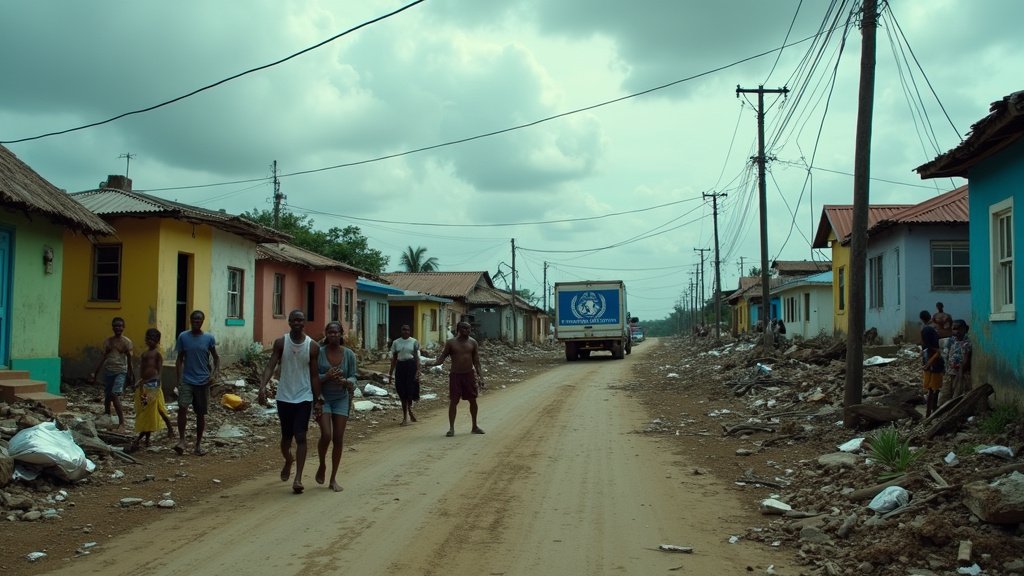
The Caribbean is grappling with the widespread and catastrophic aftermath of Hurricane Melissa, a powerful Category 5 storm that has left a trail of destruction across multiple nations. As of early November 2025, recovery efforts are in full swing, focusing on humanitarian aid, infrastructure repair, and long-term rebuilding, but the scale of the devastation presents immense challenges for the region.
Hurricane Melissa’s Path and Initial Impact
Formed on October 21, 2025, Hurricane Melissa rapidly intensified into one of the strongest Atlantic storms on record. It made landfall in Jamaica on October 28, 2025, as a Category 5 hurricane with sustained winds of 185 mph, marking the first time a storm of such magnitude directly hit the island nation. The hurricane’s immense power, described as being “at the very edge of what is physically possible,” registered on seismographs miles away and caused catastrophic damage with its torrential rains, destructive winds, and life-threatening storm surges. Following its impact on Jamaica, Melissa weakened but continued its destructive path, striking eastern Cuba as a Category 3 hurricane and affecting other neighboring countries, including Haiti, the Dominican Republic, and The Bahamas.
Devastation Across Key Nations
Jamaica bore the brunt of Hurricane Melissa’s fury. The storm caused an estimated US$8.8 billion in physical damage, equivalent to approximately 41% of the country’s 2024 GDP, making it the costliest natural disaster in Jamaica’s recorded history. Over 156,000 dwellings were affected, with 24,000 total losses, and catastrophic damage to residential buildings, infrastructure, non-residential buildings, and the agriculture sector. Entire communities in western parishes were left cut off due to destroyed roads and bridges, with up to 90% of roofs ripped off homes and buildings in some areas. At least 45 deaths were confirmed in Jamaica, with 15 others missing, and approximately 600,000 people affected by the storm.
Cuba experienced widespread flooding, power outages, and significant damage, particularly in its eastern coast. The storm’s passage resulted in over 700,000 people evacuating their homes, and 53,000 people remained displaced weeks later. Hundreds of healthcare facilities were damaged, with 642 affected in Cuba alone, raising concerns about waterborne and vector-borne diseases.
Haiti also suffered severe impacts, with at least 43 confirmed deaths, including 10 children. Homes and infrastructure along the southern coast were washed away, and heavy flooding affected millions. Nearly 1,800 people remained in shelters, and humanitarian partners scaled up assistance amid ongoing insecurity driving new displacements.
Across the Caribbean region, it is estimated that over 5 million people were impacted, with nearly 6 million affected in total across Jamaica, Cuba, and Haiti alone.
Humanitarian Crisis and Infrastructure Collapse
Hurricane Melissa triggered a massive humanitarian crisis, leaving millions displaced and communities isolated. Access to many areas remained severely constrained by debris, landslides, and damaged roads. Critical infrastructure, including hundreds of healthcare facilities—hospitals, primary healthcare centers, and pharmacies—suffered extensive damage across the region. In Cuba, 642 health facilities were damaged, 54 in Jamaica, and 10 in Haiti, severely affecting access to essential health services. Schools also faced significant disruptions, with nearly 477,000 children experiencing schooling interruptions due to damaged or closed facilities.
International Response and Aid Efforts
An extensive regional and international response has been mobilized to assist the affected nations. The Caribbean Disaster Emergency Management Agency (CDEMA) has been central to coordinating relief efforts. The United Nations, through agencies like the World Food Programme (WFP), the UN Children’s Fund (UNICEF), the UN Development Programme (UNDP), and the UN Office for the Coordination of Humanitarian Affairs (OCHA), is providing vital support.
These efforts include providing food, water, shelter, medical assistance, and hygiene kits. The WFP has been coordinating sea-lift operations and airlifts of supplies, aiming to assist up to 1.1 million people across impacted countries. UNICEF is working on rehabilitating schools and providing learning materials, while PAHO is reinforcing health emergency operations. The United States has pledged significant financial aid, including an additional US$10 million for Jamaica and US$2.5 million for Haiti, contributing to a total of nearly US$37 million. Other international organizations, such as CARE, Catholic Relief Services, DirectRelief, Project HOPE, and World Vision, are also providing essential relief and long-term recovery support.
The Road Ahead: Rebuilding and Resilience
The recovery process is expected to be long and arduous. Economic losses are substantial, with Jamaica facing potential losses exceeding US$20 billion according to some estimates, far surpassing initial government figures. The news today highlights a growing recognition that the Caribbean must invest in more sustainable solutions and climate-resilient rebuilding strategies to withstand increasingly violent and unpredictable weather events.
Prime Minister Andrew Holness of Jamaica has emphasized the government’s commitment to fiscal discipline and transparency in the rebuilding process, ensuring that every dollar spent is accounted for with tangible results. The World Bank and the Inter-American Development Bank are collaborating with the Jamaican government to inform reconstruction efforts through detailed damage assessments, emphasizing the need for resilient infrastructure and inclusive recovery. The devastation wrought by Hurricane Melissa serves as a stark reminder of the escalating impacts of climate change on vulnerable island nations, underscoring the urgent need for global solidarity and action.