
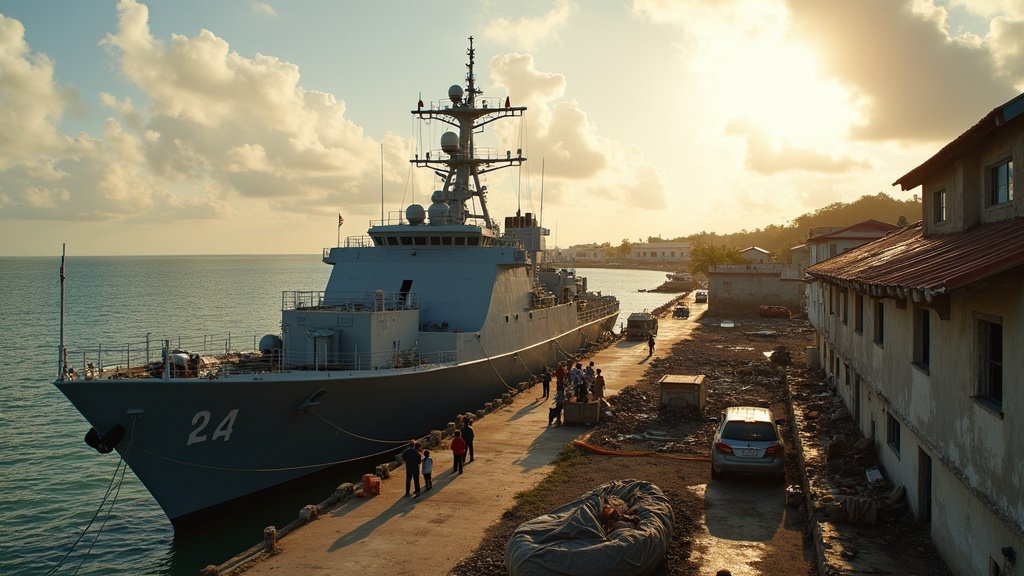
The Royal Navy patrol ship HMS Trent has concluded a vital six-day operation in Jamaica, delivering essential repairs and humanitarian aid in the wake of the catastrophic Hurricane Melissa. The vessel’s deployment underscored the United Kingdom’s commitment to its Commonwealth partners in the Caribbean following the devastating storm that left a trail of destruction across the island nation.
Hurricane Melissa’s Unprecedented Fury
Earlier this year, Hurricane Melissa, a formidable Category 5 storm, made landfall in Jamaica with sustained winds reaching up to 185 miles per hour. Described by many as the “storm of the century,” Melissa unleashed widespread devastation, causing significant loss of life, displacing tens of thousands of households, and inflicting an economic blow estimated to be between $6 and $7 billion USD, potentially reaching up to $20 billion. The storm’s ferocity ripped off roofs, destroyed homes, and severely damaged critical infrastructure, including hospitals and schools, leaving communities reeling from unprecedented destruction. In the hardest-hit parishes of St. Elizabeth and Westmoreland, the impact was particularly severe, with reports indicating that 80-90% of roofs in some districts were torn away by the hurricane’s violent winds and subsequent flooding.
HMS Trent Arrives with Specialist Support
Responding swiftly to the crisis, HMS Trent, an Offshore Patrol Vessel based in the Caribbean as part of the Royal Navy’s Atlantic Patrol Tasking, sailed to the storm-damaged port of Falmouth. Carrying a 75-strong crew, including a highly specialized 76-member Crisis Response Troop from the 24 Commando Royal Engineers, the ship was equipped to provide immediate technical expertise and hands-on assistance. The deployment was a direct response to a request from the Jamaican government, highlighting the strong bilateral relationship and ongoing cooperation between the UK and Jamaica.
Rebuilding Critical Infrastructure
The primary focus of HMS Trent’s mission was the restoration of vital public services, with particular attention paid to Falmouth Hospital and Falmouth All Age School. Engineers from the Crisis Response Troop worked tirelessly to replace seven roofs that had been completely destroyed by the hurricane. They rebuilt the structural skeletons of these buildings, temporarily covering them with specialized tarpaulins to protect them from the elements while more permanent repairs could be effected. Marine engineers from HMS Trent collaborated closely with local authorities and Jamaican engineers to restore the hospital’s water supply, repairing essential systems like boilers, laundry driers, and air conditioning units. Sailors also played a crucial role in clearing rubble and cleaning hospital wards, making the facility more habitable and preparing it for potential use as a forward operating base or even a field hospital. The children’s ward and post-surgery areas were cleared, and the hospital kitchen was cleaned, moving it closer to resuming food preparation.
A Wider UK Commitment
HMS Trent’s mission was part of a broader UK government effort to support Jamaica’s recovery. This included the announcement of £7.5 million in emergency funding, alongside substantial deliveries of over 3,000 shelter kits and more than 1,500 solar-powered lanterns, aimed at assisting those whose homes were damaged or had lost power. A specialist Foreign, Commonwealth & Development Office (FCDO) Rapid Deployment Team was also dispatched to provide consular assistance to any British nationals affected by the disaster. This comprehensive aid package reflects the UK’s dedication to supporting its Commonwealth partners during times of crisis, reinforcing the ties that bind the Caribbean nations to the United Kingdom.
Collaborative Recovery Efforts
The recovery operation in Jamaica was a testament to multi-agency collaboration. Alongside the Royal Navy and UK government teams, the mission involved the Jamaican Defence Force, UK Aid, international organizations such as UNICEF and the World Health Organisation, the Spanish Agency for International Development Cooperation, and an El Salvadorian mixed military-civilian engineering detachment. This coordinated approach ensured that resources were effectively deployed and that diverse expertise was leveraged to address the complex challenges posed by the hurricane. The efforts of local hospital and school staff, who worked alongside the visiting teams, were instrumental in the progress made.
Resilience and the Path Forward
Leading Engineering Technician Naomi Pearmine, serving aboard HMS Trent, shared her perspective: “We’ve been working with some of the local engineers, working on the hospital’s boilers to get them back up and running, ultimately getting doctors and nurses in the best position to help the local community. Anything we can do to make their lives easier is worth doing.” Sub-Lieutenant Robin Blyth, deployed with the Crisis Response Troop, added, “When we stepped ashore, we were heartbroken to see the damage that Melissa has caused. However, we were equally inspired by the resilience shown by everyone we met.” While the Royal Navy’s intervention provided immediate relief and crucial repairs, the path to full recovery for Jamaica is long and arduous. The hurricane’s impact has significantly disrupted the lifestyle of many, affecting not only homes and infrastructure but also livelihoods and the island’s vital tourism sector, which accounts for a substantial portion of its GDP.
The successful completion of HMS Trent’s mission marks a significant step in Jamaica’s recovery journey. It highlights the Royal Navy’s crucial role in disaster response and its unwavering commitment to the Caribbean region, providing a beacon of hope and tangible assistance in the aftermath of devastating natural events. This news serves as a reminder of the importance of international cooperation and preparedness in facing the increasing challenges posed by extreme weather.