
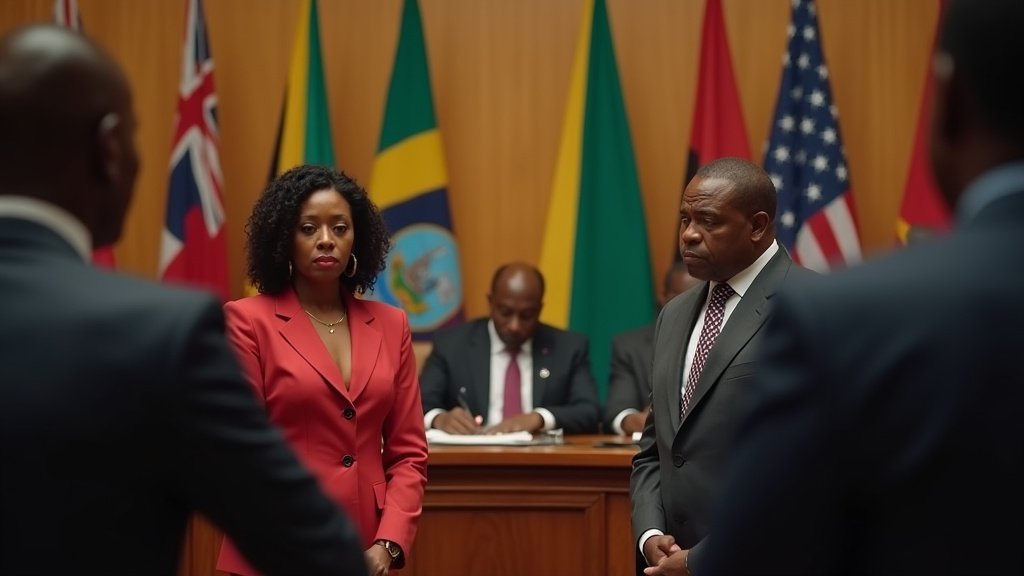
NEW YORK – September 26, 2025 – As global leaders converge for the 80th session of the United Nations General Assembly (UNGA), a palpable sense of unease emanates from the Caribbean, with its representatives raising urgent alarms over escalating military tensions and the relentless scourge of drug trafficking that threaten to destabilize the entire region. The annual gathering has become a crucial platform for Caribbean nations to voice their concerns, this year highlighting a delicate balancing act between the pursuit of peace and the harsh realities of security threats.
A ‘Zone of Peace’ Under Strain
Barbados Prime Minister Mia Mottley delivered a stark warning to the international community, asserting that the Caribbean “must remain a zone of peace” yet is witnessing a “shocking violation” of this understanding. She pointed to the recent significant build-up of military assets by both the United States and Venezuela in the southern Caribbean. Mottley cautioned that such military posturing, even if unintentional, carries a grave risk of accidental escalation, potentially placing the region at disproportionate risk. She implored both superpowers to engage in renewed diplomatic efforts and dialogue to avert conflict, emphasizing that Caribbean nations should not be viewed as “collateral damage” in larger geopolitical standoffs.
Antigua and Barbuda Prime Minister Gaston Browne echoed these sentiments, advocating for drug trafficking interdiction efforts to be firmly rooted in cooperation and conducted under clear legal authority. He cautioned against the unchecked accumulation of military assets in the region and stressed the imperative for the Caribbean to be respected as a zone of peace. This plea underscores a long-standing aspiration for the region to be free from the direct impact of superpower rivalries and armed conflicts.
However, not all regional voices align on this interpretation. Trinidad and Tobago Prime Minister Kamla Persad-Bissessar declared that the notion of the Caribbean as a “zone of peace” has become a “false ideal.” She cited the alarming surge in gang violence, driven by narcotics and firearms, and expressed gratitude for the United States’ military presence in the southern Caribbean, which she believes is effective in inhibiting drug cartel activities within her nation. This contrasting perspective highlights the complex and varied security challenges faced by individual Caribbean states.
The Pervasive Shadow of Drug Trafficking
The Caribbean continues to serve as a critical transshipment hub for illicit drugs, primarily cocaine, destined for North American and European markets. The region’s proximity to South America, coupled with varying interdiction capacities, makes it an attractive route for transnational criminal organizations (TCOs). Reports from the Organization of American States (OAS) and U.S. agencies detail how cocaine flows from South America across the Caribbean via various maritime routes, including go-fast boats, cargo vessels, and even semi-submersibles, often exploiting corruptible elements within ports and law enforcement. The drug trade not only fuels organized crime but also contributes to violence, corruption, and the destabilization of governance across the islands.
U.S. Military Buildup and Geopolitical Undercurrents
The United States has notably escalated its military presence in the Caribbean since late August 2025, deploying significant naval and air assets, including the USS Gerald R. Ford carrier strike group. The stated objective of this operation, dubbed “Southern Spear,” is to combat drug trafficking. However, the scale of this deployment, the largest in decades, has fueled speculation and concern among regional actors and international observers. Some analyses suggest that beyond counter-narcotics, the buildup may serve broader geopolitical aims, potentially linked to U.S. policy towards Venezuela and efforts to assert dominance in the hemisphere.
Venezuelan officials, including Foreign Minister Yván Gil and President Nicolás Maduro, have vehemently condemned the U.S. military actions. They characterize the strikes off Venezuela’s coast as violations of international law and sovereignty, and part of a broader U.S. agenda to destabilize their government and seize natural resources. Cuba’s Foreign Minister Bruno Rodríguez Parrilla has also voiced strong opposition, accusing the U.S. of creating a “dangerous situation” that contravenes international law and threatens regional peace under the guise of combating crime and drug trafficking.
Flow of Firearms and Regional Stability
Beyond the direct military tensions, leaders also raised concerns about the persistent flow of illegal firearms, largely from the United States, into the Caribbean. This influx of weapons exacerbates gang violence, undermines law enforcement efforts, and threatens the stability of fragile democracies. Prime Minister Mottley specifically urged for stronger dialogue with the U.S. to curb this flow, which fuels organized crime and poses a direct threat to the region’s economic and social well-being.
Underlying Health and Social Crises
While the UNGA debates focused on security and geopolitical matters, the persistent social vulnerabilities within the Caribbean region cannot be ignored. Research indicates that social inequality, insecurity, and the pervasive influence of drug trafficking contribute significantly to a growing mental health crisis. While specific data on suicide surges in Jamaica were noted in initial contexts, broader studies highlight a widespread challenge for adolescents and adults across the region. Limited access to mental health services, coupled with cultural stigma and the stress of living in environments marked by violence and economic precarity, means that many suffer in silence, often without adequate support. These underlying issues are intrinsically linked to the broader security challenges discussed at the UN, as poverty and despair can be exploited by criminal networks.
A Call for Dialogue and Cooperation
The 80th UN General Assembly provides a critical juncture for the Caribbean to amplify its voice on the international stage. The conflicting perspectives on security, particularly regarding the U.S. military buildup, underscore the diverse experiences and priorities within the region. Yet, a common thread of concern for peace, stability, and sovereignty unites many. As discussions unfold in New York, the international community is urged to recognize the delicate balance of the Caribbean and support its leaders’ calls for de-escalation, strengthened regional cooperation, and a commitment to dialogue as the paramount tools for addressing the complex security landscape of today.