
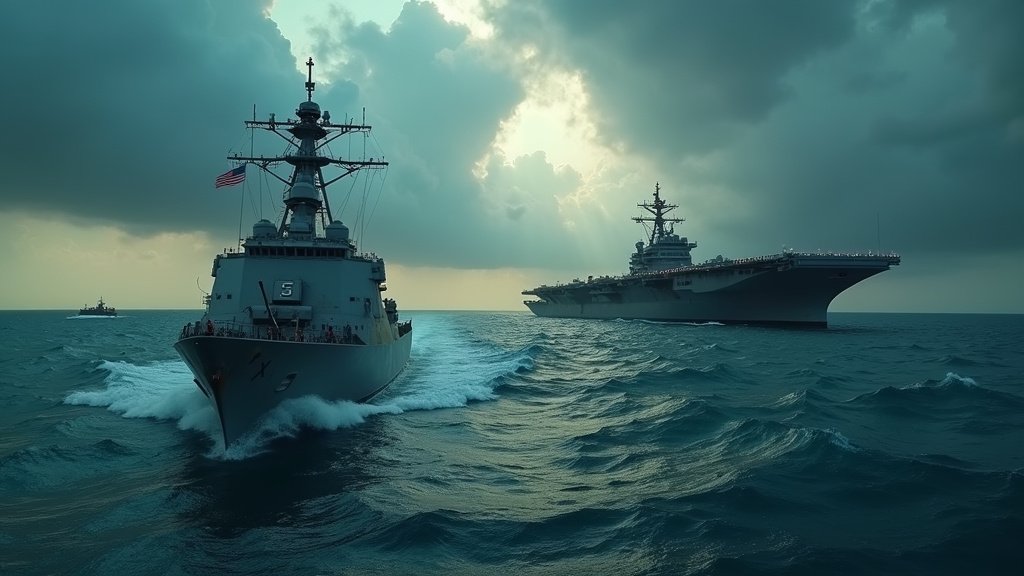
In a developing news story that has sent ripples of unease across the region, the United States military has significantly intensified its strikes against suspected drug-trafficking vessels in the Caribbean Sea and Eastern Pacific. These operations, initiated in early September 2025 and continuing through mid-November, have led to a substantial death toll and have ignited fervent diplomatic protests, particularly from Venezuela, which views the actions as a grave threat to regional peace and its own sovereignty. The escalating military activity unfolds against a backdrop of heightened geopolitical tensions and a notable US naval buildup in the area, while separately, Tropical Storm Lorenzo has dissipated in the North Atlantic without impacting land.
Escalating US Military Operations Stir Regional Outrage
The US military campaign, characterized by the Trump administration as an “armed conflict” against drug cartels and “narco-terrorists,” has involved at least 21 strikes on vessels since September 2, 2025. These operations, often targeting boats allegedly linked to groups like the Venezuelan Tren de Aragua and the Colombian National Liberation Army (ELN), have resulted in the deaths of at least 83 individuals as of mid-November. The administration asserts that these actions are justified under the law of armed conflict to protect American citizens from illicit drugs.
However, the US has not publicly provided evidence to substantiate these claims, leading to widespread skepticism and accusations of a lack of transparency. This lack of concrete justification has prompted concerns from international bodies, with UN experts raising alarms about potential international crimes stemming from these lethal attacks.
A notable development occurred on October 16, 2025, when a US strike on a suspected semi-submersible craft resulted in survivors for the first time in the campaign. Two individuals were rescued and later repatriated to their home countries, Colombia and Ecuador, a stark contrast to previous incidents where vessels were reportedly destroyed with no survivors. Prior to this, strikes such as the one on October 14, which killed six individuals near Venezuela, had drawn significant international attention.
Venezuela Demands UN Action, Citing Sovereignty Violations
The escalating US military presence and actions have provoked a strong response from Venezuela. The South American nation has formally requested an emergency session of the United Nations Security Council, denouncing the US strikes as illegal and a direct threat to regional peace and international stability. Venezuelan Ambassador to the UN, Samuel Moncada, has called for an investigation into the “murders” and a reaffirmation of Venezuela’s sovereignty and territorial integrity.
Caracas contends that these operations serve as a pretext for a US-driven regime change agenda, with broader aims to seize Venezuelan resources. Venezuela also points to alleged CIA operations and a significant naval buildup, including the deployment of advanced warships like the USS Gerald R. Ford aircraft carrier, as evidence of US aggression. The US military has stated its operations are aimed at combating drug trafficking, not regime change, but this narrative is met with deep suspicion in Caracas.
Regional Leaders Divided: Echoes of a ‘Zone of Peace’
The US military campaign has exposed a divided regional response. Veteran statesman and former Prime Minister of Jamaica, P.J. Patterson, has been a vocal critic, describing the strikes as “fundamentally dangerous” and a “horrible erosion” of regional sovereignty. Patterson invoked the historic 1972 declaration of the Caribbean as a “zone of peace,” urging Caribbean heads of government to convene urgently and formulate a common position to reaffirm the region’s commitment to sovereignty and peaceful waters. He warned that continued inaction could embolden external powers to turn the region into a “battlefield”.
In contrast, some leaders, like Trinidad and Tobago’s Prime Minister Kamla Persad-Bissessar, initially expressed strong support for the US actions, advocating for the complete elimination of traffickers. However, other prominent figures, such as Colombian President Gustavo Petro, have objected to the strikes, accusing the US of murder and violating sovereignty, leading to heightened diplomatic friction with Washington. The Caribbean Community and Common Market (CARICOM) has generally emphasized regional cooperation and the preservation of the “zone of peace” principle.
Weather Update: Tropical Storm Lorenzo Dissipates, New Disturbances Monitored
Concurrently with the geopolitical developments, the weather outlook for the region has seen some shifts. Tropical Storm Lorenzo, which formed in the North Atlantic around October 13, 2025, ultimately dissipated without posing a threat to land. By mid-October, forecasters indicated it was gradually weakening and expected to move northwards. As of November 20, the National Hurricane Center reported no expected tropical cyclone formation in the North Atlantic, Caribbean Sea, or Gulf of Mexico within the next seven days, bringing a degree of calm to the hurricane season’s final weeks. However, meteorologists have been monitoring the southwestern Caribbean due to warm waters, though current forecasts suggest limited development potential as the season officially concludes on November 30.
A Complex Regional Landscape
The ongoing US military actions in the Caribbean represent a significant escalation in regional security dynamics. The strikes, justified by the US as counter-narcotics operations, have fueled deep-seated concerns about sovereignty, international law, and the potential for broader conflict. As regional leaders grapple with these challenges, the Caribbean faces a complex landscape defined by both security threats and the imperative to uphold peace and autonomy. This news continues to develop, with implications for international relations and the stability of the wider region.