
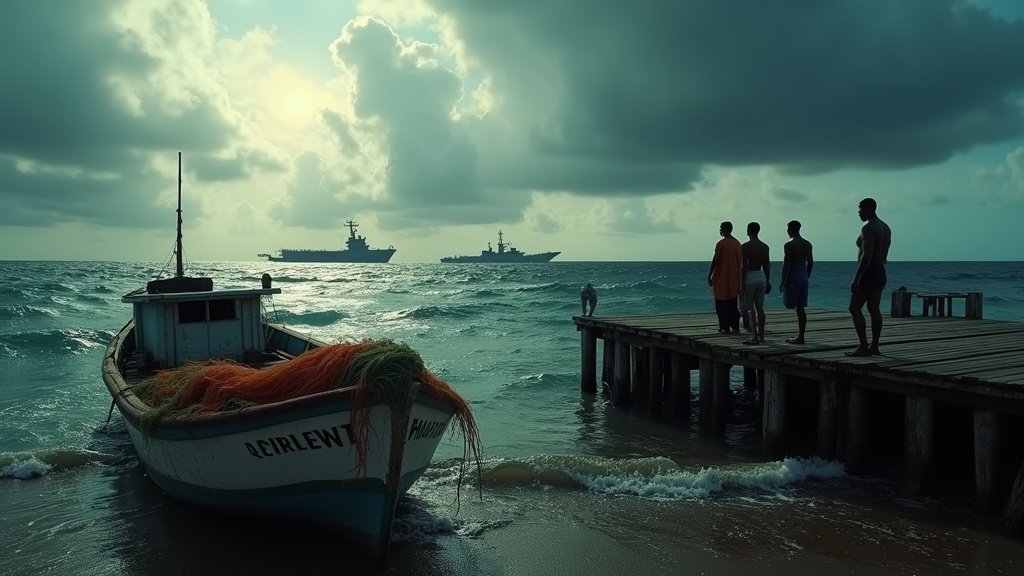
The tranquil waters of the Caribbean are increasingly becoming a zone of anxiety for local fishing communities, particularly for those in Mayaro, Trinidad and Tobago. A significant escalation in U.S. military operations targeting suspected drug vessels, part of an intensified war on narco-trafficking, has sent ripples of fear through the region’s vital fishing lifestyle.
Escalation of US Military Presence and Strikes
Beginning in late August 2025, the United States launched a substantial military buildup in the southern Caribbean, dubbed ‘Operation Southern Spear.’ This operation involved the deployment of major naval assets, including the USS Gerald R. Ford carrier strike group and the USS Iwo Jima Amphibious Ready Group, bringing thousands of sailors and Marines to the region. The stated objective was to combat drug trafficking networks and what the U.S. administration termed ‘narco-terrorism,’ with a particular focus on vessels allegedly linked to Venezuela and criminal organizations like the Tren de Aragua.
This increased presence was accompanied by a series of decisive military actions. Starting in September 2025, U.S. forces began conducting airstrikes against suspected drug-carrying vessels in the Caribbean and Eastern Pacific. The first publicly acknowledged lethal strike occurred on September 2, 2025, reportedly resulting in the deaths of eleven individuals aboard a vessel originating from Venezuela. By mid-November 2025, reports indicated that at least 83 people had been killed across 21 such strikes. These actions marked a significant departure from previous U.S. counter-narcotics strategies, which typically relied on law enforcement agencies like the Coast Guard for interdictions.
Mayaro Fisherfolk: Caught in the Crossfire
For the fisherfolk of Mayaro, a community deeply connected to the sea for its livelihood and way of life, these military actions have instilled a profound sense of unease. News reports detailing lethal strikes and the heightened U.S. military presence have directly impacted their daily routines and safety perceptions. Fishermen like Steve Williams and Johnson Dave, interviewed by local media, expressed significant anxiety. They reported altering their fishing grounds, now venturing less into areas closer to Venezuela and staying nearer to Trinidadian waters for perceived safety.
“With all these comments in the media about Venezuela, and Venezuela being our neighbour, some of the fishermen are frightened to take the chance to fish where they normally go,” Johnson Dave noted. He highlighted the high risk involved, fearing that their vessels, carrying gas or fish, might be mistaken for something else by the military based on faulty intelligence. Another fisherman, speaking anonymously, voiced a palpable fear for his life, stating, “Yes, we must be fearful for our lives because the boats that are going out there, the ships blowing them out of the sea, so that putting all of we at risk because we moving at night too”. This apprehension is forcing many to fish closer to shore, potentially reducing their catch and impacting their income and the broader fishing lifestyle in the region.
Regional Tensions and International Scrutiny
The U.S. military actions have not only affected local communities but have also heightened geopolitical tensions, particularly concerning Venezuela. Venezuelan President Nicolás Maduro condemned the U.S. operations, accusing the United States of aggression and conducting military exercises in response. While some Caribbean nations, such as those aligned with the Bolivarian Alliance for the Peoples of Our America (ALBA), have criticized the U.S. deployment as a violation of international law, others, including Trinidad and Tobago and Guyana, have shown more support, emphasizing the need to combat transnational crime.
However, the U.S. campaign has also drawn international scrutiny regarding its legality and evidentiary basis. Critics and international law experts have raised concerns about potential extrajudicial killings and the lack of publicly disclosed evidence to support the U.S. claims against the targeted vessels. The United Kingdom, a close U.S. ally, reportedly suspended intelligence sharing related to these operations due to concerns that they may not align with international law.
Record Seizures Amidst Broader Strategy
Despite the concerns and the impact on fishing communities, the U.S. Coast Guard has reported significant successes in drug interdiction efforts throughout fiscal year 2025. The service announced a record-breaking seizure of nearly 510,000 pounds of cocaine in the Eastern Pacific Ocean and Caribbean Sea, valued at over $7.2 billion. This surge in seizures is attributed to increased assets in the region and enhanced inter-agency partnerships, including the work of the elite Helicopter Interdiction Tactical Squadron (HITRON).
The deployment of major naval assets like the USS Gerald R. Ford carrier strike group is part of a broader strategy by the U.S. Southern Command to detect, disrupt, and degrade transnational criminal organizations operating in the Western Hemisphere, aiming to protect U.S. borders and national security. Yet, the collateral impact on local populations and the geopolitical ramifications continue to be a critical news point, underscoring the complex interplay between security operations and regional stability.
Conclusion
The intensified U.S. military campaign in the Caribbean, while aimed at curbing drug trafficking, has cast a shadow of anxiety over the traditional fishing lifestyle in communities like Mayaro. As naval forces assert dominance in the waters, the human cost and the potential for escalating regional tensions remain central to the unfolding news narrative. The delicate balance between eradicating illicit activities and ensuring the safety and livelihoods of coastal populations in the Caribbean continues to be a pressing issue.