
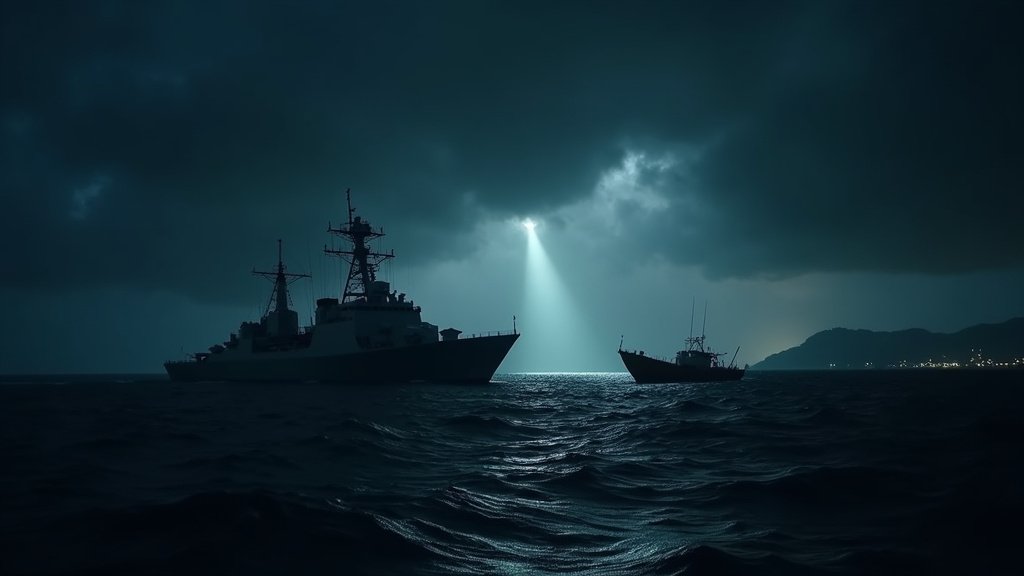
Beijing has issued a stern rebuke to the United States over its recent military operations in the Caribbean Sea, warning that the unilateral use of force threatens regional peace and security. Chinese Foreign Ministry Spokesperson Lin Jian stated on September 16, 2025, that US actions, including strikes against vessels off the coast of Venezuela, constituted a severe infringement upon the sovereignty and lawful rights of other nations, and violated international law. This condemnation comes as the Trump administration has intensified its military campaign in the region under the guise of combating drug trafficking, a strategy that has drawn significant international criticism and raised alarm bells regarding broader geopolitical implications.
US Military Escalation: A New Front in the Caribbean
Since early September 2025, the United States military, under the direction of President Donald Trump, has embarked on an aggressive campaign involving lethal strikes against suspected drug-trafficking vessels in the Caribbean Sea and, subsequently, the Eastern Pacific Ocean. The initial strike, announced on September 2, 2025, targeted a vessel near Venezuela, resulting in the deaths of all eleven individuals aboard. U.S. officials alleged the boat was carrying narcotics and operated by members of the Tren de Aragua, a designated narcoterrorist organization. President Trump himself announced the operation, stating the vessel was “U.S.-bound” and “loaded” with drugs.
Subsequent strikes followed, with multiple reports detailing further attacks on vessels originating from or operating near Venezuelan shores. By mid-November 2025, U.S. media reports indicated at least 21 strikes had been conducted, resulting in the deaths of 83 people. The U.S. military has deployed a substantial force to the region, including warships, submarines, drones, fighter aircraft, and special operations helicopters, culminating in the arrival of the USS Gerald R. Ford carrier strike group, the largest such deployment in decades. The stated objective of these operations is to dismantle “narco-terrorist” networks and disrupt drug flow into the United States, with the administration framing the actions as part of a “non-international armed conflict” against “unlawful combatants”.
China’s Stance: Opposition to Unilateral Force and Interference
China’s Foreign Ministry has been a vocal critic of these US actions. Spokesperson Lin Jian, in his statement on September 16, 2025, directly addressed the US military presence and strikes in the Caribbean. He emphasized that Beijing “opposes the use or threat of force in international relations” and “rejects external interference in Venezuela’s internal affairs under any pretext”. China has consistently called for adherence to international law and the UN Charter, advocating for normal law enforcement and judicial cooperation through established bilateral and multilateral frameworks, rather than unilateral military action.
In later statements, Foreign Ministry spokeswoman Mao Ning reiterated China’s opposition to “unilateral and excessive enforcement operations against other countries’ vessels” and warned against actions that “undermine peace and stability in Latin America and the Caribbean”. China supports strengthening international cooperation to combat transnational crime but firmly opposes the use of force that disregards reasonable and necessary limits. Beijing also supports initiatives like the Proclamation of Latin America and the Caribbean as a Zone of Peace. The Chinese perspective suggests that the US military buildup is not merely a counter-narcotics mission but a strategic power play that could destabilize the region.
Venezuela’s Denials and Regional Tensions
The Venezuelan government has vehemently denied the US accusations, characterizing the targeted vessels as fishing boats and their crews as civilians. President Nicolás Maduro has repeatedly condemned the US strikes as criminal acts and a deliberate fabrication of evidence intended to justify aggression and potentially pave the way for regime change. Venezuela has placed its military on high alert and mobilized forces, viewing the US naval presence as a provocation and a direct threat to its sovereignty. The ongoing diplomatic standoff has led to heightened tensions, with Venezuela reportedly seeking military support from allies like Russia, China, and Iran.
International Law and Global Criticism Mount
The legality and justification of the US military strikes have been widely questioned by international legal experts and human rights organizations. The UN High Commissioner for Human Rights, Volker Türk, stated in late October 2025 that the airstrikes “violate international human rights law” and must stop immediately, calling them “unacceptable” extrajudicial killings. He emphasized that countering drug trafficking is a law enforcement matter governed by strict limits on lethal force, permissible only as a last resort against an imminent threat to life, and that there was no evidence that individuals on the targeted boats posed such a threat.
Other international figures and bodies have echoed these concerns. The French Foreign Minister described the US operations as disregarding international law, while UN experts argued that the strikes violate the international law of the sea, which does not authorize unprovoked attacks on ships. Legal scholars and analysts have raised doubts about the US administration’s legal justifications, suggesting that the use of lethal force without due process or clear evidence of an armed attack against the US may constitute war crimes or extrajudicial killings. The US government’s assertion that it is engaged in a “war against narco-terrorists” has been scrutinized, with many legal experts arguing that such characterizations do not legitimize military strikes on civilian vessels.
Broader Implications for Regional Stability
Beyond the direct confrontation between the US and Venezuela, the intensified US military presence and aggressive posture in the Caribbean have broader implications for regional stability. Experts suggest that the scale of the deployment and the nature of the operations may signal a US strategy aimed at regime change or asserting broader geopolitical influence in Latin America, a region historically viewed by the US as its “backyard”. The “Operation Southern Spear” and the arrival of the USS Gerald R. Ford carrier strike group underscore a significant shift in US defense policy, expanding the military’s role in regional security.
This militarization raises concerns among Caribbean nations about maritime safety, civilian traffic, and potential disruptions to economies heavily reliant on sea trade. The increased military activity could also lead to accidental escalations or misunderstandings, further heightening tensions in an already complex geopolitical landscape. The news today highlights a critical juncture where US national security objectives intersect with international law and regional sovereignty, creating a volatile environment with far-reaching consequences.
In conclusion, the recent US military strikes in the Caribbean, particularly targeting vessels off Venezuela, have ignited a fierce debate. While the US administration defends its actions as necessary counter-narcotics operations, China and a growing chorus of international voices decry them as violations of international law and threats to regional stability. The situation underscores the complex interplay of power, sovereignty, and legality in contemporary international relations, with the Caribbean now a focal point of significant geopolitical friction.