
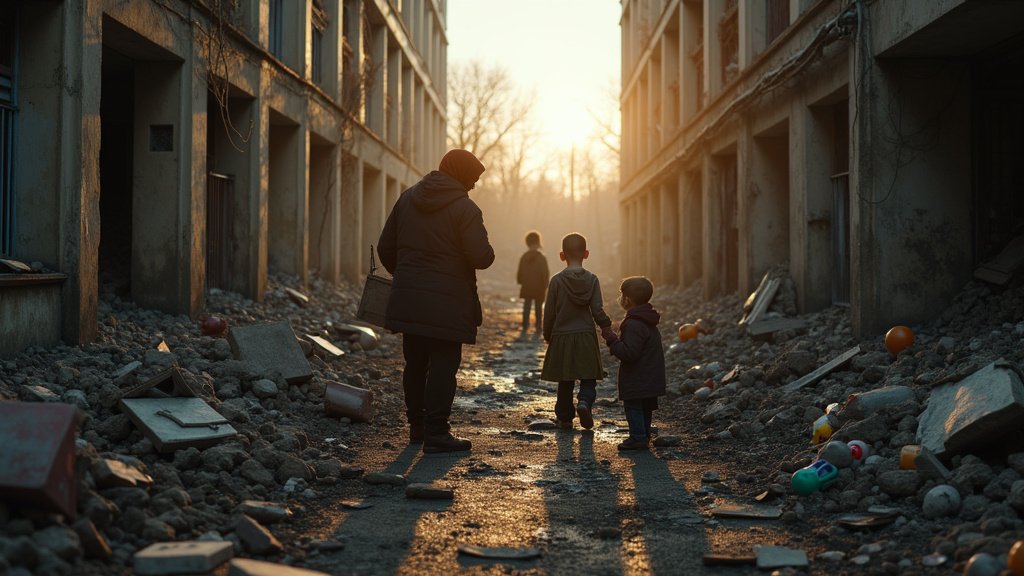
Kharkiv, Ukraine – October 22, 2025 – A Russian drone attack struck a kindergarten in the eastern Ukrainian city of Kharkiv this morning, resulting in at least one death and multiple injuries, underscoring the brutal realities of the ongoing conflict. The strike, which occurred as children sheltered in a bomb-proof basement, has drawn international condemnation and highlights the pervasive threat to civilian infrastructure in Ukraine.
The attack on the kindergarten occurred amidst a series of deadly Russian strikes across Ukraine, which have claimed several lives and injured dozens more in the past day. Ukrainian officials reported that 48 children were present during the strike but were safely evacuated to shelters, though the psychological toll on them remains a concern, with President Zelensky noting they were experiencing “acute stress reactions”. The targeting of a civilian educational facility has been decried as a war crime, with no justification possible for such an assault.
This incident unfolds as significant shifts in geopolitical policy and international legal rulings reverberate across the globe, reflecting a world grappling with escalating conflicts and complex diplomatic challenges. The news of the Kharkiv attack comes on the same day that the International Court of Justice (ICJ) issued a ruling demanding that Israel ensure essential humanitarian aid reaches Gaza, a decision met with immediate rejection by Israeli authorities. Concurrently, the European Union has finalized its 19th package of sanctions against Russia, further tightening economic pressure on Moscow, while the United States has reportedly eased restrictions on Ukraine’s use of certain long-range missiles to strike targets within Russia.
Escalating Strikes and Shifting Policies
The devastating strike on the Kharkiv kindergarten is part of a wider pattern of intense Russian aerial assaults targeting Ukrainian cities and infrastructure. Recent weeks have seen a significant increase in such attacks, with civilian casualties remaining high across multiple regions. The assaults frequently impact residential buildings, energy facilities, and other vital civilian sites, often during nighttime hours, intensifying the hardship for the Ukrainian population as winter approaches.
In a significant development in the conflict’s military dimension, the United States has reportedly lifted key restrictions that previously prevented Ukraine from using Western-supplied long-range weapons to strike deep inside Russian territory. This policy shift, reportedly made by the Trump administration, allows Kyiv to deploy weapons like ATACMS and Storm Shadow missiles against targets within Russia, particularly in areas like the Kursk region. The move is seen by some as a necessary measure to counter Russian advances and potentially enhance Ukraine’s defensive capabilities. However, Russian officials have issued stern warnings, with some characterizing the decision as a dangerous step towards a potential world war.
EU’s New Sanctions and Global Economic Pressure
Adding to the global pressure on Russia, the European Union formally adopted its 19th package of sanctions on October 23, 2025. These comprehensive measures aim to further cripple Russia’s war economy by targeting critical sectors such as energy, finance, and its military-industrial complex. A notable component of this package is a phased ban on Russian Liquefied Natural Gas (LNG) imports, with a full prohibition expected by January 1, 2027, for long-term contracts.
The sanctions also include a stringent clampdown on Russia’s “shadow fleet” of vessels used to circumvent oil price caps and further restrictions on major Russian energy companies like Rosneft and Gazprom Neft. The EU also expanded measures against financial services, payment systems, and entities enabling Russia’s evasion of existing sanctions, demonstrating a coordinated effort to maximize economic impact.
International Court’s Call for Aid and Diplomatic Engagements
In parallel to the military and economic developments, the International Court of Justice (ICJ) issued a significant advisory opinion on October 22, 2025, demanding that Israel ensure the unhindered passage of essential humanitarian aid into Gaza. The ruling affirmed Israel’s obligation as an occupying power to provide for the basic needs of the Palestinian population and facilitate relief efforts by the United Nations, including UNRWA. The ICJ also dismissed Israel’s allegations against UNRWA staff, finding them unsubstantiated.
Despite the ICJ’s strong stance, Israel has categorically rejected the ruling, labeling it a political maneuver. This decision comes amid ongoing international scrutiny of humanitarian conditions in Gaza and a broader push for a resolution to the conflict in the Middle East. In this context, US Secretary of State Marco Rubio met with Israeli Prime Minister Benjamin Netanyahu in Jerusalem around October 23, 2025. The discussions focused on the US-led peace plan for Gaza, the ceasefire, and de-escalation efforts. Rubio reported progress, characterizing the talks as constructive, while acknowledging remaining challenges.
The confluence of these events—deadly strikes on civilians, shifts in strategic military support, intensified economic sanctions, and critical international legal pronouncements—paints a grim picture of a world stage marked by escalating conflict and complex geopolitical maneuvering. The news today underscores the interconnectedness of global affairs and the profound impact these developments have on human lives and international stability.