
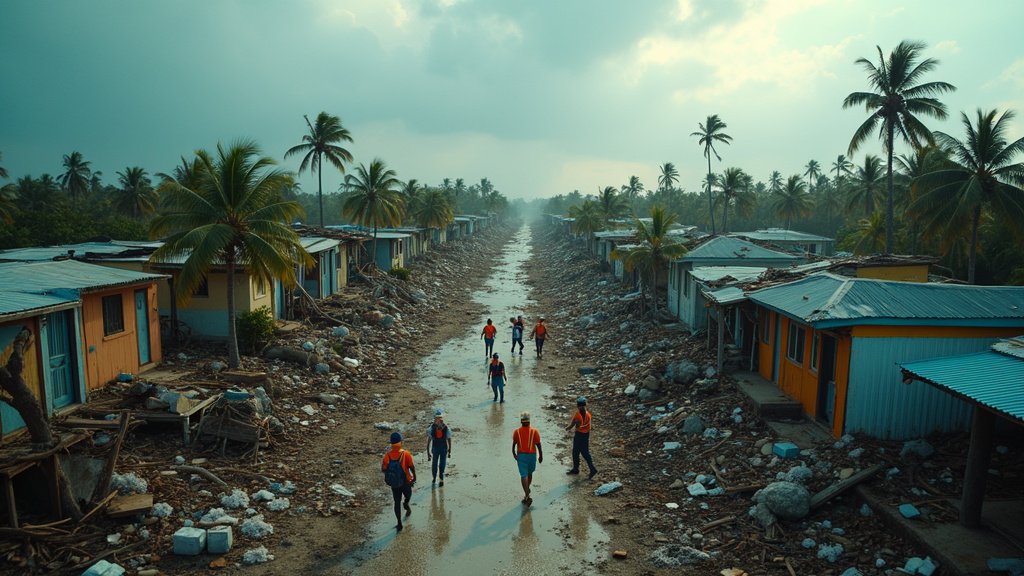
The Caribbean region is navigating the profound and escalating crisis in the wake of Hurricane Melissa, one of the most powerful storms ever recorded in the Atlantic. As of November 14, 2025, more than two weeks after the Category 5 hurricane made a catastrophic landfall in Jamaica, the full scale of its destruction is still being assessed, revealing widespread devastation across Jamaica, Cuba, and Haiti, affecting over five million people. The regional response is a race against time to deliver aid, restore essential services, and prevent a secondary disaster fueled by rising health threats.
The Unprecedented Fury of Hurricane Melissa
Hurricane Melissa formed on October 21, 2025, and rapidly intensified into an extremely powerful Category 5 hurricane. On October 28, it struck southwestern Jamaica with sustained winds of 185 mph (295 km/h), making it the strongest hurricane to ever make landfall on the island and one of the most intense Atlantic hurricanes on record. The storm’s trajectory continued into eastern Cuba as a Category 3 hurricane the following day, with significant impacts also felt in Haiti and other neighboring nations. The hurricane’s unusual intensity and erratic path presented significant challenges for traditional disaster planning models across the region.
Catastrophic Damage Across the Caribbean
The physical toll of Hurricane Melissa is immense. In Jamaica, the storm inflicted an estimated US$8.8 billion in physical damage, a figure equivalent to 41% of the nation’s 2024 GDP, making it the costliest hurricane in its recorded history. This estimate, part of the Global Rapid Damage Estimation (GRADE) assessment, captures property destruction, infrastructure damage, and agricultural losses, though broader economic losses are expected to be substantially higher, potentially exceeding US$20 billion. Over 150,000 homes were damaged or destroyed in Jamaica, with infrastructure damage alone estimated at US$2.9 billion.
Cuba faces a similarly dire situation. Preliminary assessments indicate severe damage to over 149,000 homes, with 95,000 of these in Santiago de Cuba alone, the country’s second-most populated city. More than 600 health facilities across the affected countries have been damaged, including 642 in Cuba, 54 in Jamaica, and 10 in Haiti, severely disrupting access to essential health services. Widespread power and communication outages, coupled with blocked roads from debris and landslides, have left numerous communities isolated and severely hampered initial response efforts.
The Human Toll and Escalating Health Crisis
Beyond the infrastructure, the human cost is mounting. Reports indicate that nearly six million people have been affected across Jamaica, Cuba, and Haiti. The death toll has risen significantly; as of November 14, 2025, at least 45 deaths were reported in Jamaica, with figures expected to grow as access improves. In Haiti, authorities reported 43 deaths, with 21 injured and 13 still missing. Tens of thousands remain displaced, with over 53,000 people displaced in Cuba and more than 120,000 households in Jamaica in urgent need of housing repairs.
Compounding the crisis, rising risks of waterborne and vector-borne diseases are a significant concern, particularly in eastern Cuba where health authorities have confirmed that 30% of the population has recently suffered from arboviral diseases. In Jamaica, concerns about leptospirosis are growing following widespread flooding that contaminated water sources. Damaged sanitation systems, spoiled food supplies, and prolonged power outages in both Cuba and Jamaica exacerbate these health threats, prompting advisories from health ministries urging caution during cleanup efforts.
A Coordinated Regional and International Response
In the face of this unprecedented disaster, a robust regional and international response is underway. The United Nations, along with its partners, is working at “top speed” to support government-led relief efforts. The UN Office for the Coordination of Humanitarian Affairs (OCHA) is coordinating aid distribution, while agencies like the World Food Programme (WFP) are delivering food kits, cash assistance, and supporting logistics. UNICEF is providing essential supplies for WASH (water, sanitation, and hygiene), and the Pan American Health Organization (PAHO) is sending medical supplies and equipment.
The UN Central Emergency Response Fund (CERF) has provided millions in anticipatory funding, enabling life-saving support and evacuations before the storm made landfall. International Medical Teams, such as one deployed by the UK, are providing direct healthcare in Jamaica, operating mobile clinics to support communities where health facilities have been damaged or destroyed. UNESCO is also contributing by supporting educational continuity, assessing cultural heritage damage, and promoting reliable information dissemination. The International Organization for Migration (IOM) is co-leading shelter coordination efforts, while organizations like WaterStep are deploying safe water solutions to combat health risks.
Challenges and the Path to Reconstruction
Despite the intensive response, significant challenges remain. Access to cut-off communities is still severely constrained by debris, landslides, and damaged infrastructure. The sheer volume of debris, estimated at over 4.8 million tonnes in western Jamaica alone, is a major impediment to recovery, blocking essential routes and delaying the restoration of services. The Caribbean Disaster Emergency Management Agency (CDEMA) views Hurricane Melissa as a turning point, highlighting the need to adapt disaster planning for increasingly violent and unpredictable late-season tropical systems shaped by climate change.
As the news unfolds today, the focus is shifting towards early recovery and long-term reconstruction. Financial institutions like the World Bank and the Inter-American Development Bank (IDB) are collaborating with governments to assess damage and support rebuilding efforts. The scale of the damage underscores the need for sustained international solidarity and strategic planning to rebuild resilient infrastructure and communities, ensuring that the lessons learned from Hurricane Melissa inform future preparedness and response efforts across the Caribbean. The recovery will undoubtedly be an enormous and long-term task, requiring a “whole of society effort”.