
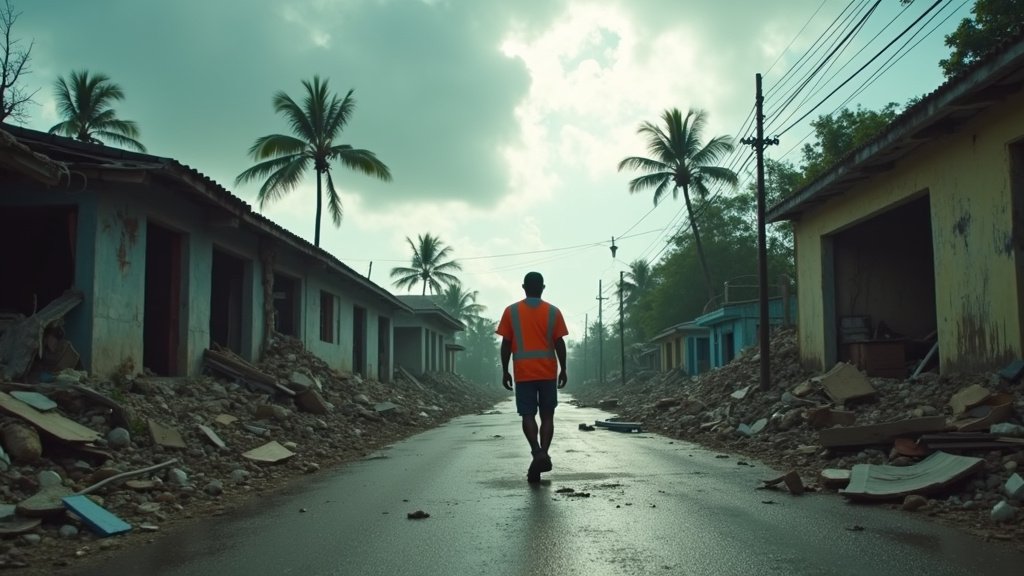
The Caribbean region is grappling with the immense aftermath of Hurricane Melissa, a catastrophic Category 5 storm that has left millions in its wake facing widespread devastation, loss of life, and critical humanitarian needs. As of early November 2025, relief operations are scaling up across Jamaica, Cuba, and Haiti, but access remains severely constrained by the storm’s destructive path, underscoring the profound challenges of recovery.
Widespread Devastation Across Three Nations
Hurricane Melissa, one of the most powerful Atlantic hurricanes on record, made landfall in western Jamaica on October 28th as a Category 5 behemoth, unleashing winds of up to 185 mph (295 kph). It subsequently crossed eastern Cuba as a Category 3 storm the following day, leaving a trail of destruction that has impacted an estimated 5 to 8 million people across the region. The storm’s ferocity was underscored by a record-breaking wind gust of 252 mph (406 km/h) recorded by NOAA Hurricane Hunters, highlighting its unprecedented intensity.
The hurricane caused catastrophic damage to infrastructure, triggering widespread power and communication outages, and blocking roads with debris and landslides. This isolation has severely hampered initial damage assessments and the delivery of life-saving aid to cut-off communities. Hundreds of healthcare facilities have been severely damaged across the affected nations, including 642 in Cuba, 54 in Jamaica, and 10 in Haiti, critically impacting access to essential health services.
Jamaica Grapples with Unprecedented Damage and Debris
Jamaica bore the brunt of Hurricane Melissa’s initial fury, with preliminary government assessments estimating damage to its road infrastructure alone at J$35 billion (over US$200 million). More than 4.8 million tonnes of debris continue to obstruct roads and public spaces, leaving approximately 30 communities cut off and hindering relief efforts. The storm displaced an estimated 30,000 households, with over 1,100 people still residing in emergency shelters as of mid-November.
The economic toll on Jamaica is staggering, with estimates suggesting losses could exceed US$20 billion, a figure equivalent to 41% of the country’s 2024 GDP, making it the costliest storm ever to hit the island-nation. The tourism and agriculture sectors, vital to Jamaica’s economy, have been severely impacted, with major hotel chains expecting to remain closed until well into 2026. Authorities have confirmed at least 45 deaths in Jamaica, with 15 others still missing, and the toll is expected to rise as access improves.
Cuba Faces Urgent Reconstruction Needs Amid Economic Strain
In Cuba, the eastern provinces of Granma, Santiago de Cuba, Holguín, and Guantánamo have borne the brunt of Melissa’s impact. The storm caused widespread flooding, power outages, and significant destruction, with initial estimates indicating over 60,000 homes were destroyed or lost their roofs. More than 53,000 people remain displaced across the affected provinces, with many relying on official shelters.
The United Nations has launched a US$74 million Plan of Action, aimed at assisting one million Cubans across four eastern provinces. This initiative focuses on critical sectors including health, water and sanitation, shelter, education, and early recovery, with special attention to vulnerable groups. The UN also released US$4 million in emergency funding before the storm hit, part of its anticipatory action framework. Cuba’s recovery efforts are complicated by years of severe economic crisis and U.S. sanctions, which limit its access to international financial support.
Haiti’s Grand Sud Region Under Immense Strain
Haiti’s Grand Sud region has been particularly devastated, with authorities reporting 43 deaths confirmed in the area and over 1,700 individuals remaining displaced as of early November. The storm caused heavy rainfall, strong winds, and coastal flooding, triggering landslides and river overflows that swept away homes and infrastructure. In Petit-Goâve alone, a significant number of fatalities, including children, were reported, with homes and bridges destroyed by the flooding of the La Digue River.
Approximately 16,000 people initially sought refuge in temporary shelters, with a portion still housed in them. Humanitarian partners are scaling up operations, distributing essential supplies, and working to reopen key routes damaged by landslides and debris, which have isolated several communal sections.
International Response Mobilizes
Governments and aid agencies are coordinating a massive humanitarian response across the affected nations. The UN and its partners are actively involved in providing essential aid, with organizations like UNICEF focusing on the critical disruption to schooling for nearly 477,000 children. The World Food Programme (WFP) is working to distribute food rations and cash assistance to hundreds of thousands of people, though substantial funding gaps remain for its operations.
The United States government has committed millions in additional aid, deploying disaster assistance response teams and urban search-and-rescue units to support recovery efforts in Jamaica and Haiti. The World Bank and Inter-American Development Bank are also engaged in damage assessments and are ready to mobilize support for reconstruction, particularly in Jamaica.
The Long Road to Recovery
Despite ongoing efforts, the scale of destruction wrought by Hurricane Melissa presents a formidable challenge to the Caribbean. Damaged infrastructure, persistent flooding in low-lying areas, and the sheer volume of debris mean that access to many communities remains difficult. The potential for secondary impacts, such as waterborne and vector-borne diseases, remains a significant concern, especially with damage to sanitation systems.
As the region moves from emergency response to long-term reconstruction, the need for sustained international support and climate-resilient rebuilding strategies is paramount. The human cost of Melissa serves as a stark reminder of the Caribbean’s vulnerability to extreme weather events in an era of climate change, underscoring the urgency for global commitment to mitigation and adaptation efforts.