
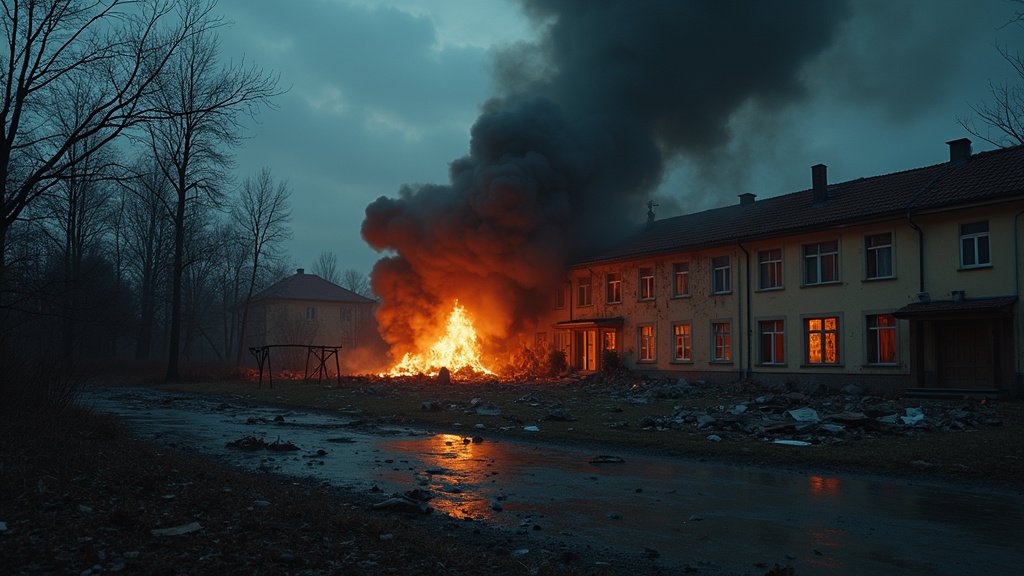
In a shocking escalation of violence, a Russian drone strike on October 22, 2025, hit a private kindergarten in Kharkiv, Ukraine, killing one adult and injuring several civilians, including a five-year-old girl. The attack, which occurred amid a wider barrage of Russian missiles and drones across Ukraine, has drawn widespread international condemnation and underscored the brutal human cost of the ongoing conflict.
Kindergarten Hit Amidst Widespread Assaults
The drone strike targeted the Honey Home private kindergarten in the Kholodnohirskyi district of Kharkiv. Fortunately, 48 children and their teachers were in an underground shelter at the time of the attack and were safely evacuated. However, the impact of the strike was severe, damaging the kindergarten building, igniting a large fire, and causing destruction to nearby residential buildings, stores, coffee shops, offices, and vehicles. The adult casualty was identified as a municipal utility worker cleaning the area during the attack. In total, at least ten people were injured, with some in serious condition.
President Volodymyr Zelenskyy of Ukraine vehemently condemned the strike, stating, “There is no justification for a drone strike on a kindergarten, nor can there ever be.” He added, “Clearly, Russia is growing more brazen. These strikes are Russia’s spit in the face to everyone who insists on a peaceful resolution”. Many of the evacuated children reportedly experienced “acute stress reactions” due to the traumatic event, highlighting the profound psychological impact on young victims.
Broader Context: A Night of Terror Across Ukraine
The attack on the Kharkiv kindergarten was not an isolated incident but part of a massive, coordinated aerial offensive by Russia. Overnight on October 21-22, 2025, Russia launched hundreds of drones and missiles targeting energy infrastructure and civilian sites across more than ten regions of Ukraine. These widespread strikes resulted in significant casualties nationwide, with reports of at least seven deaths and dozens of injuries across the country in the immediate aftermath of the overnight assaults.
In Kyiv, two people were killed and 29 injured. In Kyiv Oblast, four people died. Zaporizhzhia Oblast reported at least 15 civilians injured. The deliberate targeting of civilian infrastructure, including schools and residential areas, has become an increasingly concerning pattern in the conflict, raising serious concerns about violations of international humanitarian law. The UN Human Rights Monitoring Mission in Ukraine has documented a significant increase in civilian casualties, with frontline communities remaining the most at risk due to long-range missile and drone strikes.
International Reactions and Policy Shifts
The attack on the kindergarten has spurred renewed international calls for accountability and amplified global condemnation of Russia’s actions. The targeting of educational facilities is considered a war crime under international law.
In parallel to these developments, the United States has reportedly eased restrictions on Ukraine’s use of long-range missiles, allowing them to strike targets deeper within Russia. This policy shift, confirmed by Ukrainian officials, marks a significant development in the supply of advanced weaponry to Ukraine and follows earlier reports of Ukraine using US-made ATACMS missiles on Russian territory. The use of these longer-range missiles, capable of striking targets up to 300 kilometers inside Russia, effectively doubles the territory Ukraine can target, a move previously met with caution by the US due to fears of Russian escalation.
Meanwhile, the International Court of Justice (ICJ) has issued rulings regarding humanitarian aid delivery to Gaza. Judges have stated that Israel has a legal obligation to facilitate aid delivery and must not use starvation as a weapon of war. The ICJ found that Israel’s restrictions on aid have breached international obligations and rejected Israel’s claims about the UN agency for Palestinian refugees (UNRWA) being infiltrated by Hamas without substantiation. Israel has reportedly rejected these non-binding opinions.
The Grim Reality: Civilian Toll and Enduring Conflict
The relentless Russian attacks continue to exact a devastating toll on Ukrainian civilians. As of November 2025, the UN has documented over 53,000 civilian casualties, including more than 14,500 deaths, since the full-scale invasion in 2022. Frontline communities, particularly in regions like Kharkiv, Kherson, and Donetsk, bear the brunt of these attacks, facing constant threats from long-range weaponry. The targeting of energy infrastructure also poses a grave threat, especially as winter sets in, disrupting essential services and exacerbating the humanitarian crisis. The world news continues to report on these devastating events, underscoring the urgent need for a peaceful resolution. The ongoing conflict not only affects Ukraine but also has significant implications for global security and stability. The news today highlights the severe consequences of sustained warfare on civilian populations worldwide.
As the world watches, the resilience of the Ukrainian people is tested daily, with calls for sustained international support and a firm commitment to international humanitarian law growing louder. The attack on the kindergarten in Kharkiv serves as a stark reminder of the immense suffering inflicted upon innocent civilians in this protracted global crisis.