
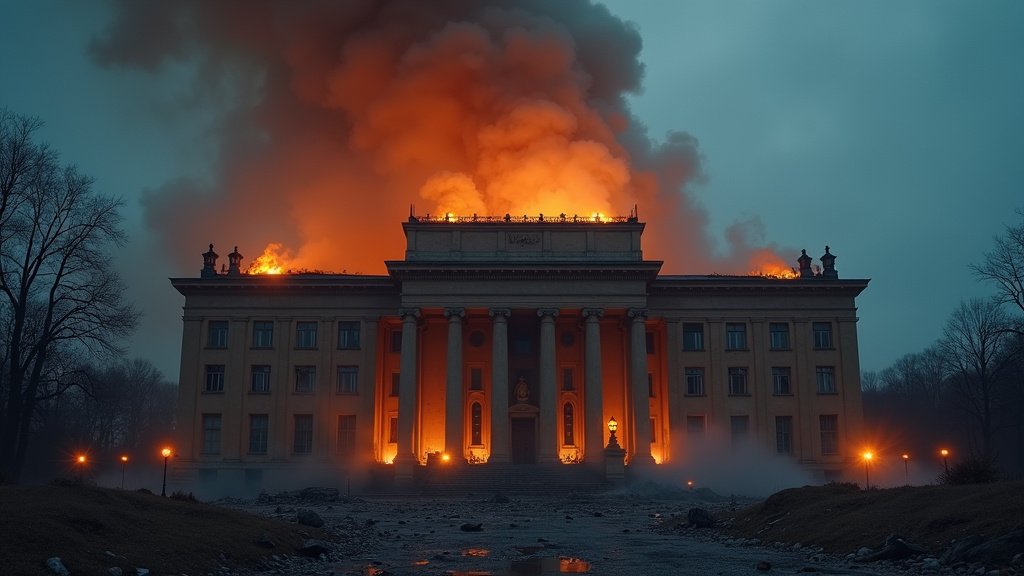
In a significant escalation of hostilities, Russia launched its largest-ever aerial assault on Ukraine early Sunday, September 7, 2025, inundating the country with over 800 drones and a barrage of missiles. For the first time since the full-scale invasion began, the attack saw Russian ordnance strike the main government building in Kyiv, the Cabinet of Ministers headquarters, causing damage and smoke to billow from its roof. The unprecedented scale of the assault, which also targeted numerous residential buildings and civilian infrastructure across the nation, has drawn widespread condemnation and underscores the ongoing brutality of the conflict.
Record-Breaking Aerial Assault
Ukrainian defense officials reported that Russia deployed approximately 810 drones and decoys, alongside 13 to 15 missiles, in a sustained overnight offensive. This marks the highest number of drones Russia has unleashed in a single day since the commencement of the full-scale invasion in February 2022. The sheer volume of aerial threats was designed to overwhelm Ukraine’s air defenses, which struggled to intercept every incoming projectile despite their significant efforts. Ukraine’s Air Force announced that its defenses successfully shot down or neutralized around 747 to 751 drones and a small number of missiles, but the sheer scale meant a substantial number made it through to impact targets across 37 locations nationwide.
Government Building Targeted in Kyiv
The most significant development of the attack was the strike on Kyiv’s Cabinet of Ministers building, a prominent government complex in the heart of the capital. While it remains unclear if the building sustained a direct hit or damage from falling debris, the incident represents a notable escalation, as Russian forces had previously avoided targeting such central government structures. Smoke was seen rising from the building’s roof and upper floors, and police cordoned off the area as emergency services responded. Ukrainian Prime Minister Yulia Svyrydenko confirmed the damage, stating, “For the first time, the government building was damaged by an enemy attack, including the roof and upper floors. We will restore the buildings, but lost lives cannot be returned”.
Human Cost and Civilian Impact
The widespread nature of the attack resulted in significant civilian casualties. Officials confirmed that at least four people were killed across the country, including an infant and their mother. Reports indicate that at least 17 to 44 people were wounded in the attacks, with residential buildings bearing the brunt of the damage in Kyiv and other regions. In Kyiv, drone strikes hit residential areas, causing fires in multi-story buildings and damaging civilian infrastructure. The attack brought the grim reality of the war directly to the doorsteps of citizens, forcing many to seek shelter as air raid sirens wailed throughout the night and into the morning.
Political Reactions and Diplomatic Undercurrents
Ukrainian President Volodymyr Zelenskyy vehemently condemned the strikes, labeling them a “deliberate crime” and an attempt to “prolong the war”. He called for strengthened international sanctions, particularly targeting Russia’s oil and gas sector, and emphasized the urgent need for additional air defense systems. Zelenskyy’s remarks alluded to potential diplomatic avenues, referencing past discussions in Paris and hinting at the possibility of more significant diplomatic engagement, possibly in coordination with international partners like France and Britain, who also condemned the attacks. These statements also touched upon the ongoing global efforts, including signals from the United States, to potentially revive peace negotiations, although the efficacy of such talks remains challenged by Russia’s persistent military actions.
Russia’s Stated Objectives
In response to the international outcry, Russia’s Defense Ministry asserted that its forces had utilized “high-precision weapons” and drones to strike legitimate military targets. These claimed objectives included drone assembly and storage sites, military air bases in central, southern, and eastern Ukraine, and an industrial facility on the outskirts of Kyiv. The ministry stated that “all designated objects were hit” and implied that no strikes were intentionally carried out on other civilian structures within Kyiv, a claim that contrasts sharply with the reported damage to residential buildings and the government headquarters. This narrative highlights the ongoing information war accompanying the physical conflict, with both sides presenting their accounts of the day’s events to the world news stage.
Broader Global Implications
The relentless drone and missile attacks serve as a stark reminder of the continuing war in Ukraine and its far-reaching global implications. Such large-scale assaults not only devastate Ukrainian cities and claim innocent lives but also test the resilience of international diplomatic efforts and the effectiveness of global security alliances. The news of this significant escalation is being closely watched around the world, underscoring the urgent need for sustained support for Ukraine and a comprehensive strategy to achieve lasting peace. The events of today, September 7, 2025, have once again thrust the conflict into the forefront of global attention, emphasizing the daily challenges faced by the Ukrainian people and the world’s collective responsibility in addressing this ongoing crisis.