
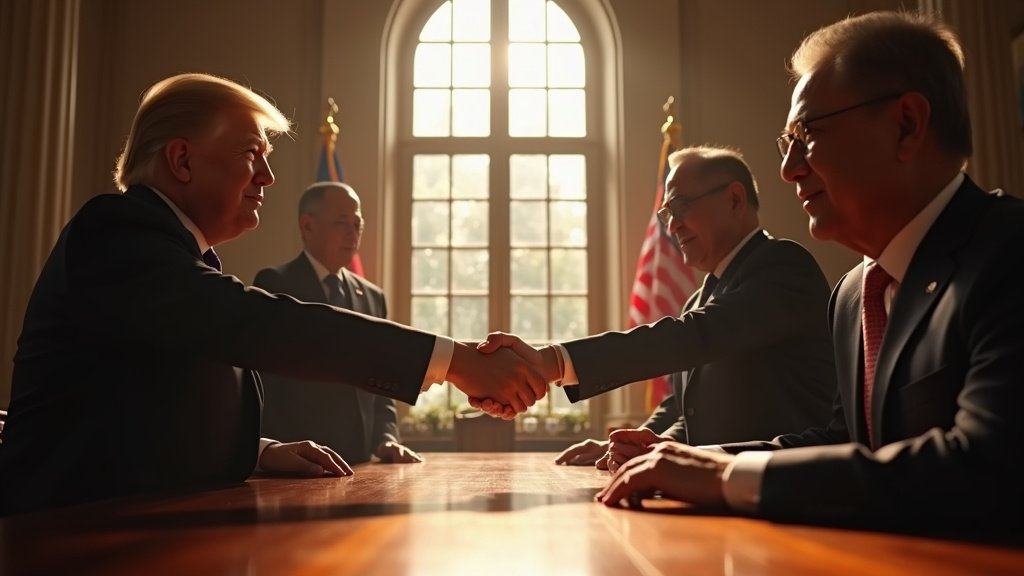
KUALA LUMPUR – In a significant diplomatic coup on October 26, 2025, U.S. President Donald Trump oversaw the signing of a landmark ceasefire agreement between Thailand and Cambodia, aimed at de-escalating months of tense border clashes. The historic accord, brokered during the 47th ASEAN Summit in Kuala Lumpur, marks a pivotal moment for regional stability and highlights the administration’s renewed focus on diplomatic engagement in Southeast Asia.
Historic Peace Accord Signed Between Thailand and Cambodia
The agreement between Thailand and Cambodia comes after a prolonged period of friction and sporadic armed engagements along their shared border. The roots of this dispute are deeply entwined with colonial-era boundary demarcations, particularly those stemming from the Franco-Siamese treaties of 1904 and 1907, which left significant stretches of the border ambiguously defined. Tensions have repeatedly flared over the years, most notably around ancient temple sites like Preah Vihear and Prasat Ta Muen Thom, areas bearing immense cultural and nationalistic significance for both nations.
Recent fighting in 2025, particularly in July, saw intense exchanges of artillery, rockets, and aerial engagements, resulting in casualties and displacement, underscoring the urgent need for a diplomatic resolution. While ASEAN has consistently strived to mediate such disputes through its established principles of consensus and non-interference, the direct involvement of President Trump in facilitating this breakthrough signifies a substantial diplomatic effort that bypasses some of the usual ASEAN-led processes. The accord, formally known as the Kuala Lumpur Peace Accord, was reportedly facilitated by Malaysia, with the U.S. observing the proceedings. This development promises to usher in an era of greater calm and cooperation along the Thai-Cambodian frontier, contributing significantly to the overall peace in Southeast Asia.
US and China Reach Framework Agreement to Avert Escalating Tariffs
In parallel to the regional peace efforts, the ASEAN Summit also served as a crucial venue for high-stakes international economic diplomacy. Sources confirm that the United States and China have reached a framework agreement intended to avert President Trump’s threatened 100% tariffs on Chinese imports [initial context]. This development comes amidst a period of intense trade friction between the world’s two largest economies, characterized by escalating tariffs and counter-tariffs throughout early 2025.
Earlier this year, tariffs had reached unprecedented levels, with the U.S. imposing duties that approached 145% on certain Chinese goods, and China retaliating with its own significant tariffs. A temporary truce and reduction in tariffs were achieved in May 2025 after talks in Geneva, but uncertainty persisted regarding a long-term resolution. The framework agreement announced today signifies a crucial de-escalation, with both sides reportedly aiming for a final, comprehensive deal at the upcoming APEC meeting scheduled to be held in Gyeongju, South Korea [initial context]. This breakthrough is anticipated to bring much-needed stability to global markets and supply chains, which have been significantly disrupted by the protracted trade dispute.
Secretary Rubio Navigates Complex Diplomatic Landscape
U.S. Secretary of State Marco Rubio played a prominent role at the ASEAN Summit, engaging in a series of critical bilateral and multilateral discussions. He reaffirmed strong U.S.-India relations amidst prevailing trade tensions and concurrent U.S. engagement with Pakistan [initial context]. Rubio emphasized that the United States’ evolving relationship with Pakistan is not intended to undermine its ties with India, navigating a historically delicate geopolitical balance.
Rubio’s diplomatic agenda also focused on countering China’s growing influence and ensuring regional peace and security, particularly concerning the contentious South China Sea. He held productive discussions with his Chinese counterpart, Foreign Minister Wang Yi, which were described as positive and constructive, aimed at fostering stability in the bilateral relationship and potentially paving the way for a summit between President Trump and Chinese President Xi. Rubio also highlighted the significant U.S. investment and strategic partnership in Southeast Asia, noting ASEAN’s central role in the region’s diplomatic and economic architecture. The U.S. has sought to reassure regional partners of its commitment, even as trade policies have created complex dynamics.
ASEAN Summit: A Global Nexus for Diplomacy and Trade
The 47th ASEAN Summit in Kuala Lumpur has once again underscored the bloc’s pivotal role as a hub for international diplomacy, trade, and conflict resolution. President Trump’s decision to personally attend the summit signaled a renewed commitment to Southeast Asia, a region increasingly positioned at the crossroads of global power competition. The summit’s agenda reflected a broad spectrum of pressing world news, from averting major trade wars to brokering peace in long-standing regional disputes.
Beyond the headline agreements, the summit provided a platform for leaders to address a myriad of global challenges, including economic resilience, supply chain security, and the promotion of a rules-based international order. The engagements this week in Kuala Lumpur demonstrate ASEAN’s capacity to facilitate dialogue and forge consensus among diverse stakeholders, shaping the geopolitical and economic landscape for the coming year. The news from this summit underscores the complex, interconnected nature of today’s world, where regional diplomacy has profound global implications. The outcomes achieved this week will undoubtedly resonate across the globe, impacting international relations and trade dynamics for the foreseeable future.