
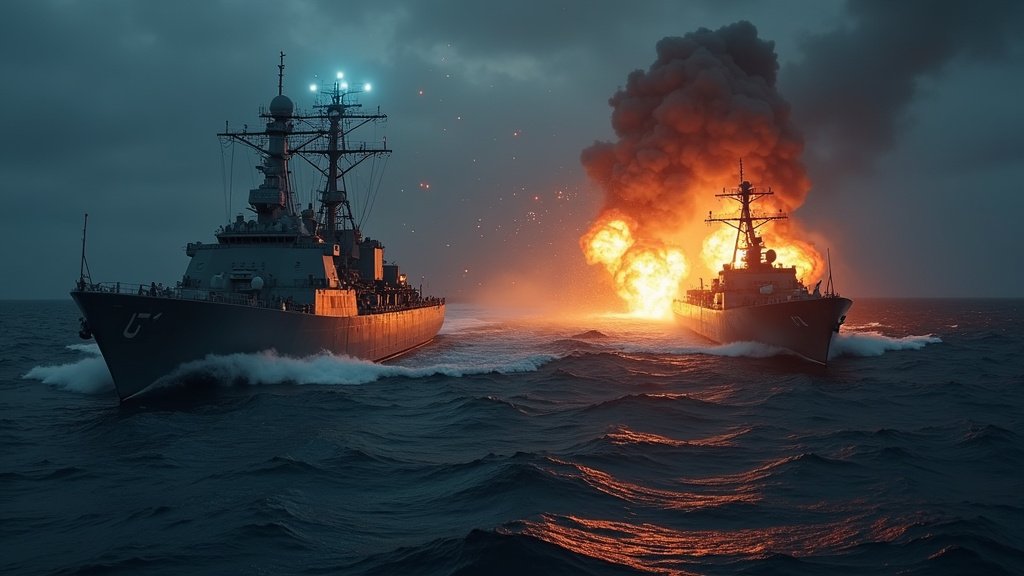
WASHINGTON D.C. – The United States has declared a formal “armed conflict” against international drug cartels, escalating its military operations in the Caribbean and Eastern Pacific with a series of deadly strikes on suspected drug-smuggling vessels. President Donald Trump officially notified Congress on October 1, 2025, that the U.S. was engaged in a “non-international armed conflict” with “unlawful combatants” operating as drug cartels, a designation aimed at justifying increased military action.
This declaration follows a surge of U.S. Navy airstrikes that began in September 2025. The first major kinetic strike occurred on September 1, 2025, when a U.S. Navy vessel destroyed a boat departing from Venezuela, resulting in the deaths of all eleven people on board. Venezuelan sources confirmed the incident took place on September 1. The following day, Secretary of Defense Pete Hegseth stated that military operations against drug cartels would continue, and Secretary of State Marco Rubio suggested similar strikes were possible.
Operation Southern Spear: A New Front Against Trafficking
These actions are part of “Operation Southern Spear,” a comprehensive U.S. military and surveillance campaign formally unveiled on November 13, 2025, by Secretary Hegseth. The operation leverages a hybrid fleet of advanced robotic and autonomous systems alongside traditional naval forces to detect and combat drug trafficking networks across the Western Hemisphere. The initiative is coordinated by U.S. Southern Command (USSOUTHCOM) and its U.S. 4th Fleet, with a joint task force established in October to target cartels operating in the region.
“Operation Southern Spear defends our Homeland, removes narco-terrorists from our Hemisphere, and secures our Homeland from the drugs that are killing our people,” Hegseth stated via social media, emphasizing the Western Hemisphere as “America’s neighborhood” that must be protected. The campaign has seen a significant naval buildup, including the deployment of the USS Gerald R. Ford, the world’s largest aircraft carrier, to the Caribbean Sea around mid-November.
Escalation and Casualties in the Caribbean
As of November 16, 2025, the U.S. military has conducted at least 21 strikes on 22 vessels in the Caribbean and Eastern Pacific, resulting in the deaths of at least 83 individuals, with two survivors reported. The strikes have targeted vessels alleged to be operated by narcoterrorist organizations, including Venezuela’s Tren de Aragua and Colombia’s National Liberation Army, though the U.S. has not publicly disclosed evidence supporting these allegations.
President Trump has characterized cartel members as “unlawful combatants” and stated the strikes are necessary to prevent lethal drugs from reaching American shores. He has also used the platform to criticize Venezuelan President Nicolás Maduro, labeling him and his regime as complicit in drug trafficking and offering a reward for Maduro’s arrest.
Legal and International Scrutiny
The Trump administration’s approach has drawn significant criticism and raised legal questions. Legal experts and some lawmakers have questioned the legality of the strikes, with some labeling them “sanctioned murder” or “extrajudicial killings”. Critics argue that drug trafficking alone does not meet the threshold for an “armed conflict” under international law and that the U.S. has not provided evidence for its claims about the cargo or the identities of those targeted.
International reactions have been mixed, with some allies expressing concern. French Foreign Minister Jean-Noël Barrot stated that the operations “disregard international law” and could cause instability in the region, particularly affecting French territories in the Caribbean. Reports have also emerged of the United Kingdom and Canada suspending intelligence sharing with the U.S. over concerns about the legality and potential implications of the strikes, though Secretary Rubio has dismissed these reports as “false”. Colombia has also suspended intelligence sharing, with President Gustavo Petro stating that “the fight against drugs must be subordinated to the human rights of the Caribbean people”.
Regional Tensions and Shifting Routes
The intensified U.S. military presence and strikes have coincided with heightened tensions between the United States and Venezuela. Venezuela has responded by announcing a “massive deployment” of its military forces, including nearly 200,000 troops, to counter the U.S. naval buildup off its coast.
Analysts suggest the U.S. objective may extend beyond counter-narcotics, with some speculating that the operations serve as pressure tactics against the Maduro regime, potentially aiming for regime change. Meanwhile, drug cartels are reportedly adapting their smuggling routes to avoid the increased U.S. presence, leading to concerns that the strikes may merely reroute, rather than eliminate, trafficking flows.
The Trump administration, however, remains committed to its strategy, with Secretary Hegseth vowing that “narco-terrorists will face the same fate” and that the mission will continue to protect American citizens from illicit drugs. The ongoing escalation in the Caribbean signals a significant, and potentially prolonged, new phase in the U.S. approach to combating drug trafficking and its perceived threats to national security.