
U.S. Conducts 20th Strike in Caribbean, Killing Four Amidst Escalating ‘Operation Southern Spear’
WASHINGTON D.C. – November 14, 2025 – The United States military has conducted its 20th strike on an alleged drug-running boat in the Caribbean Sea, resulting in the deaths of four individuals. The operation, which took place on Monday, November 10, 2025, marks a significant escalation in the Trump administration’s intensified campaign against alleged narcotics trafficking and “narco-terrorism” throughout the Western Hemisphere.
The intensified military campaign was formally christened “Operation Southern Spear” by Defense Secretary Pete Hegseth on November 13, 2025. This broad initiative, ordered by President Donald Trump, aims to “defend our Homeland, remove narco-terrorists from our Hemisphere, and secure our Homeland from the drugs that are killing our people,” according to Hegseth’s social media pronouncements. U.S. Southern Command (SOUTHCOM) has stated that intelligence confirmed the targeted vessel was engaged in illicit narcotics smuggling along a recognized trafficking route.
This latest strike brings the total number of U.S. military operations against suspected drug vessels in the Caribbean and Eastern Pacific to approximately 20 to 21 since early September 2025, with an estimated death toll ranging from 80 to 83 individuals. The administration has, however, not publicly presented evidence substantiating its claims that those killed were “narco-terrorists”.
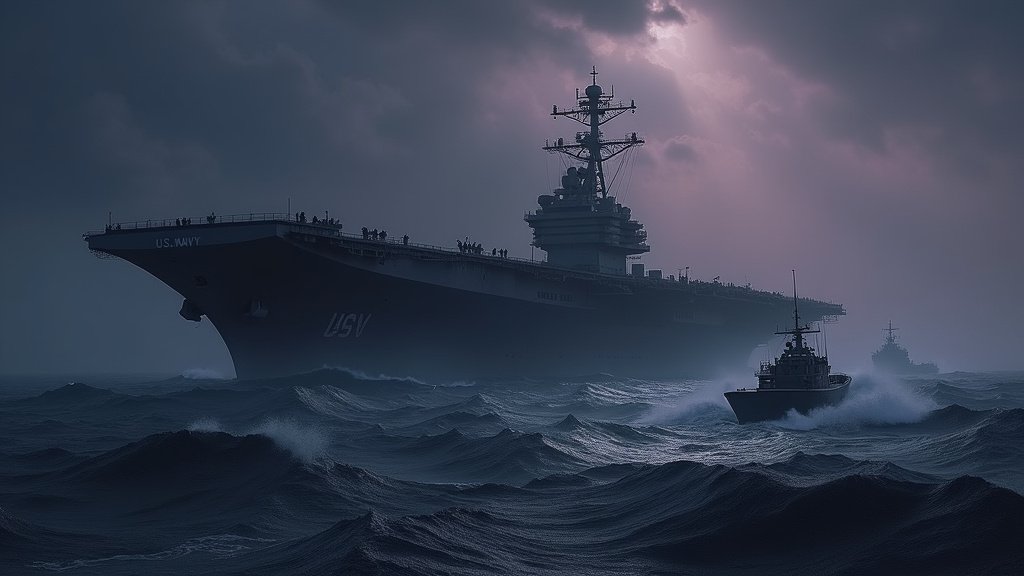
The military posture in the region has been dramatically amplified by the arrival of the USS Gerald R. Ford aircraft carrier strike group in the Caribbean Sea on November 16, 2025. This formidable naval deployment, comprising the world’s largest aircraft carrier, numerous escort warships, and approximately 12,000 U.S. personnel, constitutes the most substantial U.S. military presence in the Caribbean in decades, signaling a significant increase in operational capabilities and regional engagement.
Operation Southern Spear: A New Phase of Counter-Narcotics
Operation Southern Spear, under the leadership of SOUTHCOM and Joint Task Force Southern Spear, is designed to disrupt maritime narcotics networks. The operation integrates advanced robotics and autonomous systems with traditional naval forces, aiming to enhance maritime domain awareness and counter-narcotics efforts. The initiative underscores the Trump administration’s commitment to combating drug trafficking, a policy framework that has seen the U.S. military conduct numerous lethal strikes against vessels suspected of carrying illegal substances. The U.S. Coast Guard has also reported record-breaking cocaine seizures for Fiscal Year 2025, seizing nearly 510,000 pounds in the Eastern Pacific Ocean and Caribbean.
International Condemnation and Legal Concerns
The escalating U.S. military actions in the Caribbean have not gone unnoticed internationally, drawing significant criticism and raising serious legal questions. The UN High Commissioner for Human Rights has warned that the repeated lethal attacks on boats may constitute potential international crimes and violate international human rights law, calling for transparent investigations. France has publicly stated that the U.S. operations disregard international law.
Russia has vehemently condemned what it terms “excessive military force,” arguing that such actions violate international law and set a dangerous precedent that destabilizes the region, while simultaneously reaffirming its support for Venezuela. In response to these concerns, several nations, including the United Kingdom, Canada, and Colombia, have reportedly halted intelligence sharing with the United States, citing doubts about the legality and evidentiary basis of the strikes. Legal scholars have also raised concerns that the strikes may constitute illegal extrajudicial killings under maritime law and human rights law.
Geopolitical Ripples: Venezuela and Regional Stability
The heightened U.S. military presence and ongoing strikes have amplified geopolitical tensions, particularly concerning Venezuela. Caracas has characterized the U.S. buildup as a threatening gesture and a potential precursor to regime change efforts. The Trump administration has implicated Venezuelan President Nicolás Maduro and his government in drug trafficking, notably by designating Venezuela’s alleged “Cartel de los Soles” as a Foreign Terrorist Organization.
While the U.S. administration asserts that its naval buildup is primarily focused on interdicting drug flows into the United States, critics and international legal experts contend that the operations blur the lines between legitimate law enforcement and military action. Concerns have been raised that these actions may violate international maritime and human rights laws, particularly given the lack of judicial oversight and public evidence. The legality of the U.S. approach is further scrutinized by the absence of clear evidence, leading to questions about whether the administration is adhering to established international legal frameworks and the War Powers Act.
The unfolding situation in the Caribbean highlights a complex interplay of national security objectives, international law, and regional stability. The continuous stream of news surrounding these events underscores the evolving nature of U.S. foreign policy and its impact on the global lifestyle and security landscape, as nations grapple with the implications of assertive military actions and the persistent challenge of drug trafficking.