
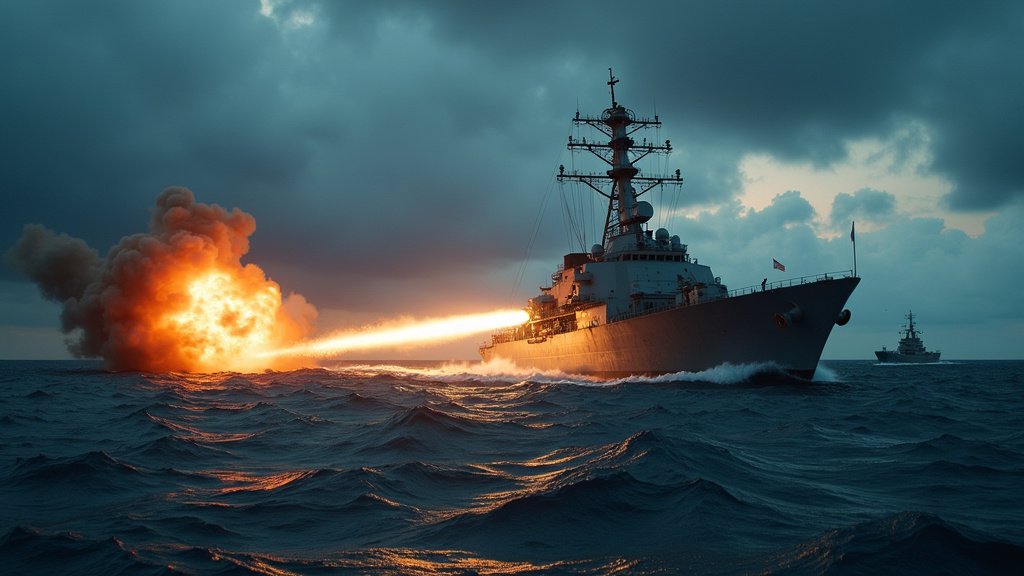
The United States has carried out its fifth deadly strike in the Caribbean in recent weeks, targeting a vessel believed to be involved in drug trafficking near Venezuela’s coast on Tuesday, October 14, 2025. The operation resulted in the deaths of six individuals aboard the boat, President Donald Trump announced via social media platform Truth Social. No U.S. forces were harmed in the engagement.
This incident is the latest in a series of aggressive maritime actions by the U.S. military in the region, which began in early September 2025. The Trump administration has framed these operations as a critical component of its broader strategy to combat drug cartels and “narco-terrorist” networks, which it claims pose a significant threat to U.S. national security. The escalating actions have intensified existing tensions between the United States and Venezuela, raising significant concerns about regional stability and the legality of the U.S. military’s expanding role in counternarcotics efforts.
Escalation in the Caribbean: A Pattern of Strikes
The October 14th strike marks a significant point in a rapidly unfolding campaign. Since September 2, 2025, U.S. forces have conducted numerous lethal operations against vessels in international waters, primarily in the Caribbean Sea and increasingly in the Eastern Pacific Ocean. According to reports, by mid-November 2025, at least 83 people had been killed across more than 20 separate strikes on alleged drug-smuggling boats. The fifth strike, in particular, occurred in international waters off the Venezuelan coast, with President Trump asserting that intelligence confirmed the vessel was trafficking narcotics and was affiliated with “narcoterrorist networks”. He also shared video footage appearing to show the vessel being struck by a missile.
This intensified posture represents a significant shift from traditional U.S. counternarcotics policy, which historically relied on law enforcement agencies like the Coast Guard for interdiction rather than direct military engagement. The Trump administration justified this change by arguing that previous interdiction methods had proven ineffective over decades. The deployment of naval assets, including the arrival of the USS Gerald R. Ford carrier strike group in November, underscores the scale of this broadened military commitment in the Caribbean and broader Western Hemisphere.
Legal and International Scrutiny Mounts
Despite the U.S. government’s justifications, the operations have drawn substantial criticism from various quarters. Human rights groups, legal experts, and international bodies have questioned the legality and proportionality of these strikes. Critics argue that the individuals aboard the targeted vessels, even if involved in smuggling, do not meet the legal definition of unlawful combatants, making the lethal force employed akin to extrajudicial killings.
Venezuela and Colombia, among other nations, have vehemently condemned the U.S. actions. Venezuela’s Foreign Minister Yvan Gil stated that the attacks violated fundamental principles of international law. President Nicolás Maduro has characterized the strikes as “serial executions” and accused the United States of seeking regime change under the guise of combating drug trafficking, suggesting the true intention is to gain control over Venezuela’s natural resources. The United Kingdom has suspended intelligence sharing with the U.S. on suspected drug trafficking vessels due to doubts about the legality of Washington’s practices.
US-Venezuela Tensions and Broader Geopolitical Context
The maritime strikes are set against a backdrop of prolonged political and economic tension between the United States and Venezuela. The U.S. has long accused President Maduro’s government of corruption and involvement in illicit drug trade, even doubling a bounty for his arrest to $50 million. The Trump administration has formally declared that the U.S. is in an “armed conflict” with drug cartels, designating them as “unlawful combatants”. This declaration, made to Congress, serves as a legal basis for the military operations, allowing for actions that differ from traditional law enforcement approaches.
However, many experts and critics question whether the primary U.S. objective is genuinely to interdict drugs or to exert pressure on the Maduro regime. Reports from the U.S. Drug Enforcement Administration have indicated that Venezuela is not a primary source of drugs entering the U.S.. The expansion of U.S. military presence and aggressive tactics in the Caribbean are viewed by some as a geopolitical maneuver to increase U.S. influence and potentially destabilize the region rather than solely address narcotics flow.
Domestic Disquiet and the Path Forward
Domestically, the U.S. military campaign has also faced scrutiny. While some Republicans have sought more information from the White House, Democrats have voiced stronger objections, arguing the strikes contravene both U.S. and international law. A recent Senate resolution aimed at limiting the President’s authority for such strikes ultimately failed to pass, highlighting the deep divisions on Capitol Hill regarding the executive branch’s use of military force.
The current news from the Caribbean indicates a significant escalation in U.S. foreign policy and military engagement. The administration’s assertive stance, characterized by lethal strikes against suspected drug smugglers, has been met with international condemnation and domestic debate. As the operations continue, the legality, effectiveness, and long-term geopolitical consequences for the Caribbean and U.S.-Venezuelan relations remain subjects of intense scrutiny and concern, with the region potentially facing a more dangerous chapter.