
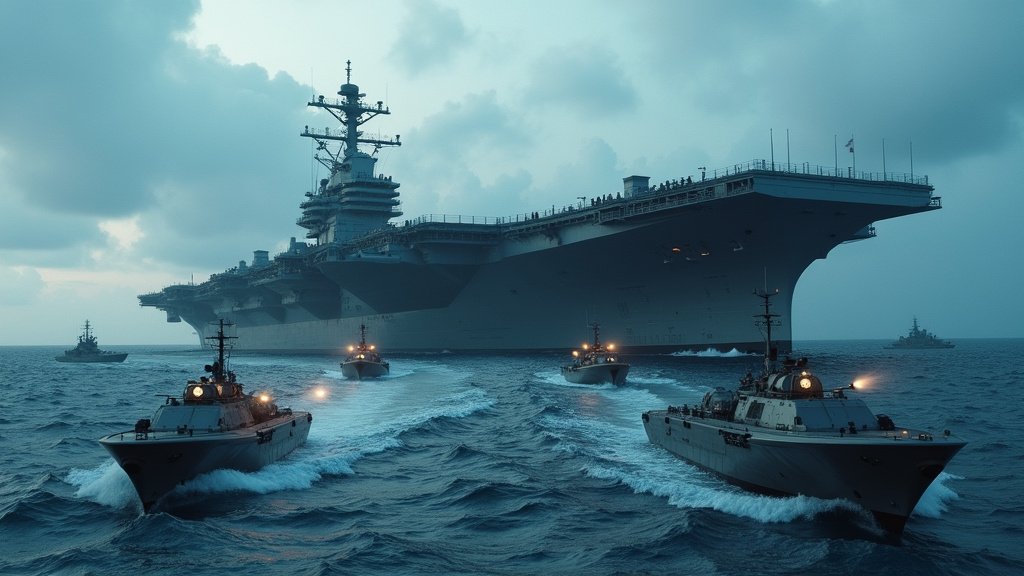
Caribbean Sea – The United States has dramatically intensified its military posture in the Caribbean region with the arrival of the USS Gerald R. Ford, the world’s largest and most advanced aircraft carrier. This significant deployment, part of the newly unveiled Operation Southern Spear, marks the largest naval buildup in the Caribbean in decades and escalates ongoing tensions with Venezuela. The operation, formally announced by Defense Secretary Pete Hegseth on November 13, 2025, under President Trump’s directive, is officially framed as a counter-narcotics initiative aimed at dismantling drug trafficking networks throughout the Western Hemisphere.
Operation Southern Spear: Counter-Narcotics and Advanced Technology
Operation Southern Spear represents a multifaceted US military and surveillance campaign designed to detect, monitor, and disrupt drug-trafficking networks operating across the Caribbean and eastern Pacific. The operation is notable for its integration of a hybrid fleet, utilizing robotics and autonomous systems alongside traditional naval forces. This includes long-endurance robotic surface vessels, interceptor boats, and unmanned aerial vehicles, intended for round-the-clock surveillance. The US Defense Department states the mission’s aims include defending the homeland, removing “narco-terrorists,” and securing US borders from drug smuggling. This initiative also serves as a testing ground for advanced naval technologies, with the US Navy seeking to operationalize robotic systems in maritime environments.
Unprecedented Scale of Military Presence
The arrival of the USS Gerald R. Ford and its associated strike group adds formidable firepower to an already substantial US military presence in the regional waters. The deployment now comprises nearly a dozen Navy ships, including guided-missile destroyers and amphibious assault ships, supported by thousands of personnel. In total, approximately 12,000 US sailors and Marines are operating in the Caribbean and eastern Pacific as part of this operation. This concentration of forces is the largest seen in the Caribbean in decades, rivaling deployments from the Cold War era and potentially surpassing those seen during the 1989 invasion of Panama. Military bases, including the Roosevelt Roads Naval Station in Puerto Rico, are being rehabilitated and utilized as staging areas for these expanded operations.
US Justifications and Recent Strikes
The Trump administration has consistently justified the military buildup and Operation Southern Spear as crucial for combating the flow of narcotics into the United States and neutralizing threats posed by “narco-terrorists”. This rationale has accompanied a series of US military strikes against vessels suspected of transporting drugs since early September 2025. These interdictions have reportedly resulted in the deaths of approximately 70 to 83 individuals across more than 20 vessels. The administration has also moved to designate Venezuela’s “Cartel de los Soles,” which it alleges is led by President Nicolás Maduro and other high-ranking regime officials, as a foreign terrorist organization, a designation set to take effect on November 24, 2025.
Venezuela’s Strong Reaction and Mobilization
Venezuelan President Nicolás Maduro has vehemently denounced the US military buildup, accusing Washington of fabricating a pretext for potential military intervention and regime change aimed at controlling Venezuela’s oil resources. In response to the escalating US presence, Venezuela has declared a state of “maximum alert” and placed its military on full operational readiness. The country has announced a large-scale military mobilization, reportedly involving hundreds of thousands of troops and a “massive deployment of ground, aerial, naval, riverine, and missile forces”. Maduro has characterized the US naval deployment as the “greatest threat our continent has faced in the past 100 years”. Despite these strong condemnations and military preparations, there have been indications that diplomatic discussions between the US and Venezuela may be possible, though the specifics remain unclear.
Geopolitical Tensions and Regional Concerns
The increased US military footprint in the Caribbean has generated significant concern among regional governments and international observers. While some nations, like Trinidad and Tobago, have expressed support for the US operation, others, including Cuba, have condemned the US military presence. France and Russia have voiced criticism, with French officials suggesting US operations may violate international law and Russian officials labeling US actions as those of “lawless countries”.
Many analysts view the entire deployment and the associated strikes as a strategic pressure campaign aimed at forcing Maduro’s resignation, rather than solely a counter-narcotics effort. The lack of public evidence supporting the claim that all targeted individuals were “narco-terrorists” has also raised ethical and legal questions, with some critics suggesting the actions amount to extrajudicial killings. The uncertainty over potential US actions, including the possibility of striking land targets within Venezuela, has created unease throughout the region. The ongoing military exercises and the substantial presence of US forces underscore the complex geopolitical dynamics at play in the Caribbean today.