
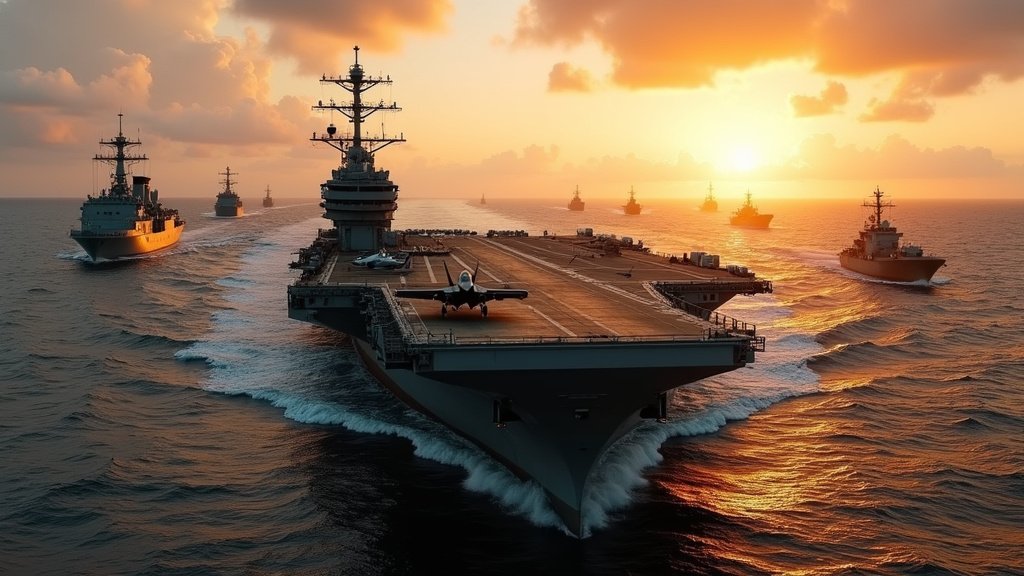
The United States has dramatically increased its military presence in the Caribbean with the arrival of the USS Gerald R. Ford, its most advanced aircraft carrier, marking a significant escalation of pressure on Venezuelan President Nicolás Maduro. This major naval deployment, part of a broader U.S. military initiative codenamed “Operation Southern Spear,” involves nearly a dozen warships and approximately 12,000 sailors and Marines, signaling the largest U.S. military buildup in the region in decades.
U.S. Navy’s Most Advanced Carrier Arrives in Caribbean
The USS Gerald R. Ford Carrier Strike Group entered the Caribbean Sea on November 16, 2025, bolstering an already substantial American naval force operating in the region. The deployment includes the formidable carrier itself, accompanied by guided-missile destroyers and other escort vessels, carrying a full complement of advanced aircraft, including F-35C stealth fighters. This marks a powerful projection of U.S. military capability, designed to assert dominance and influence in a strategically vital area. The carrier group’s mission, as stated by U.S. Southern Command, is to “protect our nation’s security and prosperity against narco-terrorism in the Western Hemisphere.”
‘Operation Southern Spear’: Objectives and Rationale
Announced by Secretary of War Pete Hegseth, “Operation Southern Spear” is framed by the U.S. administration as a critical mission to “dismantle transnational criminal organizations” and “counter drug terrorism.” This operation has been accompanied by a series of controversial U.S. military strikes against vessels suspected of transporting illicit drugs. Since September 2025, the U.S. has reportedly conducted at least 21 airstrikes on suspected drug-smuggling boats in the Caribbean and the Eastern Pacific, resulting in the deaths of approximately 80-83 individuals, according to various reports.
The administration has characterized the targets as “narco-terrorists,” a designation that has drawn significant criticism and calls for evidence from international bodies, U.S. allies, and members of Congress. The United Nations human rights chief has deemed these strikes “unacceptable” and a violation of international law. Venezuela has vehemently denounced the actions, calling them “illegal,” “aggression,” and an attempt by the U.S. to fabricate a war.
Escalating Pressure on Nicolás Maduro
Beyond the stated counter-narcotics objectives, the deployment is widely interpreted as a direct and escalating pressure tactic aimed at compelling Venezuelan President Nicolás Maduro to step down. U.S. policy has long sought to remove Maduro from power, with the U.S. government having ceased to recognize him as Venezuela’s legitimate leader in January 2019. Secretary of State Marco Rubio announced plans to designate Venezuela’s “Cartel de los Soles”—a network alleged to include high-ranking military and government officials complicit in drug trafficking—as a Foreign Terrorist Organization. This move effectively labels Maduro as a “drug cartel boss” and broadens the potential scope for U.S. military actions.
Maduro and his government have responded to the increased U.S. military presence and pressure by mobilizing Venezuelan troops and civilians for defensive exercises, accusing the U.S. of seeking regime change. Venezuela’s president has also indicated a willingness for discussions with President Trump, though the context of these potential talks remains unclear amidst the heightened tensions.
Regional Reactions and Broader Implications
The significant U.S. military buildup has generated alarm across the region. Leaders and experts have expressed concern over the escalating U.S. posture, with some, like Colombian President Gustavo Petro, describing the military assembly as “an unmistakable act of aggression against Latin America.” This move is seen by some as a revival of the “Monroe Doctrine,” reasserting U.S. dominance in its traditional sphere of influence, especially as it occurs amid rising geopolitical competition with Russia and China in Latin America.
The arrival of the USS Gerald R. Ford, the world’s largest and most advanced aircraft carrier, fundamentally shifts the military balance of power in the Caribbean. Its operational capabilities, supported by an extensive array of tactical aircraft and naval escorts, provide the U.S. with air and maritime dominance, far surpassing the capabilities of Venezuela’s air force. While the deployment aims to deter escalation and pressure Maduro, it also carries inherent risks of miscalculation or unintended consequences, as experts debate the potential for a protracted conflict or regional instability.
The current news highlights a complex interplay of counter-narcotics efforts, political objectives, and geopolitical strategy in the Caribbean today. As “Operation Southern Spear” continues, the region watches closely for the next moves in this high-stakes geopolitical drama, with implications reaching far beyond Venezuela itself.