
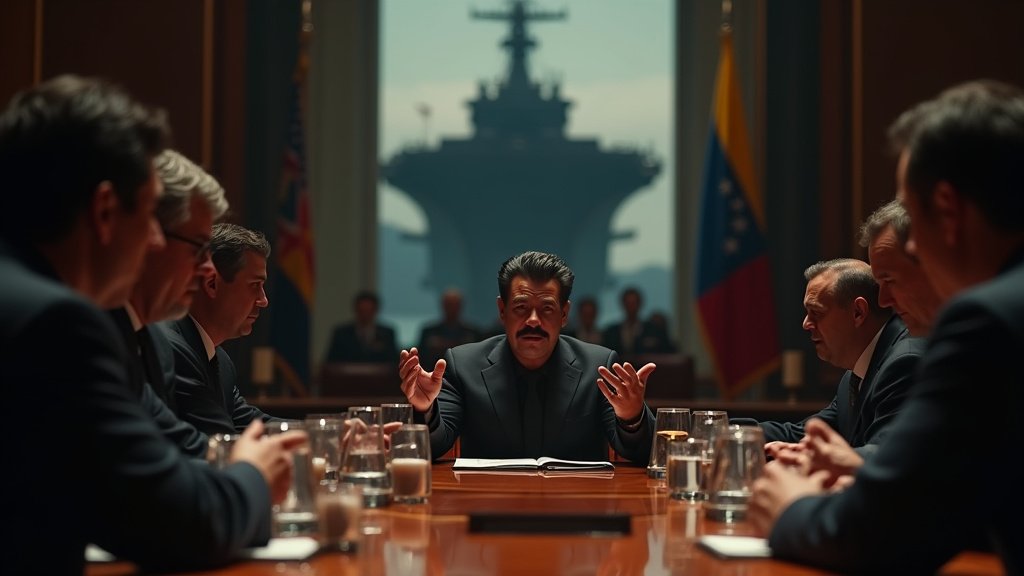
Caracas, Venezuela – President Nicolás Maduro has emphatically declared Venezuela’s commitment to peace in the Caribbean, starkly rejecting what he describes as “imperialist ambitions” from the United States that he argues threaten regional stability. These statements emerge as the US significantly escalates its military presence and conducts a series of deadly strikes against vessels near Venezuelan waters, fueling anxieties about the geopolitical landscape in Latin America and the Caribbean.
Maduro’s Call for Peace and Accusations
Speaking at a meeting of the National Sovereignty and Peace Council in Caracas, President Maduro asserted that Venezuela “does not want war in the Caribbean or in Latin America – we only want peace.” He accused Washington of expanding its military footprint in the region to “impose a single way of thinking, a single system, and a single authority,” sentiments he declared belong to a “long over” era. Maduro also broadened his critique, blaming the CIA for “negative events” in several countries and urging Latin American nations to unite against foreign interference. He further condemned what he termed “racist and xenophobic discourse” that associates Venezuelan identity with crime, emphasizing that his people are “dignified, compassionate, and hardworking.”
Escalating US Military Posture and Operations
The heightened rhetoric from Caracas coincides with a substantial increase in US military activity in the Caribbean. The Pentagon has deployed its most advanced units and weapons, marking one of the largest US military buildups in the region in decades. Key assets include the USS Gerald R. Ford aircraft carrier, numerous warships, submarines, and advanced fighter jets like the F-35. The stated justification for this deployment, dubbed “Operation Southern Spear,” is to combat Latin American drug cartels and stem the flow of narcotics into the United States, following a decree by President Trump authorizing broader force deployment against these groups.
However, this operation has involved a series of lethal strikes on at least 22 alleged drug-smuggling boats since September, resulting in the deaths of over 80 people. Critics, including international law experts and some regional governments, have questioned the legality of these strikes, with Venezuela and Colombia asserting they constitute extrajudicial killings. The US has not publicly presented evidence linking the occupants of the targeted boats to drug smuggling.
Furthermore, media reports and analysts suggest that beyond counter-narcotics, a key objective of the US military buildup may be to pressure for regime change in Venezuela. President Trump himself has not ruled out sending US troops into Venezuela.
Venezuela’s Response and Readiness
In response to the US military buildup, Venezuela has announced a “massive” nationwide mobilization of its armed forces and civilian militias. This mobilization is part of the “Independence Plan 200” or “Independence Plan 2025,” a strategy aimed at bolstering the country’s defense capabilities. The nation claims to have approximately 337,000 active military personnel, supported by millions in its militia. President Maduro has declared the country ready to defend its sovereignty and repel any aggression, though acknowledging the significant disparity in military power compared to the United States. Venezuela has also activated extraordinary constitutional measures granting Maduro expanded security powers. In a diplomatic move, Venezuela has requested an emergency session of the UN Security Council to address the escalating situation.
Regional Implications and International Reactions
The rising tensions are a significant concern for regional stability in the Caribbean and Latin America. While the US frames its actions as a counternarcotics effort, many international observers and regional leaders view it as an aggressive tactic. France’s Foreign Minister has publicly criticized the US strikes, stating they “disregard international law.” Other nations like Cuba and Nicaragua have expressed solidarity with Venezuela.
Despite the military posturing, there have been indications of potential dialogue. Both Presidents Maduro and Trump have publicly expressed openness to talks. However, the underlying issues of geopolitical influence, regional security, and the legitimacy of the Venezuelan government remain central to the ongoing news from the Caribbean today.