
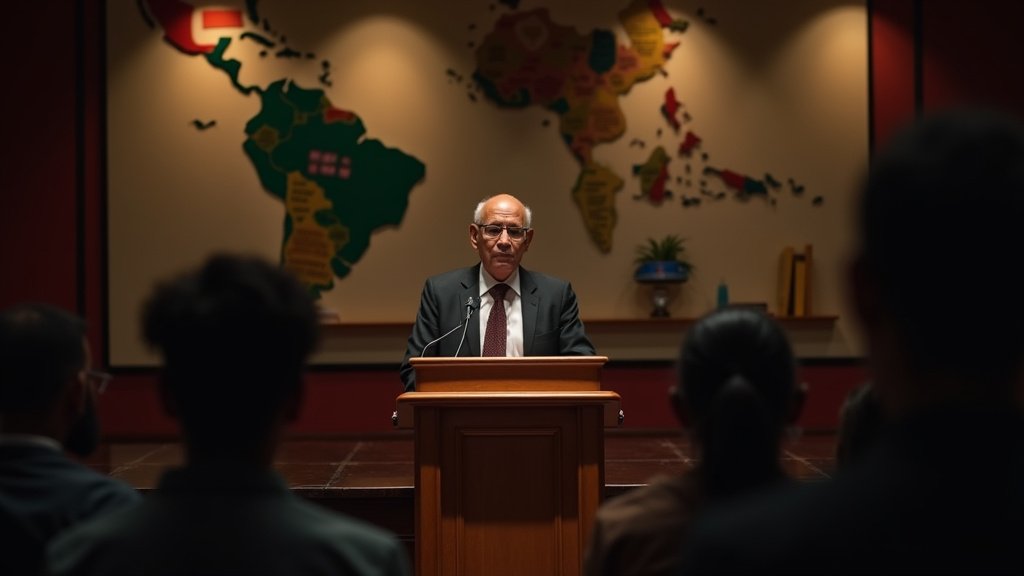
Dr. Vishnu Bisram, a renowned scholar and journalist, recently delivered an insightful keynote address at Jawaharlal Nehru University (JNU) in Delhi. The symposium, organized by JNU’s Department of African Studies, focused on the African and Caribbean diasporas. Dr. Bisram shared his extensive knowledge on these communities. His address highlighted the profound historical experiences of both the African and Indian diasporas in the Caribbean.
A Scholar’s Deep Dive into Caribbean Diasporas
Dr. Bisram, an internationally recognized Guyanese scholar, presented on “The Indian and African Diasporas in Guyana and the Caribbean: Identity and Role in Economic Development” on December 2, 2025. This event marked a significant academic discourse on the formation and influence of these diasporic groups. Dr. Bisram is known for his deep academic background. He holds degrees in natural sciences, social sciences, humanities, and education. He studied in Guyana, the USA, and India. This broad educational foundation informs his comprehensive analysis.
The scholar is a prolific writer on diaspora matters. He has published numerous articles on the Indian diaspora. He has also spoken at international conferences. These events took place in Fiji, Mauritius, South Africa, the Caribbean, USA, Mexico, and Canada. Dr. Bisram is considered an authority on various diasporas. His expertise extends to Latino, Caribbean, and Asian diasporas. This was his second time speaking on the Indian diaspora in Delhi. He had previously addressed the India International Habitat Center in January. This JNU address was his first focused on the African diaspora in the region.
Historical Roots: Slavery and Indentured Labor
Dr. Bisram’s keynote delved into the historical underpinnings of Caribbean societies. He discussed the Atlantic Slave Trade. This brutal system forcibly brought millions of Africans to the Americas. He also spoke about indentured labor migration. This included various groups like Portuguese, Chinese, and Indians. These migrations shaped the demographic and cultural fabric of the Caribbean. Dr. Bisram underscored that both slavery and indentureship were dehumanizing. He described them as severe violations of human rights. Slavery, he stated, was a crime against humanity. Indian indentureship was similarly oppressive.
The transatlantic slave trade brought approximately 10 to 12 million Africans to the Americas. These enslaved people provided labor for plantations. The Caribbean received a substantial portion of this forced migration. Following the abolition of slavery, colonial powers sought new labor sources. This led to the system of indentured servitude. Indians, in particular, were brought to the Caribbean as indentured laborers. They worked on sugar plantations. This migration began in the mid-19th century. Many of these laborers came from Eastern Uttar Pradesh and Bihar in India.
Preserving Heritage Across Oceans
A key theme of Dr. Bisram’s address was the enduring connection of the Indian diaspora to their ancestral homeland. He highlighted that unlike many other groups, Indians have largely retained transnational and cultural linkages with India. This ability to maintain connections across vast distances is a significant aspect of their diasporic experience. Their resilience in preserving culture under colonial conditions is notable. The descendants of indentured laborers, known as Girmitiyas, worked hard to maintain their identity.
The Indian diaspora in the Caribbean is a diverse community today. It has significantly shaped the islands’ cultural, social, and economic landscapes. Despite facing immense challenges like grueling labor and exploitation, they showed remarkable resilience. This allowed them to establish a distinct Indian identity and create vibrant communities. They have maintained traditional customs, religious festivals, and cultural practices. This cultural continuity is a testament to their enduring spirit.
Dr. Bisram’s Broader Impact
Dr. Bisram’s engagement at JNU is part of his extensive work on diasporas. He has a lifelong commitment to community upliftment. He has sponsored programs in his ancestral villages in India for two decades. He has also been involved in activism in the USA and Guyana. He was instrumental in movements for free and fair elections in Guyana. Dr. Bisram’s scholarly contributions are extensive. He has penned groundbreaking writings on the Indian Caribbean Diaspora in the USA. He is recognized for coining terms like “Indian Diaspora” in the late 1970s.
His academic credentials are also impressive. He holds multiple degrees. These include PhDs in History, Sociology, and Political Science, with coursework in Economics. He has taught for over forty years in the US. Dr. Bisram has been honored for his humanitarian efforts and academic achievements. He received recognition from the New York State Assembly. He was also honored in Fiji for his global service. JNU has a strong focus on diaspora studies. The Centre for African Studies at JNU researches the Global Indian Diaspora and Asian engagement with Africa. Professor Amba Pande from JNU is also a researcher in diaspora and transnational migration.
Conclusion: Bridging Past and Future
Dr. Vishnu Bisram’s keynote address at JNU provided a comprehensive overview of the Indian and African diasporas in the Caribbean. He connected historical injustices of slavery and indentureship to the vibrant communities that exist today. His work emphasizes the unique ability of the Indian diaspora to maintain cultural ties across generations and continents. This discourse enriches understanding of global migration and identity formation. It highlights the ongoing impact of these stories on contemporary societies. Dr. Bisram continues to be a leading voice in diaspora scholarship. His research bridges the past and present. It offers valuable insights for understanding global community dynamics.