
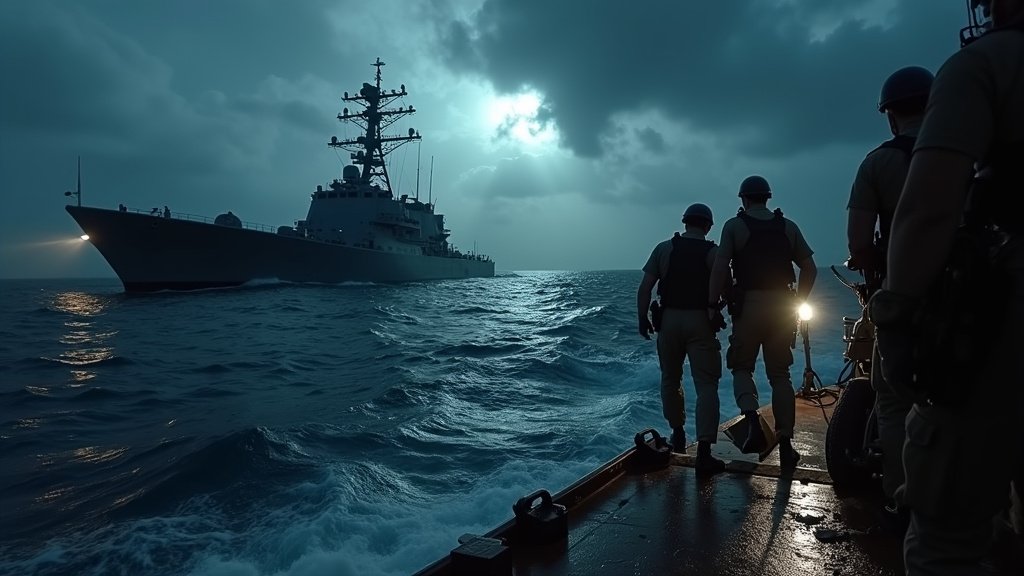
WASHINGTON D.C. – In a significant escalation of its counternarcotics campaign in the Caribbean, U.S. military operations against suspected drug-trafficking vessels have resulted in multiple fatalities and, for the first time, the apprehension of survivors from a narco-submarine attack.
A Landmark Strike with Unprecedented Survivors
On October 16, 2025, a U.S. military strike targeting a suspected narco-submarine off the Venezuelan coast yielded a pivotal outcome: the first known survivors of such an operation. Two individuals were killed in the engagement, while two others were taken into U.S. Navy custody aboard a warship. These survivors were subsequently repatriated to their respective home countries, Colombia and Ecuador. Former President Donald Trump confirmed the strike, describing the targeted vessel as a “submarine” specifically built for transporting vast quantities of drugs. This incident marked a departure from previous U.S. strikes in the region, which had typically resulted in the total destruction of vessels and no survivors.
Intensified Campaign Across the Caribbean
The October 16th incident is part of a broader and significantly intensified U.S. counternarcotics campaign that began in September 2025. The U.S. has conducted a series of airstrikes on vessels alleged to be involved in drug trafficking, primarily operating from Venezuela and bound for the United States.
Just two days prior to the narco-submarine strike, on October 14, 2025, six individuals were reportedly killed in a separate military action off the Venezuelan coast. Prior to that, on October 3, Defense Secretary Pete Hegseth announced a strike that killed four people aboard a vessel carrying substantial narcotics en route to the U.S.. The U.S. has also claimed to have struck vessels operated by groups it designates as narcoterrorists, including the Venezuelan criminal organization Tren de Aragua and the Colombian guerilla group National Liberation Army (ELN), though evidence for these allegations has not been publicly released.
As of mid-November 2025, these operations, which have expanded to include the Eastern Pacific Ocean, have resulted in at least 83 deaths across 21 strikes on 22 vessels. The scale of the deployment, including the arrival of the USS Gerald R. Ford carrier strike group, represents one of the largest U.S. naval concentrations in the Caribbean in decades.
The Vessels and the Allegations
The targets of these operations have included speedboats and sophisticated semi-submersible crafts, commonly known as narco-submarines, which are designed to evade detection while transporting large quantities of illicit substances. President Trump has repeatedly asserted that these vessels were “loaded” with drugs, including fentanyl, and posed a direct threat to American lives. He has characterized the individuals involved as “narcoterrorists” and claimed they were affiliated with designated terrorist organizations.
However, concerns have been raised by international observers, human rights organizations, and some U.S. lawmakers regarding the legality of the strikes and the lack of publicly available evidence to substantiate the claims about the targets and their cargo. Venezuela’s government has vehemently denied the U.S. narrative, labeling the strikes as acts of aggression and accusing Washington of fabricating evidence to justify military action.
Geopolitical Undercurrents and Lingering Questions
Beyond the stated goal of interdicting drugs, analysts and observers suggest that the robust military buildup and the aggressive strike campaign may serve broader geopolitical objectives, including a concerted effort to pressure or facilitate regime change in Venezuela. The Trump administration has accused Venezuelan President Nicolás Maduro of deep connections to drug cartels, notably the Cartel de los Soles, which has been designated a Foreign Terrorist Organization.
The apprehension of survivors from the October 16th narco-submarine strike introduces complex legal questions regarding their treatment, detention, and ultimate disposition. Reports from communities in Trinidad and Tobago and Venezuela suggest that some victims of earlier strikes may have been local fishermen, adding a tragic dimension to the unfolding stories of these encounters.
As the U.S. continues its assertive counternarcotics operations in the Caribbean and Eastern Pacific, the incidents highlight the evolving tactics in the fight against international drug trafficking. The recent events, particularly the emergence of survivors from narco-submarine attacks, underscore the high stakes and multifaceted nature of these ongoing military actions, leaving the international community to ponder the full implications for regional stability and the future of law enforcement at sea. The effectiveness and legality of these strikes, and their potential long-term consequences for the affected communities, remain subjects of intense scrutiny.