
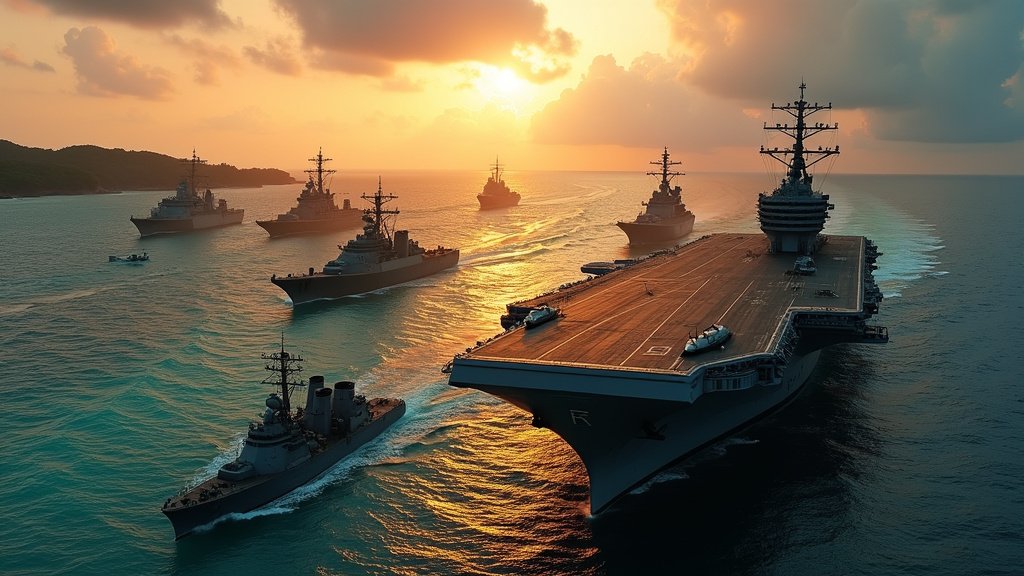
In a significant statement that has reverberated across the region, Catholic bishops from the Antilles Episcopal Conference (AEC) have expressed profound alarm over the recent and extensive buildup of U.S. naval and military assets in the Southern Caribbean. Issued on October 25, 2025, the declaration criticizes the escalating military presence, highlighting potential negative repercussions for the region’s socio-economic, political, and humanitarian well-being.
Unprecedented Military Mobilization in the Caribbean
The region has witnessed the largest U.S. military deployment in decades, a surge orchestrated under the Trump administration and designated as “Operation Southern Spear.” By mid-October, approximately 10,000 U.S. troops were in the area, bolstered by the deployment of the USS Gerald R. Ford carrier strike group, along with multiple guided-missile destroyers, cruisers, amphibious vessels, and submarines. This formidable display of military power, which includes thousands of sailors and marines, has been justified by U.S. officials primarily as a mission to combat drug trafficking and “narcoterrorism,” particularly those operations allegedly linked to Venezuela. The build-up, which began in August 2025, has seen U.S. forces conduct numerous strikes against alleged drug-smuggling vessels in both the Caribbean and Pacific waters, leading to significant casualties.
Bishops Condemn Aggression, Champion Sovereignty
The statement from the AEC, representing 19 dioceses across 13 independent countries and various territories, directly challenges the methods and implications of the U.S. military expansion. The bishops firmly rejected “aggression and intimidation as means of resolving conflict or ideological differences,” emphasizing that “the disregard for the sovereignty of independent nations cannot be accepted as a reasonable measure in the name of border security”. They articulated that the presence of warships and the resulting disruption of marine livelihoods pose “real and immediate threats to regional stability and to the welfare of our nations”. Fishermen in areas like Trinidad and Tobago and Venezuela have reportedly altered or ceased their activities due to fear.
Geopolitical Undercurrents Fuel Regional Anxiety
Beyond the stated counter-narcotics objective, the intensified U.S. military presence has fueled speculation about broader geopolitical aims. Regional observers and officials, including those from the Bolivarian Alliance for the Peoples of Our America (ALBA-TCP), have voiced concerns that the buildup could be a pretext for increased pressure on Venezuelan President Nicolás Maduro’s government, or even an effort to control regional energy routes. Venezuela has publicly condemned the U.S. operations as “hostile provocation” and a threat to regional peace, while some neighboring countries like Trinidad and Tobago have aligned with U.S. objectives, sparking criticism from Caracas. The scale of the deployment, the most significant in the Caribbean in decades, also suggests potential long-term strategic re-evaluation of the region by the Pentagon, with procurement notices exploring medium-term military sustainment.
A Call for Dialogue and Regional Unity
In their news release, the bishops underscored the shared heritage and collective identity of the Caribbean peoples, calling for a renewed commitment to “dialogue and regional unity”. They acknowledged the right of nations to protect borders and combat illicit trade but insisted that these objectives must be pursued with “respect for law, the dignity of human life, and with a tacit understanding of our region’s deep commitment to peace”. The religious leaders urged those in leadership positions to “de-escalate militarisation” and reiterated that “war or the threat of war is never the right solution”.
The bishops also addressed the moral challenges facing the Caribbean, recognizing the narcotics trade as a grave crisis that “continues to devastate Caribbean societies – eroding lives, futures, and the very moral fabric of our communities”. However, they warned that “arbitrary and unwarranted taking of life cannot be justified as a means of resolution,” violating the sacredness of human life. In their message, they encouraged a focus on faith, trust in the Lord, and prayer for peace, reminding the faithful that they are “commanded to love one another—even our enemies”.
As geopolitical tensions persist, the concerns raised by the Caribbean bishops highlight a deep-seated desire within the region for stability, sovereignty, and a resolution to crises that prioritizes diplomacy and human well-being over military escalation. Their statement serves as a poignant reminder of the diverse perspectives and significant human impact stemming from heightened international military operations in the Caribbean.