
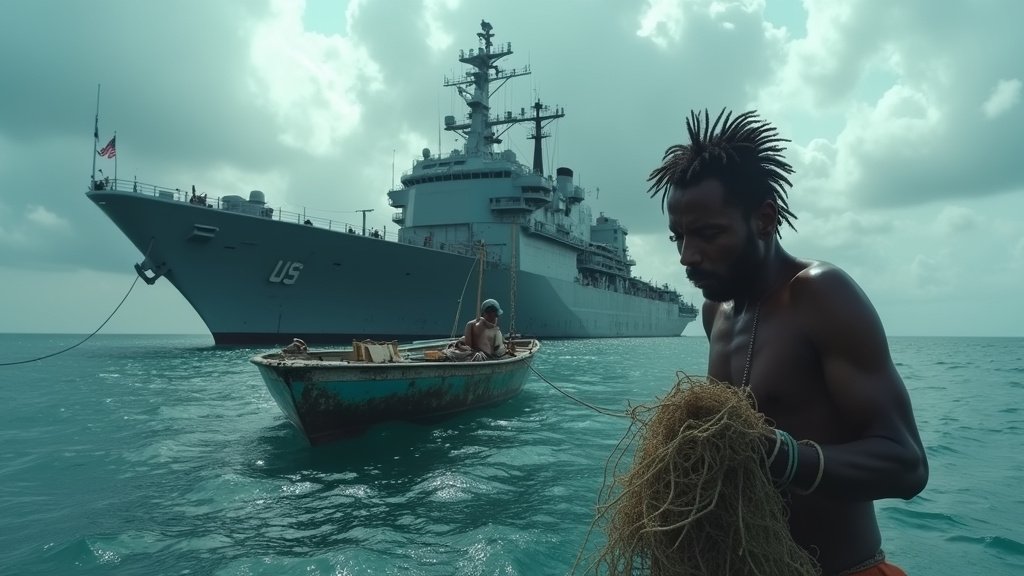
A growing chorus of Caribbean civil society organizations has vehemently condemned recent United States military strikes in the region, labeling them as “summary executions of noncombatants” and clear violations of international law. Amidst a significant escalation of US military presence, these groups are urgently calling for de-escalation and a reaffirmation of the Caribbean as a Zone of Peace.
Escalation of US Military Operations
Since early September 2025, the United States has dramatically increased its naval and air power in the Caribbean Sea and Pacific Ocean as part of a declared mission to combat maritime drug trafficking. This surge includes the deployment of multiple warships, a nuclear-powered submarine, and the massive aircraft carrier USS Gerald R. Ford, alongside thousands of troops. The US administration, led by President Donald Trump, has characterized suspected smugglers as “narcoterrorists” and has carried out at least 19 to 22 strikes on vessels, resulting in a reported death toll of 60 to over 80 individuals.
Civil Society’s Urgent Appeal
Coalitions of Caribbean civil society groups, including the Jamaica Cuba Friendship Association, Jamaica LANDS, and the Caribbean Revolutionary Awakening, have been at the forefront of the condemnation. Their joint statements highlight the horrific consequences of these strikes, noting that methods used have “left bodies disintegrated and their families unable to properly mourn them.” These organizations argue that the US actions target fishing boats without sufficient evidence of drug trafficking or security threats, creating widespread fear among local fishermen who are trying to earn a legal livelihood.
In an era where regional news often focuses on recovery and development, these strikes have cast a shadow of fear. The groups are demanding that Caribbean leaders actively discourage foreign military deployments and reaffirm the region’s long-standing commitment to peace and sovereignty. They argue that the current deployments “do nothing to aid our security and, on the contrary, provoke conflict in a way that risks destabilizing the entire region.”
International Condemnation and Legal Scrutiny
The US operations have drawn sharp criticism from international bodies and legal experts. The UN High Commissioner for Human Rights, Volker Türk, has described the strikes as “extrajudicial killings” that “violate international human rights law” and must stop immediately. Türk emphasized that countering illicit drug trafficking is a law-enforcement matter governed by strict limits on lethal force, and that the individuals on the targeted boats did not appear to pose an imminent threat, thus not justifying the use of lethal force under international law. He called for prompt, independent, and transparent investigations.
Amnesty International has similarly warned that such strikes could amount to unlawful executions, violating fundamental human rights and the right to life. Other international figures, including France’s Foreign Minister Jean-Noël Barrot and Russia’s Foreign Ministry spokeswoman Maria Zakharova, have also voiced strong disapproval, calling the US actions violations of international law and dangerous precedents.
Questioning the Rationale and Wider Implications
Critics question the necessity and proportionality of the military response to alleged drug trafficking, with some pointing out that the majority of drugs destined for the US transit through the Pacific rather than the Caribbean. The US administration has defended its actions as crucial for national security, but has faced scrutiny for not publicly providing evidence to substantiate its claims or justify the lethal force used.
Beyond the immediate human cost, the heightened US military presence and strikes raise concerns about regional stability, potential refugee crises, and strained diplomatic relations, particularly with Venezuela. The actions have also created divisions among Caribbean nations regarding the region’s stance on foreign military deployments and the principle of a “Zone of Peace.”
A Call for Diplomacy and Peace
As tensions persist, civil society groups across the Caribbean are amplifying their calls for diplomacy over hostility. They advocate for a reduction in military build-up and for compensation for the families of victims. The movement for peace and sovereignty in the Caribbean seeks to counter what many perceive as an aggressive foreign policy that threatens to undermine the region’s stability and cultural heritage of peaceful coexistence. The news from the Caribbean underscores a critical global conversation about the use of military force, international law, and the right to life.